Screen Mesh Options Explained
Insect, solar, privacy, no-see-um, pet-resistant and clear vinyl — what each does, what it trades away, and how to match one to a specific opening.

Mesh is the part of a retractable screen that decides what it actually does. The housing, track and tension determine whether it works mechanically; the mesh determines whether it solves your problem.
It is also the one specification that cannot be changed later without a mesh replacement — so it is worth getting right at the outset.
Standard Insect Mesh
The baseline, and the right answer for most openings. Woven at around 18x14 or 18x16 threads per inch, it gives maximum airflow and the clearest outward view while excluding mosquitoes, flies and common insects.
It is included in the price, and on shaded or north-facing openings there is rarely a reason to move away from it.
Trade-off: none of significance for insect control. It does nothing about heat, glare or privacy.
Solar Mesh
A tighter, more opaque weave that blocks a substantial share of heat, ultraviolet light and glare while keeping the outward view.
This is the upgrade that matters most in southern Idaho. South- and west-facing openings here take direct high-desert sun for hours through the afternoon, and solar mesh changes how usable the room behind them is from mid-afternoon onward. It also slows the fading that direct sun does to flooring, rugs and furniture.
Trade-off: slightly reduced view clarity and airflow compared with standard insect mesh. On a west-facing patio door most people find that trade strongly worthwhile; on a north-facing bedroom it would be a downgrade.
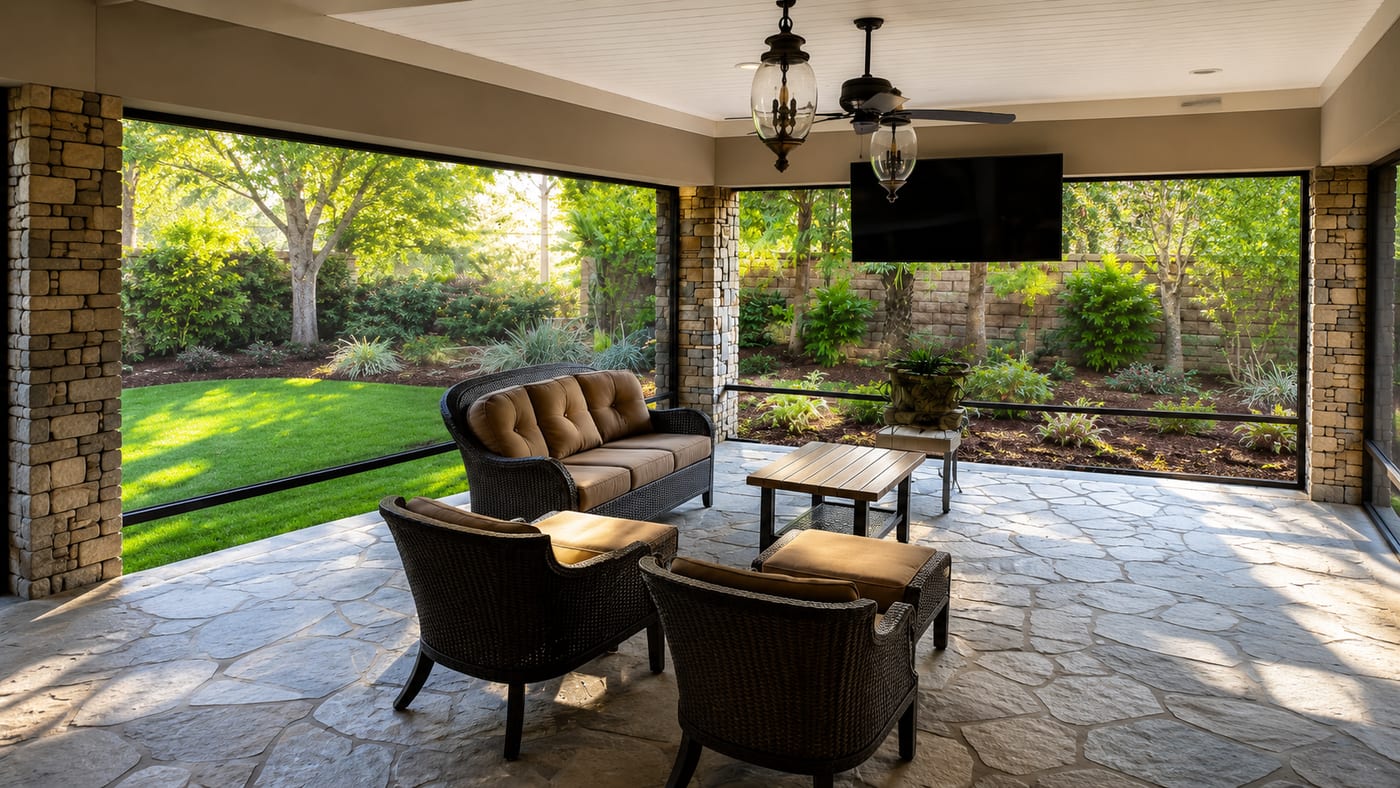
Privacy Mesh
A tight weave that screens the space from outside during daylight while keeping your own view outward. The asymmetry is what makes it useful — it is not simply a more opaque screen.
Relevant on the closer lot spacing common in newer subdivisions around the Treasure and Magic Valleys, where patios and windows face neighbouring properties directly.
Trade-off: two worth knowing. View clarity drops relative to standard mesh, so it belongs on the overlooked side rather than everywhere. And it works on daylight — after dark, a lit interior is visible from outside regardless of mesh, which is a lighting question rather than a screening one.
No-See-Um Mesh
A tighter weave — around 20x20 threads per inch — that physically excludes the smaller insects that pass straight through standard mesh.
Worth specifying near water: the Snake River corridor, irrigation canals, ponds, and low-lying ground that holds moisture. Also worth considering on bedroom windows generally, since those tend to be opened at dusk, which is exactly when the smaller insects are active.
Trade-off: reduced airflow compared with standard mesh, because the weave is denser. On a bedroom you want cross-ventilation through, that is a real consideration.
Pet-Resistant Mesh
A heavier, vinyl-coated weave built to resist punctures, hold its shape under lateral pressure, and avoid fraying when scratched.
For households where a dog or cat interacts with the deployed screen regularly — leaning on it, pawing at it, occasionally trying to walk through it.
Trade-off: visibly heavier than standard mesh, so view clarity is reduced. Worth pairing the decision with mesh retention, since the two problems overlap: pet-resistant mesh resists damage, while Mesh Lock (at $250 on a single, $500 on a double) stops the mesh being pushed out of its track in the first place.
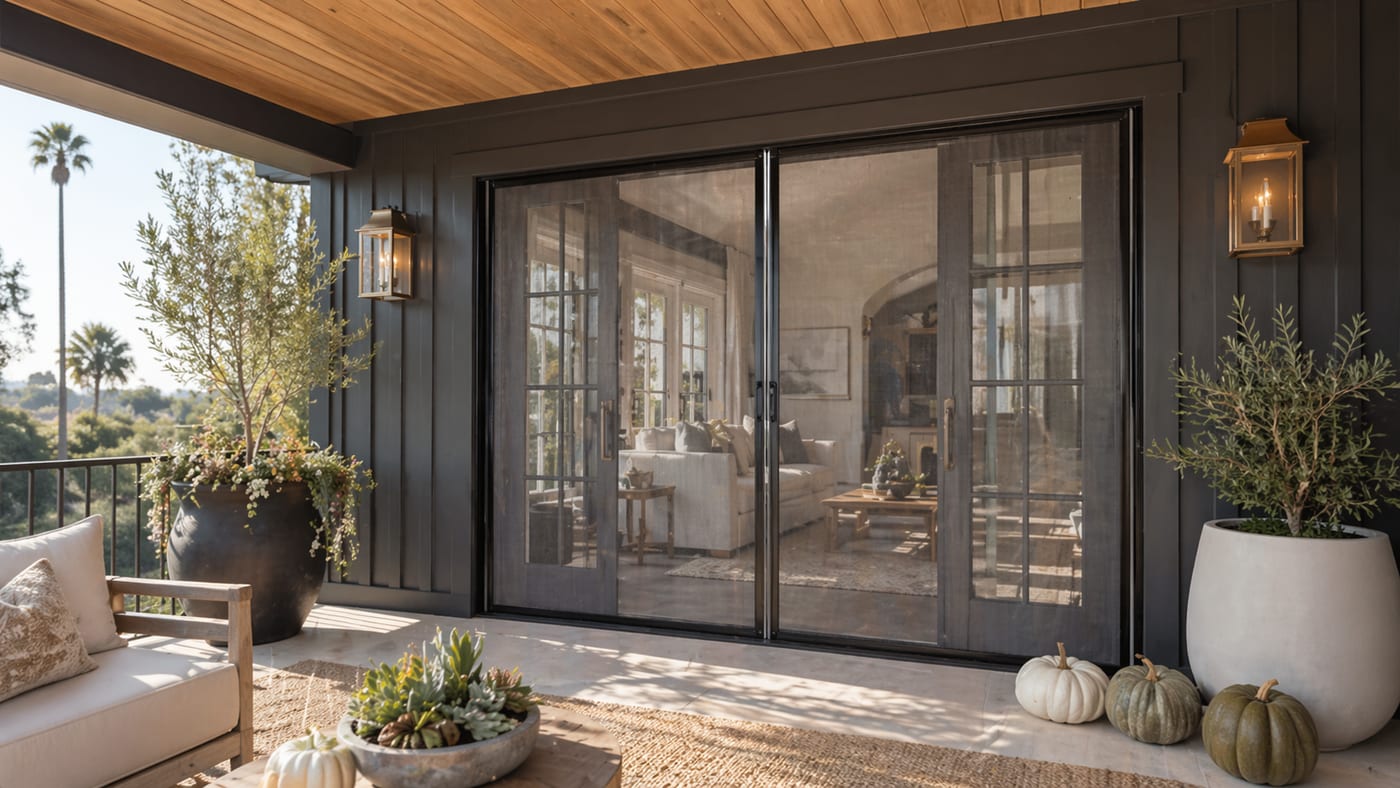
Clear Luxury Vinyl
Not mesh at all, and worth understanding as a different product.
Vinyl is a solid, transparent panel that blocks wind and holds warmth rather than filtering insects. On a covered patio or porch it is what extends the usable season into spring and autumn — the months when the space is otherwise bright, calm and simply too cool to sit in.
Trade-off: it does not filter insects, and it does not breathe. A space panelled entirely in vinyl in July is stifling. Most patios that use it run vinyl on the windward bay and mesh elsewhere, or swap seasonally.
Vinyl also needs different care: mild soap and water only, never an abrasive pad or solvent, both of which permanently cloud the surface.
Matching Mesh to the Opening
Mesh is specified per opening, not per house, and that flexibility is worth using.
West-facing patio door — solar mesh, and Mesh Lock if pets use it.
North-facing bedroom window — standard insect mesh for airflow and clarity, or no-see-um if you are near water.
Overlooked side window — privacy mesh.
Covered patio, windward bay — clear vinyl for shoulder seasons.
Everything shaded and unremarkable — standard insect mesh.
How Mesh Choice Affects Lifespan
Different weaves wear differently, which is worth factoring in alongside performance.
Ultraviolet light is what eventually makes any mesh brittle, and brittleness is what causes tearing at the edges where tension is highest. A denser weave carries more material per square inch, which generally means more to degrade before failure — but it also absorbs more energy rather than letting light through.
The bigger variable is not the weave at all. It is exposure. A screen deployed every day on a south-facing opening works its mesh far harder than the same mesh on a shaded north elevation, regardless of type.
This is where the retractable design does the heavy lifting: because the mesh stores inside its housing whenever the screen is not in use, it accumulates a fraction of the UV and dust exposure a fixed screen absorbs over the same years. In a climate with long, intense summers and persistent blowing dust, that difference matters more than the choice between weaves.
Mixing Mesh Across One Space
On a multi-bay covered patio, the bays do not have to match, and treating them identically is usually the weaker outcome.
A patio with three open sides typically wants different things from each: solar on the western face taking afternoon sun, standard insect mesh on a sheltered side where airflow matters most, and clear vinyl on the windward bay for shoulder-season use.
Because each bay is a separate screen with its own specification, that mixed configuration costs nothing extra beyond the panels themselves — and it produces a space that handles sun, wind and insects rather than compromising between them.
Why This Decision Is Different From the Others
Most specification choices can be revisited. You can add screens to more openings later, and structural components are built to last decades.
Mesh cannot be changed without replacing the mesh — which is a service appointment at $260 on a standard single, not a catastrophe, but not free either.
The most common regret is standard mesh on a west-facing opening. It works perfectly well as an insect screen; it simply leaves the room uncomfortable through summer afternoons, which was the actual problem the household wanted solved.
Seeing It Before Deciding
Mesh is genuinely difficult to judge from a photograph or a website swatch. The differences that matter — how much view clarity you lose to solar mesh, how much airflow you lose to no-see-um — are visible in person and almost invisible on screen.
Physical samples are brought to the consultation for exactly this reason, and looking at them at the actual opening, in its actual light, is worth the few minutes it takes.
Next Steps
For pet households specifically, read Pet-Resistant Retractable Screens. For when mesh reaches the end of its life, see When to Replace Your Screen Mesh. For pricing, What Phantom Screens Cost.
Request a free quote and a specialist will bring samples to the openings themselves.
Starting prices are current for Phantom Screens of Twin Falls and include professional installation. Final pricing is confirmed after an in-home measurement.
Frequently Asked Questions
What mesh options are available? Standard insect mesh, solar mesh, privacy mesh, no-see-um mesh, pet-resistant mesh, and clear luxury vinyl panels. Mesh is specified per opening.
What does solar mesh do? It blocks a substantial share of heat, UV and glare while keeping the outward view, at the cost of slightly reduced clarity and airflow. Worth it on south- and west-facing openings.
Does privacy mesh work at night? No. It screens during daylight while keeping your view out. After dark a lit interior is visible from outside regardless of mesh.
What is no-see-um mesh for? A tighter weave that excludes smaller insects standard mesh admits — relevant near rivers, canals and standing water. It reduces airflow slightly.
Is clear vinyl a type of mesh? No. It is a solid transparent panel that blocks wind and holds warmth but does not filter insects or breathe. It is used to extend a covered patio's season.
Can I change mesh later? Yes, but it requires a mesh replacement — a service appointment from $260 on a standard single. That is why mesh is the specification most worth getting right initially.
Can different openings have different mesh? Yes, and they usually should. Mesh is chosen per opening based on orientation, use and what you need it to do.
Tags
Written by
Phantom Screens of Twin Falls Team
Custom retractable screen solutions for homes across Idaho and Western Wyoming.
Related Articles

Pet-Resistant Retractable Screens
What pets actually do to screens, how pet-resistant mesh and mesh retention differ, which of the two you need, and what each costs.

Retractable Screens for Large & Oversized Openings
Openings past 96 inches need a different system. What covers up to 15 feet wide and 12 feet high, how spans divide, and what oversized systems cost.
How to Choose a Retractable Screen
A practical decision path — which openings to screen, single or double, manual or motorized, which mesh, and which upgrades earn their cost.
Interested in Retractable Screens?
Get a free quote for custom Phantom retractable screens — motorized, door, or window screens for your home.
Get a Free Quote