Retractable Screens for Large & Oversized Openings
Openings past 96 inches need a different system. What covers up to 15 feet wide and 12 feet high, how spans divide, and what oversized systems cost.

Past roughly 96 inches wide, screening stops being a door problem and becomes an engineering one. The mesh has further to span, the tension holding it flat has more work to do, and the track carrying it has to be built accordingly.
This covers what oversized systems handle, where the boundaries sit, and what they cost.
Where the Boundary Is
Standard retractable door screens are custom-built up to 96 inches wide and 120 inches tall. That covers the large majority of residential doors, including most sliders and French pairs.
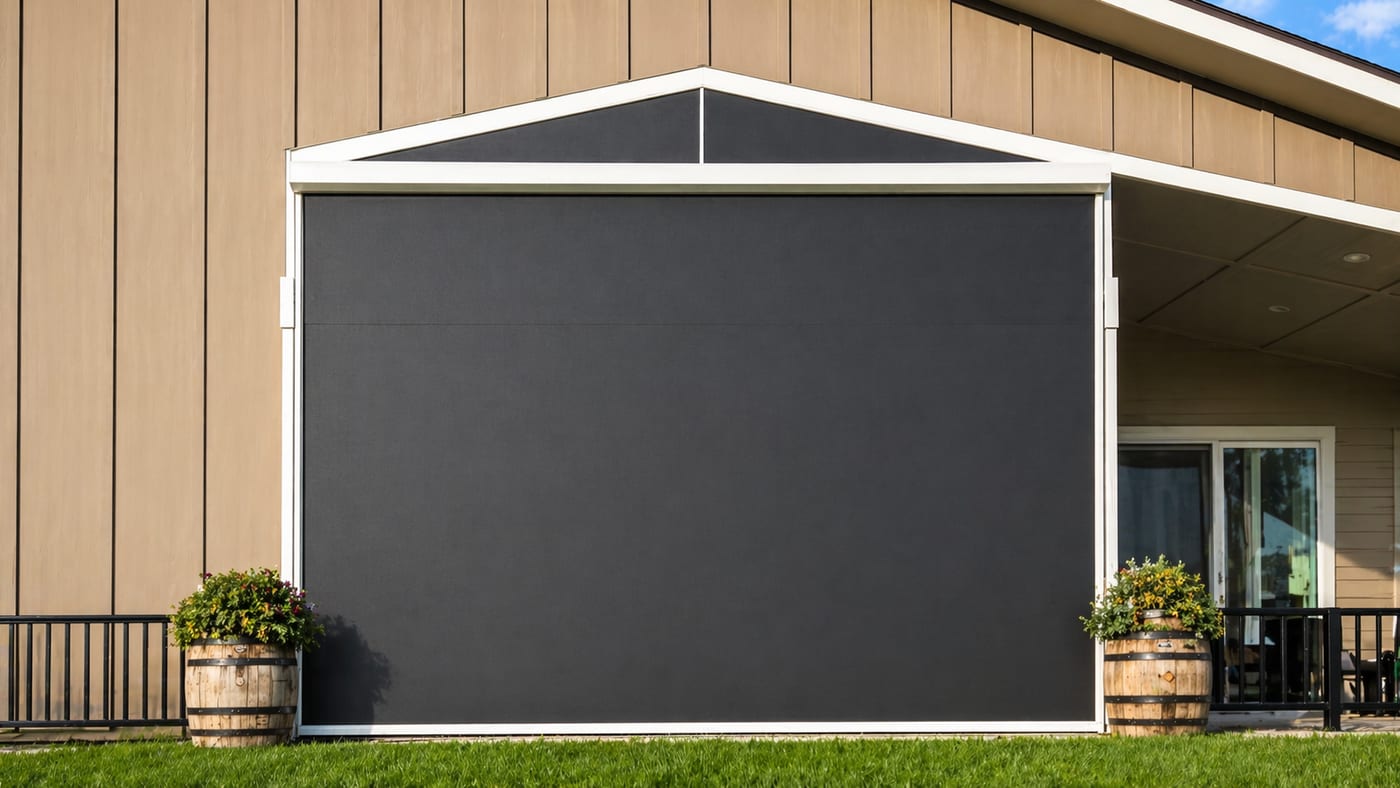
Beyond that, an oversized system covers openings up to 15 feet wide and 12 feet high in a single screen — among the tallest retractable screens available.
Wider still is handled by running multiple screens across the opening, divided at posts, mullions or beams.
What Oversized Systems Cover
The openings that have become common on newer builds and remodels around the Treasure and Magic Valleys.
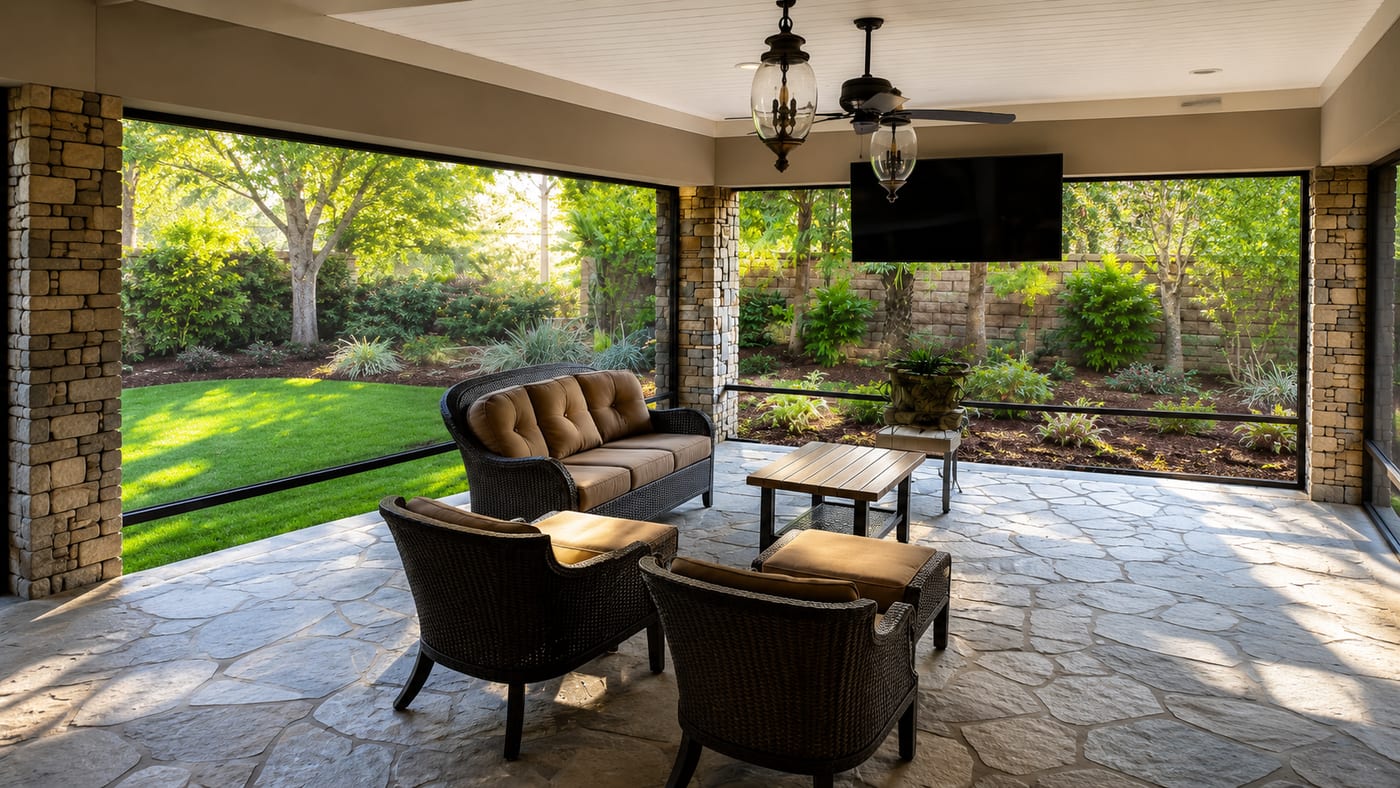
Bi-fold and accordion doors, which fold back to open an entire wall. Stacking glass walls and lift-and-slide systems. Multi-panel sliders where several panels operate. And wide covered patio openings, which are not doors at all but are screened the same way.
These work with the door systems those openings typically use — including La Cantina, NanaWall, Marvin and Pella configurations — because the screen mounts to the opening rather than integrating with the door hardware.
Why Width Changes the Product
It is not simply more mesh.
A screen spanning fifteen feet has to be held flat across that entire distance. Any tension error that would be invisible on a three-foot door screen shows up as a visible sag or wrinkle at fifteen. The tensioning system is specified for the span rather than scaled up from a smaller one.
The track carries more too, and it has to keep the screen running straight over a much longer travel. Smooth-glide tracks with precision ball-bearing rollers are what keep one-hand operation realistic at full width — without them, a manual screen at that span becomes genuinely difficult to operate.
Height compounds it. A twelve-foot drop puts far more material and weight into the system than a standard door, which is why tall openings carry their own considerations.
How Wide Spans Divide
Where an opening exceeds fifteen feet, it divides — and the natural division points are whatever structure already exists.
On a covered patio, that is the posts. A thirty-foot patio with posts every ten feet becomes three screens, each running post to post. The division reads as part of the architecture rather than as an arbitrary seam.
On a glass wall, the mullions between panels serve the same purpose.
Practically, this is also how cost is determined: oversized systems are priced per screen, so knowing how many the opening calls for makes the quote predictable.
Manual or Motorized at This Scale
Both are available — $4,200 manual, $5,400 motorized per screen.
Manual remains viable at full width thanks to the track system, and on an opening screened occasionally it is the sensible spend.
Motorized becomes compelling with frequency and exposure. A fifteen-foot screen operated several times an evening is a different proposition from one deployed twice a season, and on an exposed site a wind sensor retracting the screen automatically protects a large, expensive surface when nobody is home.
Panel Options
Oversized systems are not limited to insect mesh.
Solar mesh for heat and glare on west-facing spans. Privacy mesh where overlooked. Clear luxury vinyl, which blocks wind and holds warmth rather than filtering insects — the option that extends a covered outdoor space into spring and autumn.
Cable guide configurations are available where conventional side tracks are impractical, using tensioned cables to guide the screen edges instead.
Tall Openings Specifically
Height gets less attention than width and deserves more, because it introduces different problems.
A twelve-foot drop puts considerably more material and weight into the system than a standard door. That affects the tension required, the load the housing carries, and how evenly the screen travels.
Hand operation is where it shows first. Drawing a screen across a wide opening is straightforward; controlling a very tall one evenly by hand is harder, and uneven operation — pulling at an angle, catching the bar — is what puts wear into a track over time. That is a large part of why tall openings lean toward motorized more readily than wide ones do.
On standard door screens, openings roughly 96¼ to 120 inches tall carry a $200 adjustment for the additional material and drop. Above 120 inches the job moves into oversized territory regardless of width.
What Structural Movement Does at This Scale
Large openings are more sensitive to seasonal movement than small ones, simply because there is more span for a small shift to express itself across.
Freeze-thaw cycling moves structures over an Idaho winter. On a three-foot door screen a fractional shift is absorbed without notice. Across fifteen feet, the same movement can be enough to change how the screen tracks — which is why a large screen that ran cleanly in October sometimes catches in April.
That is normally an alignment adjustment rather than a fault, and it is one of the more common spring service calls on oversized systems. Worth knowing so it is not mistaken for a failure.
What the Structure Needs
Two things: something solid along the top to carry the housing, and something at each side for the tracks.
On a door opening that is the existing frame. On a covered patio it is the header and the posts. Where neither exists — an open deck, for instance — structure has to be added before screening is possible.
Whether the existing structure is adequate is established at the measurement, particularly on lighter builds like pergolas.
Screening the Whole Wall, or Just the Doorway
On a bi-fold or stacking wall this is the decision that determines the product, and people frequently start on the wrong side of it.
A wall that folds fully back has no frame left in the middle to attach anything to. Screening "the doorway" is not an option once the panels are stacked — there is no doorway, there is an opening. That is precisely why these need a single screen spanning the whole span rather than a door-sized one.
The practical consequence is a cost step rather than a gradual increase. An opening that would take a $989 single door screen if it had a conventional door becomes a $4,200 large-opening system because of how it opens, not because of its width alone.
Worth knowing before budgeting a remodel. If a bi-fold wall is going in and you expect to screen it, the screen belongs in the plan at that number rather than as a door-screen afterthought.
What It Costs
Large-opening and oversized systems start at $4,200 manual and $5,400 motorized per screen, installed. Openings divided into multiple screens are priced per screen.
Custom fabrication, professional installation and the warranty are included — limited lifetime on components, 7 years on motors, 24 months on labor. A $200 deposit starts the order.
Full pricing is in What Phantom Screens Cost.
Next Steps
For multi-panel glass walls specifically, read Screening a Multi-Panel Glass Wall. For covered outdoor spaces, see Screening a Covered Patio, or browse oversized door screens.
Request a free quote and a specialist will assess the span and how it divides.
Starting prices are current for Phantom Screens of Twin Falls and include professional installation. Final pricing is confirmed after an in-home measurement.
Frequently Asked Questions
How wide an opening can a single screen cover? Up to 15 feet wide and 12 feet high — among the tallest retractable screens available. Wider openings divide at existing posts or mullions.
When does a door screen become an oversized system? Past roughly 96 inches wide or 120 inches tall. Below that, a standard door screen covers it.
Do they work with bi-fold and stacking doors? Yes — bi-folds, accordions, stacking glass walls and lift-and-slide systems, since the screen mounts to the opening rather than to the door hardware.
Can a 15-foot screen be operated by hand? Yes. Smooth-glide tracks with ball-bearing rollers keep one-hand operation realistic at full width, though frequency of use often justifies motorizing.
How much do oversized screens cost? From $4,200 manual and $5,400 motorized per screen, installed. Openings needing multiple screens are priced per screen.
What if there is nothing to mount to? Structure has to be added first. That is a construction question rather than a screen one, and it is identified at the measurement.
Tags
Written by
Phantom Screens of Twin Falls Team
Custom retractable screen solutions for homes across Idaho and Western Wyoming.
Related Articles

Pet-Resistant Retractable Screens
What pets actually do to screens, how pet-resistant mesh and mesh retention differ, which of the two you need, and what each costs.

Screen Mesh Options Explained
Insect, solar, privacy, no-see-um, pet-resistant and clear vinyl — what each does, what it trades away, and how to match one to a specific opening.
How to Choose a Retractable Screen
A practical decision path — which openings to screen, single or double, manual or motorized, which mesh, and which upgrades earn their cost.
Interested in Retractable Screens?
Get a free quote for custom Phantom retractable screens — motorized, door, or window screens for your home.
Get a Free Quote