Best Retractable Screens for French Doors
What separates a French door screen that lasts from one that binds: the centre join, mesh retention, housing profile, track quality, warranty terms, and whether anyone measures the door.

Most retractable screens look identical in a photograph. The differences show up two years in, on a French door pair that gets used every day through a summer.
Here are the six things that actually separate one from another, and the question to ask about each.
1. How the Centre Join Is Built
On a French pair the two screens meet in the middle, and that join is the first thing to fail on a poorly built set. If the halves are fabricated independently and hung to loose tolerance, you get a gap — and a gap is the entire point of failure, because insects find it immediately and the screen stops doing its job.
A properly built pair is fabricated as a matched set to the measured opening, so the halves meet flush and seal against each other.
Ask: is the pair built as a matched set to my measured opening, or assembled from stock parts?
2. Whether the Mesh Is Retained in the Track
A standard screen lets the mesh float along the track. Push it laterally — a dog, a child, a gust funnelling down a canyon — and it can come out of the channel.
A mesh retention system secures the mesh into the track edges so it resists that pressure. On a French door, usually the main route to the patio, this matters more than on any other opening in the house. Here it is the Mesh Lock option at $500 on a double.
Ask: is mesh retention available at all, and what does it cost?
3. The Housing Profile
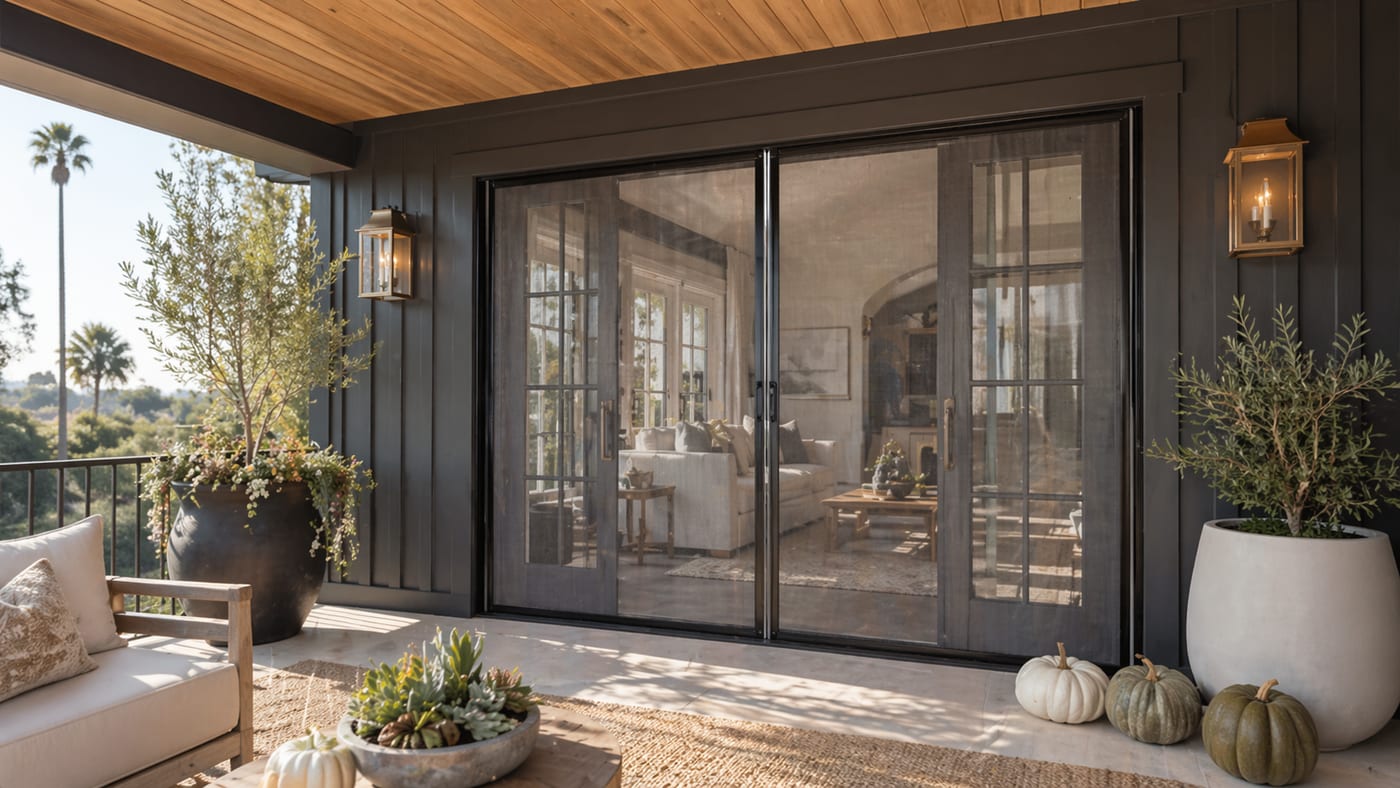
The housing holds the mesh when retracted. A bulky one announces itself against the door frame and undermines the reason for buying a screen that disappears in the first place.
A 2.5-inch aluminum housing is slim enough to read as trim rather than as an addition. Where frame depth allows, it can be mounted within the existing frame so no hardware shows against the wall at all.
Ask: how deep is the housing, and can it be mounted in-jamb on my frame?
4. Track and Roller Quality
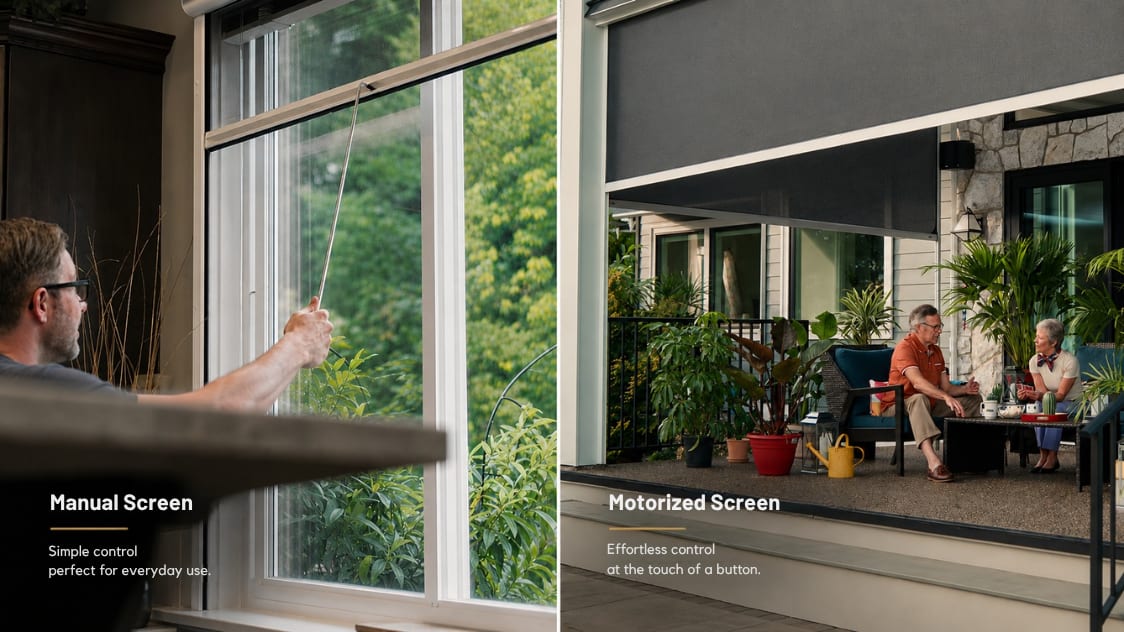
Everything about how a screen feels in use comes from the track. Smooth-glide tracks with precision ball-bearing rollers keep one-hand operation possible even on wide spans. Cheaper tracks bind as soon as grit gets into them — and grit is not optional in high-desert country with blowing dust.
Tension is the related question. Phantom's Sure Fit motorized track uses Next Generation Spring Tension Technology, where tension self-adjusts to keep the mesh aligned and wrinkle-free through every cycle. The value is consistency in year five rather than just year one: a screen running slightly out of tension develops wrinkles, tracks unevenly, and loads the rollers unevenly.
Ask: what is the track and roller system, and how does it handle tension over time?
5. What the Warranty Actually Covers
Warranty terms tell you how a manufacturer expects its own product to behave, which is considerably more informative than any brochure claim.
Phantom screens carry a limited lifetime warranty on components, a 7-year warranty on motors, and a 24-month labor warranty. Screen mesh is not included under the component warranty, but it can always be repaired or replaced if needed.
That split is the tell, and it is worth reading correctly. The structure is warranted for life because it is built to outlast the mesh. The mesh is handled separately because it is the serviceable part — designed to be replaced when its time comes, without touching the investment around it.
A product warranted as a single disposable unit is telling you something quite different about how long anyone expects it to last.
Ask: what is covered for how long, and what is explicitly excluded?
6. Whether Anyone Measures Your Door
French doors settle, sit out of square, and carry hardware at exactly the point where the two screens meet. A pair built from a phone measurement will bind, gap, or catch on the handles.
The measurement also determines the things you cannot see in a quote: frame depth for in-jamb mounting, swing direction for housing placement, and threshold condition for the bottom track.
Ask: does someone come and measure, and is the pair built to that measurement?
What the Cheapest Quote Usually Leaves Out
A noticeably lower number is not automatically a worse product, but it is usually explained by one of four things. Worth checking which.
Installation priced separately. The most common one. A screen quoted without fitting looks cheaper until the install line arrives, and on a French pair — where tolerance at the centre join is the whole job — fitting is not the part to economise on.
Stock sizing rather than custom fabrication. A screen selected from a size range and adjusted to fit is a different proposition from one built to the opening. On a square, standard opening the difference may never show. On a French pair in a house that has settled, it shows immediately.
No mesh retention option. If Mesh Lock or an equivalent is not offered at all, the quote is cheaper because the product is less capable, not because it is better value.
A shorter warranty, or one that covers less. Compare what is covered and for how long, not just the headline figure. A limited lifetime component warranty and a 7-year motor term describe a product expected to last decades; a two-year all-in warranty describes something else.
None of that makes the cheaper option wrong. It makes it a different thing, and worth choosing deliberately rather than by price alone.
Comparing Quotes Fairly
Once you have the answers above, the numbers become comparable. Two further questions make them properly like-for-like.
Is installation included, or added afterwards? It is included here on every configuration, but that is not universal, and an installation line added later is the most common reason a cheaper quote stops being cheaper.
Is custom fabrication included, or is it a surcharge? Every screen here is built to the measured opening as standard, because there is no non-custom option.
One Thing Worth Deciding Early
Mesh type is the specification people most often defer and most often regret, because unlike almost everything else it cannot be changed later without a mesh replacement.
The housing, track and hardware are fixed once installed, but they are also the parts you are unlikely to want to change. Mesh is the part your needs actually move on — a new dog, a neighbour's extension changing the privacy picture, or simply discovering that a west-facing pair makes the room unusable at five o'clock in July.
It is worth spending a few minutes at the doors with the samples during the consultation rather than defaulting to standard insect mesh because it is included. Standard is genuinely the right answer on a shaded or north-facing pair. It is the wrong answer on a west-facing one, and that is a specification decision, not a preference.
What This Costs
A custom-built, professionally installed double French door configuration starts at $1,949, with Mesh Lock adding $500 and tall openings adding $200.
For how the configuration works, read French Door Screens: What to Know Before You Buy. For pricing across every configuration, see What Phantom Screens Cost.
Request a free quote and a specialist will measure your doors and confirm the configuration.
Starting prices are current for Phantom Screens of Twin Falls and include professional installation. Final pricing is confirmed after an in-home measurement.
Frequently Asked Questions
What should I look for in a French door screen? How the centre join is built, whether mesh retention is available, the housing profile, track and roller quality, the warranty split between structure and mesh, and whether anyone measures the actual door.
Why do French door screens develop a gap in the middle? Because the two halves were not built as a matched pair to the measured opening. The centre join has to meet flush and seal, which requires tighter tolerance than two independent single screens.
Is mesh retention worth it on French doors? On the main route to the patio, generally yes. Mesh Lock secures the mesh into the track edges against lateral pressure from pets, children and wind.
Does the warranty cover the mesh? No. Components carry a limited lifetime warranty, motors 7 years, labor 24 months. Mesh is excluded by design because it is the serviceable component, and it can always be repaired or replaced.
How much do good French door screens cost? A custom-built, professionally installed double French door configuration starts at $1,949, with Mesh Lock adding $500.
Does a slimmer housing mean a weaker screen? No. The housing holds the retracted mesh; strength comes from the extruded aluminum frame, the track and the tensioning system. A 2.5-inch housing is about keeping the retracted screen visually unobtrusive.
Tags
Written by
Phantom Screens of Twin Falls Team
Custom retractable screen solutions for homes across Idaho and Western Wyoming.
Related Articles

Pet-Resistant Retractable Screens
What pets actually do to screens, how pet-resistant mesh and mesh retention differ, which of the two you need, and what each costs.

Screen Mesh Options Explained
Insect, solar, privacy, no-see-um, pet-resistant and clear vinyl — what each does, what it trades away, and how to match one to a specific opening.

Retractable Screens for Large & Oversized Openings
Openings past 96 inches need a different system. What covers up to 15 feet wide and 12 feet high, how spans divide, and what oversized systems cost.
Interested in Retractable Screens?
Get a free quote for custom Phantom retractable screens — motorized, door, or window screens for your home.
Get a Free Quote