French Door Screens: What to Know Before You Buy
Double French doors need two screens that meet cleanly in the middle. How the configuration works, why swing direction changes the installation, what to check before ordering, and what it costs.

French doors are the hardest common door to screen well and the easiest to screen badly. Two leaves, a centre join that has to seal, hardware sitting exactly where the screens meet, and a swing that must stay clear. Get any of those wrong and you have a screen that binds, gaps, or fouls the door every time you open it.
Here is what actually determines whether a French door screen works.
The Configuration: Two Screens, Not One
A French door pair takes a screen per leaf. Each stores in its own housing at the outer edge and draws inward; the two halves meet at the centre of the opening. Retract both and the doorway is completely clear.
The centre join carries the whole design. Both halves must meet flush and seal against each other — and that is why a double is built as a matched pair rather than as two independent singles that happen to be installed near each other.
It is also why the price is $1,949 rather than twice the $989 single. You are not buying two screens. You are buying two screens fabricated and hung to meet each other.
Swing Direction Changes the Installation
French doors swing in or out, and the screen has to be mounted where it never fights the door.
On an out-swing pair, the doors move away from the opening. The screen mounts on the interior side with clear travel, which is the simpler case.
On an in-swing pair, the doors sweep into the room, and the screen and its housing have to sit outside that arc. There is a workable answer, but it depends on the frame depth available and the hardware actually fitted — which is exactly why this gets settled by someone standing at your door rather than from a catalogue.
If a supplier quotes a French door pair without asking which way your doors swing, that is worth noticing.
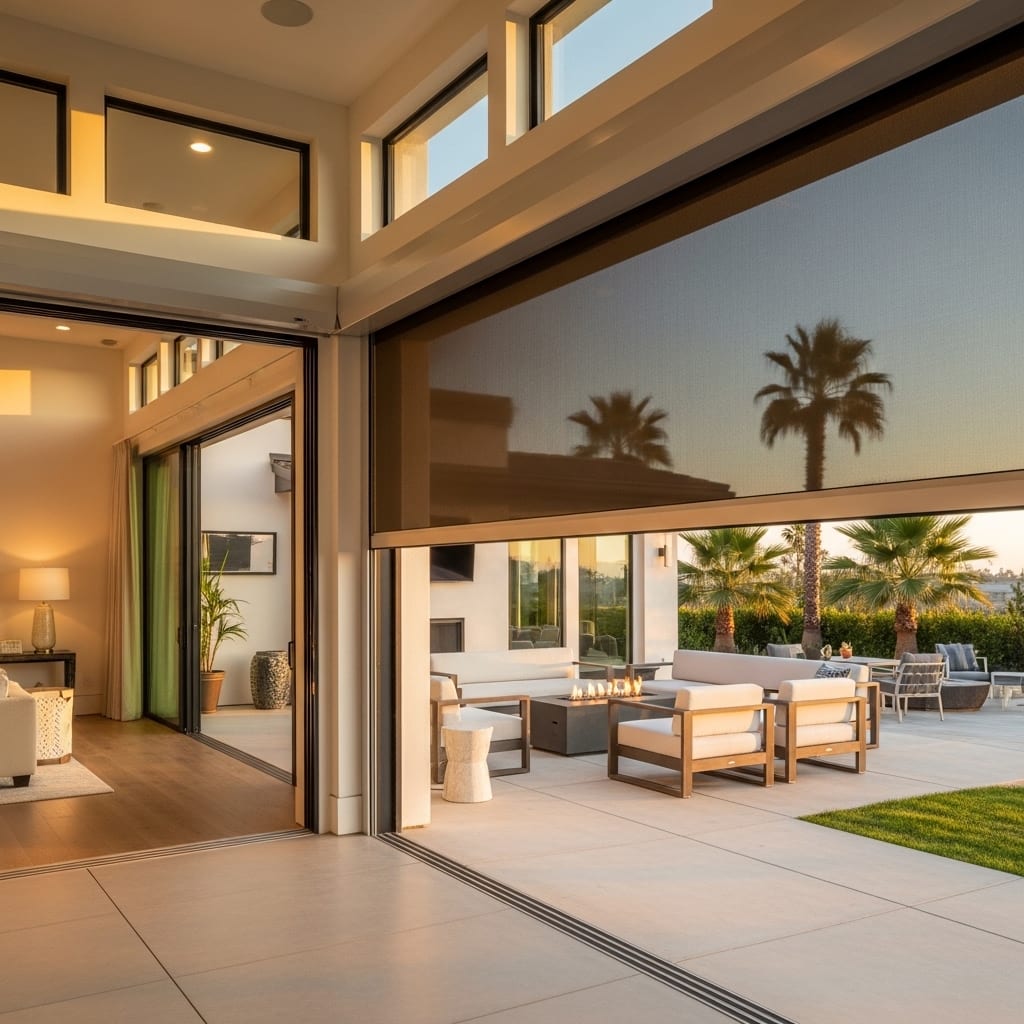
What to Check Before You Order
Frame depth. Where there is enough depth, the housing can sit within the existing frame so no hardware reads against the wall when the screen is retracted. On a French door — usually a feature opening — that difference is visible.
Handle and latch hardware. French door handles sit at the centre join, precisely where the two screens meet. The screen has to clear that hardware cleanly. Multiple handle and latch options exist for exactly this reason, and matching them is part of the specification rather than an afterthought.
Threshold condition. The bottom track needs a clean, level run across the full width. An uneven or damaged threshold does not stop the installation, but it does need to be known about in advance rather than discovered on the day.
Whether the opening is square. Older homes settle, and French door openings are wide enough that a small amount of racking shows. Out-of-square is normal and workable — provided the screen is built to the opening as measured.
Mesh Choices That Matter on a French Door
French doors are usually the main route to a patio, which means high traffic and often pets.
Mesh Lock, at $500 on a double, secures the mesh into the track edges so it resists lateral pressure. On the door a dog pushes through several times a day, this is the difference between a screen that lasts and one that needs service within a couple of seasons. On a formal French door onto a rarely-used balcony, it is unnecessary.
Solar mesh is worth considering if the pair faces south or west. Southern Idaho's afternoon sun is direct for hours through summer, and French doors tend to be the largest glass in the room.
No-see-um mesh matters near water — the Snake River corridor, irrigation canals, ponds — where the smaller insects standard mesh admits are actually the problem.
Each opening is specified independently, so the French pair can differ from everything else in the house.
Common Problems, and What Causes Them
Three complaints come up repeatedly about French door screens, and each traces back to something specific.
"There is a gap in the middle." The halves were not built as a matched pair to the measured opening, or the opening is out of square and was measured as though it were not.
"It catches on the handle." The screen was specified without accounting for the door hardware at the centre join.
"It drags along the bottom." Usually the threshold, sometimes debris in the track. In high-desert country, blowing dust in the bottom track is a genuine and recurring cause — it is also the easiest to fix, by clearing the track periodically.
None of these are inherent to retractable screens on French doors. They are all specification or measurement failures.
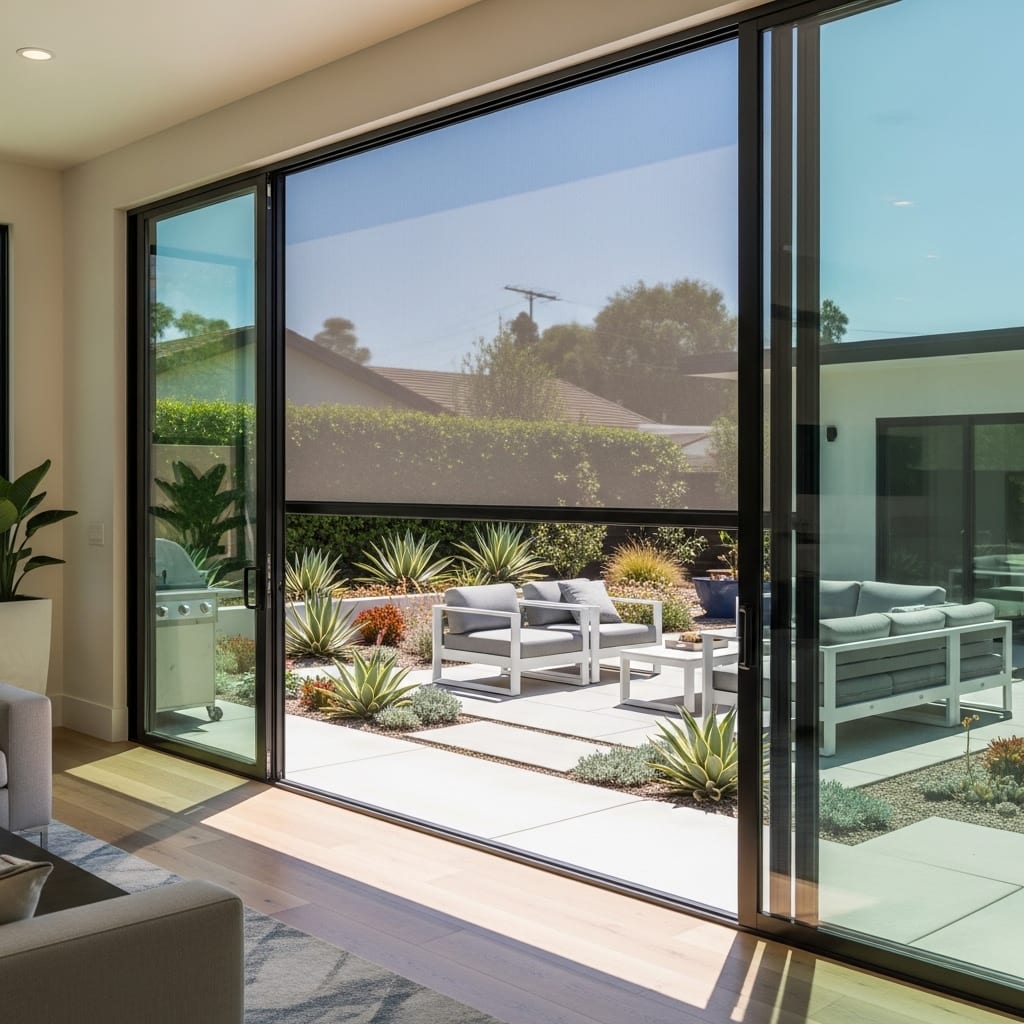
Living With It: What Changes Day to Day
The practical difference on a French door pair is that both leaves become usable in summer.
Unscreened, most households end up treating a French pair as a single door — one leaf opened, the other left shut, because opening both means inviting everything outside in. Screened, the whole opening works the way it was designed to, which is usually why the doors were specified in the first place.
That matters more here than in milder climates. Southern Idaho evenings cool substantially after sundown, and a wide opening that can be left open from eight o'clock is worth considerably more than one that cannot.
Maintenance and What to Expect Over Time
Retractable screens are low-maintenance rather than no-maintenance, and the requirements are modest.
Keep the bottom track clear. In high-desert country with blowing dust, grit in the bottom track is the most common cause of a screen that starts to drag, and it is also the easiest thing to prevent — an occasional wipe or vacuum along the track handles it.
Clean the mesh gently. Mild soap, water, a soft cloth or brush. Because the mesh stores inside its housing when not deployed, it accumulates far less dust than a fixed screen would over the same period.
Let the screen complete its travel. Releasing a slide bar halfway and letting it snap back is what puts uneven wear into the roller over years.
When the mesh does eventually reach the end of its service life — driven by UV exposure and use rather than by a fixed timetable — it is replaced independently. The housing, track and hardware stay in place. That is a service call, not a reinstallation, which is the whole point of the design.
What It Costs
Double French door screens start at $1,949, including custom fabrication and professional installation. Mesh Lock adds $500. Openings roughly 96¼–120 inches tall carry a $200 adjustment.
If the screen ever needs attention later, a service call is $150, and mesh repair runs from $260 on a standard single.
See the full price guide for every configuration, or What Drives the Price of a Retractable Screen for how the variables interact.
Next Steps
For a shortlist of what to compare across suppliers, read Best Retractable Screens for French Doors. For how French doors compare with sliders, see Retractable Screens for Sliding & French Doors.
Ready for a number on your doors? Request a free quote — the measurement and consultation are free and carry no obligation.
Starting prices are current for Phantom Screens of Twin Falls and include professional installation. Final pricing is confirmed after an in-home measurement.
Frequently Asked Questions
How much are retractable screens for French doors? A double French door configuration starts at $1,949 including professional installation, with a $200 adjustment for openings roughly 96¼–120 inches tall.
Do French doors need one screen or two? Two — one per leaf, meeting at the centre and retracting to opposite sides. That is what makes it a double rather than a single.
Will the screen interfere with my door handles? No. French door hardware sits at the centre join where the screens meet, and multiple handle and latch options exist so the screen clears it. Matching that is part of the specification.
Do in-swing French doors work with retractable screens? Yes. The screen and housing are positioned outside the door's swing arc; the exact approach depends on frame depth and is confirmed on site.
What if my door opening is not square? Common in older homes and entirely workable. Every screen is custom-built to the opening as measured, which is why the measurement happens at your door.
Why do French door screens develop a gap in the middle? Because the two halves were not built as a matched pair to the measured opening. The centre join has to meet flush and seal, which requires tighter tolerance than two independent screens.
Can I get a retractable screen on only one of the two doors? It is possible, but it leaves the other leaf unscreened, so insects simply use that side. On a pair that both open, a double is the configuration that actually solves the problem.
Tags
Written by
Phantom Screens of Twin Falls Team
Custom retractable screen solutions for homes across Idaho and Western Wyoming.
Related Articles

Pet-Resistant Retractable Screens
What pets actually do to screens, how pet-resistant mesh and mesh retention differ, which of the two you need, and what each costs.

Screen Mesh Options Explained
Insect, solar, privacy, no-see-um, pet-resistant and clear vinyl — what each does, what it trades away, and how to match one to a specific opening.

Retractable Screens for Large & Oversized Openings
Openings past 96 inches need a different system. What covers up to 15 feet wide and 12 feet high, how spans divide, and what oversized systems cost.
Interested in Retractable Screens?
Get a free quote for custom Phantom retractable screens — motorized, door, or window screens for your home.
Get a Free Quote