Motorized Retractable Screen Pricing
What a motorized retractable screen costs, what the motor and controls actually buy over a manual system, and when powered operation earns the difference in an Idaho home.

A motorized retractable screen for a large opening starts at $5,400 installed. The manual version of the same span starts at $4,200.
That $1,200 gap is the question most people are actually asking when they search for motorized screen pricing. This page covers what it buys, when it pays for itself, and when manual is the smarter spend.
What the $1,200 Actually Buys
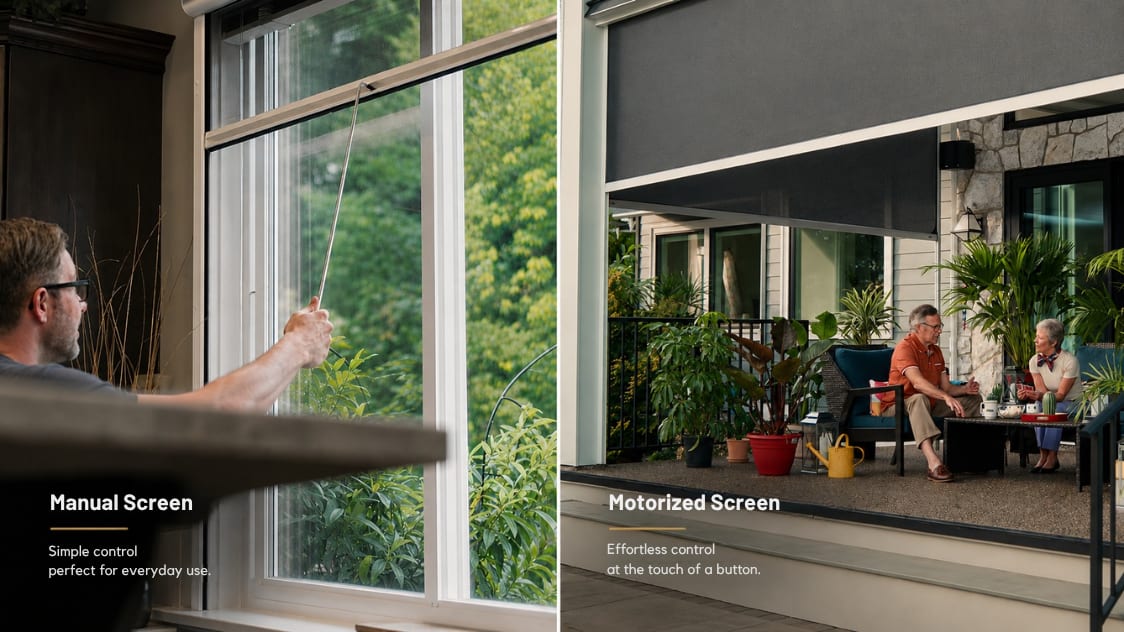
The motor itself is the smallest part of it. A motorized system includes the motor, the control hardware, wiring and integration, and a track built for powered travel rather than hand operation.
That last point gets overlooked. A track designed for a person pulling a slide bar is not the same as one designed for a motor driving the screen to a stop hundreds of times a season. Powered travel puts consistent, repeated load through the system, and the track and tensioning are specified for it.
Control comes with it: handheld remote, wall switch, smartphone app, or voice through Alexa and Google Home. Where a home already runs whole-home automation, integration is available for Control4, Crestron and Lutron.
Sensors — the Part People Underestimate
Motorized systems can take wind and sun sensors, and in southern Idaho the wind sensor is the one that earns its place.
A wind sensor retracts the screen automatically when gusts pick up. Along the canyon rim, out across the open ground toward Jerome and Filer, and up in the Wood River Valley, wind arrives faster than anyone gets to a switch — and it frequently arrives when nobody is home at all. A screen that pulls itself in is a screen that is not being stressed by a gust you never saw.
This is worth being blunt about: a large screen left deployed in high wind is the most common way these systems get damaged. The sensor is not a luxury feature on an exposed site. It is the thing that protects the rest of the investment.
A sun sensor lowers the screen on a schedule or a light threshold to manage heat and glare — useful on the west-facing patios that take full high-desert afternoon sun through summer.
When Motorized Is Worth It
Reach. If the screen crosses a wide patio, hand operation several times an evening stops being charming quickly. Fifteen feet is a long way to walk a slide bar when you are carrying a tray.
Height. Tall openings are hard to operate evenly by hand. Uneven operation — pulling harder on one side, catching the bar at an angle — is what puts wear into a track and eventually causes binding.
Frequency. A screen used every evening through summer justifies powered operation far more readily than one deployed a handful of times a season.
Exposure. On a windy site, the sensor alone can carry the decision regardless of the other three.
Accessibility. Worth stating plainly: for anyone with limited reach, grip strength or mobility, a wall switch or app turns an opening they could not comfortably use into one they can.
When Manual Is the Right Call
Most openings do not need a motor, and it is worth saying so.
On door-sized openings, manual is the norm. A single door screen at $989 or a double at $1,949 operates easily with one hand, and spring tension does the retracting. There is no meaningful convenience gain from motorizing a normal patio door, and it is the most common way people spend money that does not improve the result.
Even on some large openings, manual is the better value. A smooth-glide track with precision ball-bearing rollers keeps one-hand operation realistic even at 15 feet wide. If the screen is deployed occasionally rather than daily, and the site is sheltered, the manual system at $4,200 does the same job for $1,200 less.
Sure Fit and What Track Technology Changes
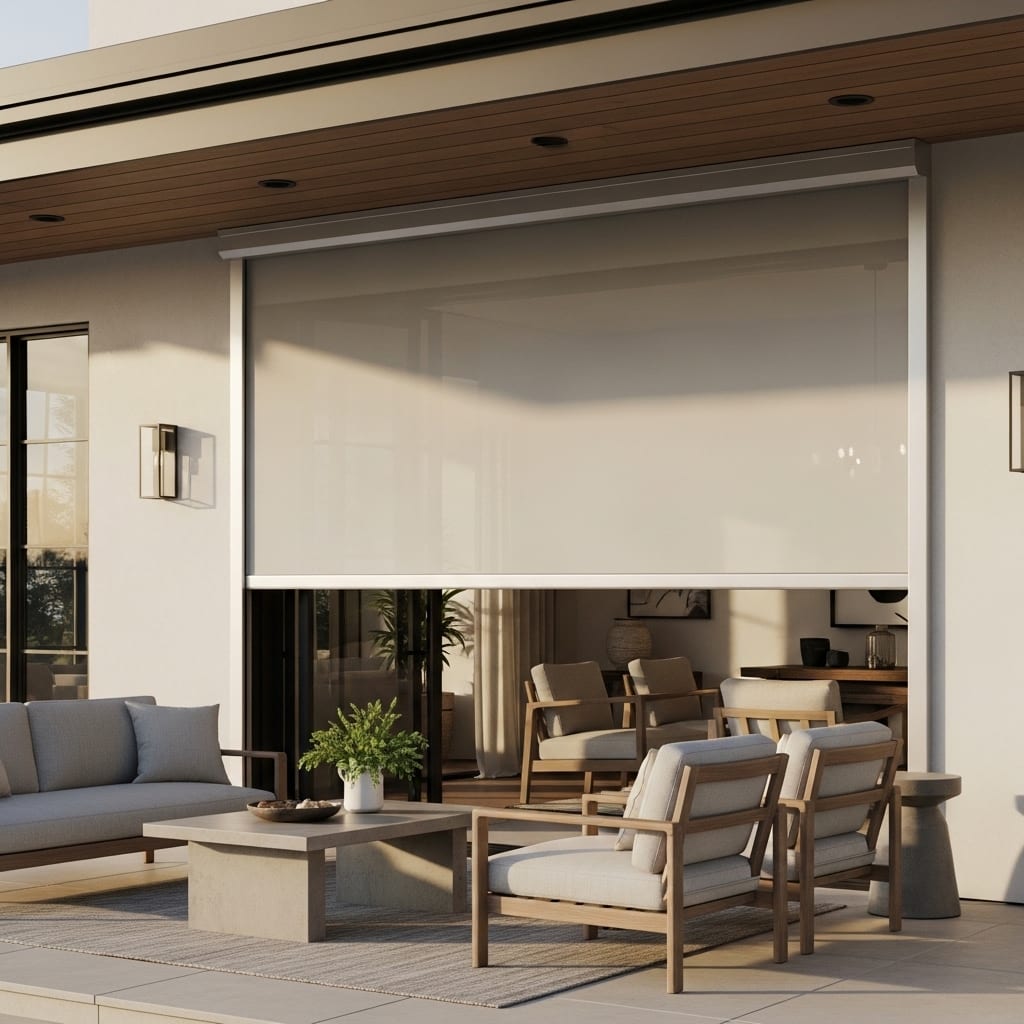
Not all motorized tracks are equal. Phantom's Sure Fit motorized track is built around Next Generation Spring Tension Technology, where the tension self-adjusts to keep the mesh aligned and wrinkle-free through every cycle.
The practical benefit is consistency over time. A screen that runs slightly out of tension develops wrinkles, tracks unevenly, and puts uneven load into the rollers. Self-adjusting tension is what keeps operation smooth on year five rather than just year one — which matters more on a motorized system, because the motor will keep driving a screen that a person would have noticed was binding.
You can read more on the Sure Fit motorized screens page.
What Is Included at Both Price Points
- Professional installation — included on manual and motorized alike, and confirmed to operate across the full range of travel before the installer leaves.
- Custom fabrication to the measured opening.
- The warranty — a limited lifetime warranty on components, a 7-year warranty on motors, and a 24-month labor warranty. Screen mesh is not included under the component warranty, but it can always be repaired or replaced if needed.
The 7-year motor term is the number to weigh when comparing against a cheaper powered screen. A motor is the part most likely to be asked to work for a decade, and the warranty on it tells you what the manufacturer expects.
Running Costs
Worth mentioning because people ask: the electrical draw is negligible. These motors run briefly, a few times a day at most, and draw far less than almost anything else on the patio. There is no meaningful ongoing cost to motorization beyond the purchase.
Maintenance is the same as a manual screen — keep the bottom track clear of grit so the screen seats and glides properly. In high-desert country with blowing dust, clearing the track occasionally matters more than it would elsewhere, and it matters slightly more on a motorized system because a motor will drive through resistance a hand would have felt.
What About Motorizing an Existing Opening?
A question that comes up often: can a manual screen be converted to motorized later?
In practice this is not a retrofit. The track, tensioning and housing on a motorized system are specified for powered travel from the start, so converting means replacing the system rather than adding a motor to it. If there is a realistic chance you will want powered operation on a large opening, it is considerably cheaper to specify it at installation than to decide in three years.
This is worth thinking through carefully on a covered patio, because it is the opening most likely to change use. A patio that gets screened for insects in year one often becomes a genuine outdoor room by year three — used for dinners, used later into autumn — and that shift is exactly what pushes people toward wanting a switch instead of a slide bar.
Comparing Motorized Quotes
If you are weighing more than one motorized quote, four questions make the numbers comparable:
What is the motor warranty? Seven years is the benchmark here. A shorter term on the component most likely to be asked to work for a decade tells you something.
Are sensors included or extra? Wind sensors in particular — on an exposed site this is not a nice-to-have.
Is installation in the price? It is here, on both manual and motorized.
What control methods are supported? Remote only, or wall switch, app and voice as well? Whole-home integration available, or standalone?
Working Out Which You Need
The honest answer usually comes from standing at the opening. Span, height, exposure and how often you will actually use it are things a specialist can assess on site in a few minutes — and will tell you when a motor is not worth it.
Request a free quote for a number on your opening. For starting prices across every configuration, see What Phantom Screens Cost, and for the full set of pricing variables read What Drives the Price of a Retractable Screen.
Starting prices are current for Phantom Screens of Twin Falls and include professional installation. Final pricing is confirmed after an in-home measurement.
Frequently Asked Questions
How much do motorized retractable screens cost? A large-opening motorized system starts at $5,400 installed. The manual equivalent starts at $4,200.
What is the price difference between manual and motorized? About $1,200 on a large opening, covering the motor, control hardware, integration and a track built for powered travel.
Can motorized screens work with Alexa or Google Home? Yes. They support remote, wall switch, app and voice control, and integrate with Control4, Crestron and Lutron for whole-home automation.
Are wind sensors worth adding? On an exposed site, usually yes. The sensor retracts the screen automatically when gusts pick up, including when nobody is home — and a large screen left out in high wind is the most common way these systems get damaged.
Is the motor covered by warranty? Motors carry a 7-year warranty. Components carry a limited lifetime warranty and labor is covered for 24 months.
Do door screens come motorized? Door-sized openings are typically manual and operate easily by hand. Motorization is normally specified for large and oversized openings where span or height makes hand operation impractical.
Do motorized screens cost much to run? No. The motors run briefly and draw very little power. There is no meaningful ongoing cost beyond the purchase.
Tags
Written by
Phantom Screens of Twin Falls Team
Custom retractable screen solutions for homes across Idaho and Western Wyoming.
Related Articles

Pet-Resistant Retractable Screens
What pets actually do to screens, how pet-resistant mesh and mesh retention differ, which of the two you need, and what each costs.

Screen Mesh Options Explained
Insect, solar, privacy, no-see-um, pet-resistant and clear vinyl — what each does, what it trades away, and how to match one to a specific opening.
Retractable Screens for Large & Oversized Openings
Openings past 96 inches need a different system. What covers up to 15 feet wide and 12 feet high, how spans divide, and what oversized systems cost.
Interested in Retractable Screens?
Get a free quote for custom Phantom retractable screens — motorized, door, or window screens for your home.
Get a Free Quote