What Drives the Price of a Retractable Screen
Opening size, single versus double, manual versus motorized, mesh type and mesh retention — the five variables that decide what a retractable screen costs, and which are actually worth paying for.

Two houses on the same street can get retractable screen quotes that differ by thousands for what sounds like the same product. That is not inconsistent pricing. It is that "retractable screen" names a category, not a configuration.
Five variables set the number. Understanding them makes quotes comparable, and tells you which upgrades are worth taking and which are not.
1. The Size of the Opening
This is the biggest factor by a distance, and it does not scale the way people expect.
A wider opening needs more mesh, a longer track, and a tensioning system engineered to keep that mesh flat and square across the whole span. Past roughly 96 inches wide, the system changes class entirely — different track, different tensioning, different engineering problem.
That is why a single door screen starts at $989 while a large-opening system starts at $4,200. You are not paying four times as much for four times the mesh. You are paying for a fundamentally different piece of engineering that holds a 15-foot span of fabric flat enough to run on a track and taut enough to keep insects out.
Standard door screens cover openings to 96 inches wide and 120 inches tall. Beyond that, an oversized system covers up to 15 feet wide and 12 feet high in a single screen.
2. Single or Double
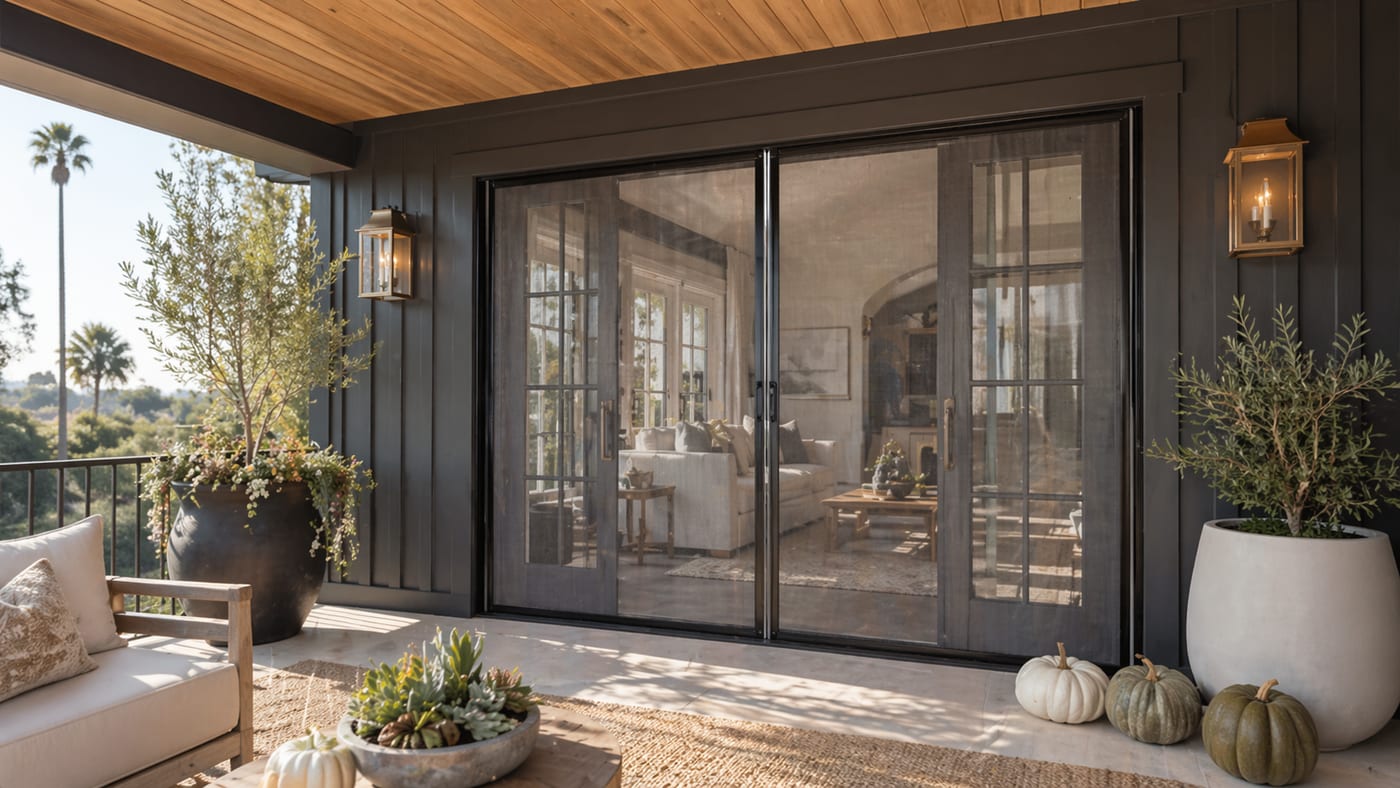
One screen crossing one opening is a single, from $989. Two screens meeting in the middle — a French door pair, a wide double opening — is a double, from $1,949.
The gap is not simply "two of them". Two halves have to meet flush at the centre and seal against each other. That requires both sides to be fabricated as a matched set and hung to tighter tolerance than two independent screens would need.
It matters because the centre join is where a badly built pair fails first. A gap at the join is not a cosmetic issue — it is the one place insects reliably find, which defeats the entire purpose of the screen. Paying for the tolerance is paying for the thing to work.
3. Manual or Motorized
On a door-sized opening, manual is the norm and works well. You draw the screen across; spring tension takes it back. There is no reason to spend past it on a normal door.
On a large opening, both are available: $4,200 manual against $5,400 motorized. That $1,200 buys the motor, control hardware, integration, and a track built for powered travel — plus remote, wall-switch, app or voice control, and the option of wind and sun sensors.
Reach is usually what decides it. A screen crossing a 15-foot patio, operated by hand several times an evening, stops being charming quickly. Height compounds it: tall openings are harder to operate evenly by hand, and uneven operation is what puts wear into a track.
Exposure is the other argument. On a windy site, the sensor alone can justify the upgrade — it retracts the screen automatically when gusts arrive, including when nobody is home. The full breakdown is in Motorized Retractable Screen Pricing.
4. Mesh Type
Mesh is where a screen stops being generic and starts being specified for a particular opening. It is included in the price — the choice is about fit, not upsell.
Standard insect mesh gives maximum airflow and the clearest view. The right default for most doors and windows, and for anything shaded or north-facing.
Solar mesh trades a little visibility to block a meaningful share of heat, UV and glare. On south- and west-facing openings — which in southern Idaho take direct high-desert sun for most of the afternoon — it changes how usable the room behind the glass actually is, and slows the fading that sun does to furniture and flooring.
Privacy mesh provides daytime screening from outside while keeping the outward view from inside. Useful where a window faces a street, a neighbour, or a shared outdoor area.
No-see-um mesh uses a tighter weave to exclude the smaller insects standard mesh lets through. Worth specifying near the Snake River, irrigation canals, or any standing water.
Mesh is chosen per opening. There is no requirement to run the same mesh everywhere, and usually good reason not to — solar on the west slider, standard insect mesh on the shaded north side.
5. Mesh Retention
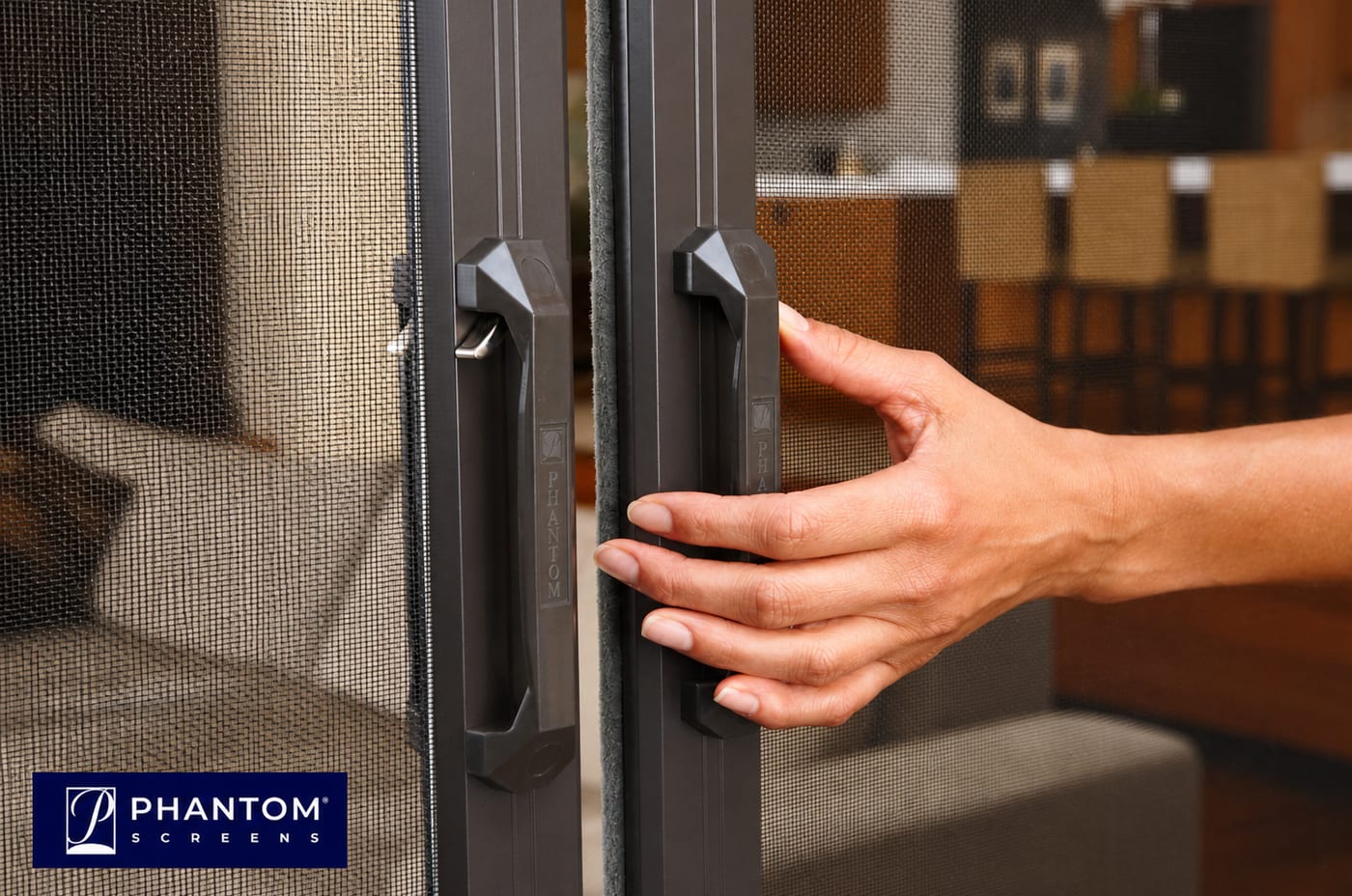
A standard door screen lets the mesh float along its track. Push it sideways — a dog's shoulder, a child running through, a gust funnelling down a canyon — and it can come out of the channel.
Mesh Lock secures the mesh into the track edges so it resists that pressure. It adds $250 on a single and $500 on a double.
On a door nobody leans on, standard mesh is genuinely fine and the upgrade is unnecessary. On the patio door a labrador shoulders through twice an hour, it is usually the highest-value line in the quote — the difference between a screen that lasts and one that needs service in eighteen months.
What Does Not Change the Price
Some things that appear as line items on other quotes are simply included here:
- Installation. Professional, factory-trained, included on every configuration.
- Custom fabrication. Every screen is built to the measured opening. "Custom" is not an upgrade because there is no non-custom option.
- The warranty. Limited lifetime on components, 7 years on motors, 24 months on labor.
- Out-of-square openings. Common in older homes, handled as part of measuring properly.
One Adjustment Worth Anticipating
Openings roughly 96¼ to 120 inches tall carry a $200 adjustment. More drop means more material, a longer track, and tension set for the extra travel. If you have tall patio doors or a raised header, budget for it rather than being surprised by it.
Where People Overspend, and Where They Underspend
After enough quotes, patterns show up. Two in particular.
The common overspend is motorizing a door. Motorization is built for span and height — a wide patio opening, a tall header, a screen you cannot comfortably reach across. On a standard entry or patio door, a manual screen operates easily with one hand and does exactly the same job for considerably less. If someone is quoting a motor on a normal door, ask what problem it is solving.
The common underspend is skipping mesh retention on a high-traffic door. Mesh Lock is $250 on a single, and it is the difference between a screen that survives a household with a dog and one that needs service within a couple of seasons. People decline it to save $250 on a $989 screen and then pay a $150 service call plus mesh repair later. On the busiest door in the house it is the single best-value option in the quote.
There is a third, quieter one: choosing standard insect mesh on a west-facing patio door because it is the default. It works, but a room that becomes unusable from four o'clock onward in July is a problem solar mesh would have solved at specification time and cannot be retrofitted without a mesh replacement.
Making Quotes Comparable
If you are weighing more than one company, these are the questions that make the numbers mean the same thing:
Is installation included, or added later? Is the screen built to my measured opening, or selected from stock sizes? Is mesh retention available, and at what cost? What does the warranty cover, and what does it exclude? Does someone come and measure before quoting?
That last one matters more than it sounds. A quote produced without a measurement is a guess, and the correction always arrives after you have committed.
Next Steps
For actual starting prices across every configuration, see What Phantom Screens Cost. If you are weighing whether the category is worth it at all, read Are Retractable Screens Worth It?
For a number specific to your openings, request a free quote — measurement and consultation are free and carry no obligation.
Starting prices are current for Phantom Screens of Twin Falls and include professional installation. Final pricing is confirmed after an in-home measurement.
Frequently Asked Questions
What is the biggest factor in retractable screen cost? The size of the opening. Cost does not scale linearly with width — past roughly 96 inches the system changes class, which is why large-opening systems start at $4,200 against $989 for a single door.
Is a double screen twice the price of a single? No. A single starts at $989 and a double at $1,949. The two halves must meet and seal cleanly at the centre, so a double is built as a matched pair to tighter tolerance rather than as two independent screens.
Does choosing a different mesh cost more? Mesh is specified per opening and standard insect mesh is included. Solar, privacy and no-see-um weaves are available and priced during the in-home consultation, where you can compare physical samples.
Is Mesh Lock worth $250? With a dog, a cat or small children using the door daily, generally yes — it keeps the mesh in the track under lateral pressure. On a screen nobody leans against, standard mesh is fine.
Do I pay extra for custom sizing? No. Every screen is custom-built to the measured opening as standard.
Why do I need an in-home measurement for a quote? Because frame depth, door swing, threshold condition and whether the opening is square all affect both the price and whether the screen works properly. A quote without a measurement is an estimate that gets corrected later.
Tags
Written by
Phantom Screens of Twin Falls Team
Custom retractable screen solutions for homes across Idaho and Western Wyoming.
Related Articles

Pet-Resistant Retractable Screens
What pets actually do to screens, how pet-resistant mesh and mesh retention differ, which of the two you need, and what each costs.

Screen Mesh Options Explained
Insect, solar, privacy, no-see-um, pet-resistant and clear vinyl — what each does, what it trades away, and how to match one to a specific opening.

Retractable Screens for Large & Oversized Openings
Openings past 96 inches need a different system. What covers up to 15 feet wide and 12 feet high, how spans divide, and what oversized systems cost.
Interested in Retractable Screens?
Get a free quote for custom Phantom retractable screens — motorized, door, or window screens for your home.
Get a Free Quote