Retractable Screen Door Installation: What to Expect
What happens from measurement to finished installation — what gets checked, how long it takes, what the installer confirms before leaving, and why professional fitting matters on these systems.

A retractable screen is a precision product fitted to an imprecise opening. That gap is where installations succeed or fail, and it is why fitting matters more on these than on almost any other home product.
Here is what the process actually involves, start to finish.
Step One: The Measurement
Everything depends on this visit, and it takes longer than people expect — because four things get established that cannot be assessed any other way.
Whether the opening is square. Houses settle. An opening a quarter-inch out across the diagonal is completely normal and entirely workable, but only if the screen is built to those actual dimensions. A screen made to nominal size for an out-of-square opening binds on one side and gaps on the other.
Frame depth. This decides whether the housing can sit within the existing frame — an in-jamb fit, where nothing reads against the wall when retracted — or whether it surface-mounts to the wall face. It is a visible difference on a door you look at daily.
Door swing and hardware. On French doors especially, in-swing versus out-swing determines where the housing and tracks can go, and handle placement at the centre join has to be cleared.
Threshold condition. The bottom track needs a clean, level run. A damaged or uneven threshold does not stop the work, but it needs to be known about beforehand rather than discovered on installation day.
Step Two: Fabrication
Screens are built to the measurements taken, not selected from a size range and trimmed. That is why there is a lead time between measurement and installation, and why "custom" is not an upsell — there is no non-custom option.
Mesh is specified at this stage too. Standard insect mesh, solar, privacy or no-see-um, plus mesh retention if it has been specified. Those choices are made per opening, so a west-facing patio door can differ from a shaded side entry.
Step Three: Installation Day
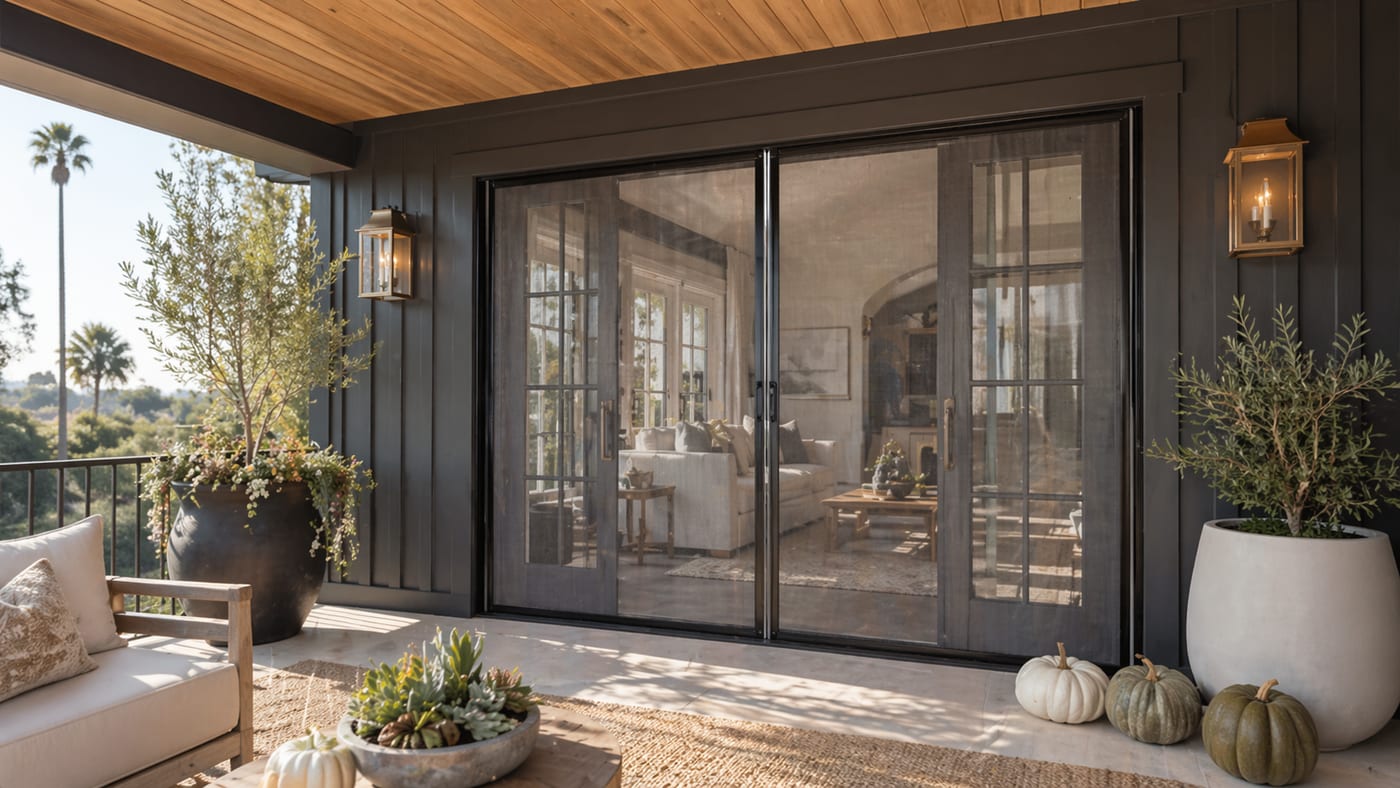
The housing is mounted, the tracks are run top and bottom, and the screen is fitted and tensioned.
Tensioning is the part that is easy to underestimate. Too little and the mesh sags and tracks unevenly; too much and it strains the roller and makes operation stiff. Getting it right for the specific opening — and for how out-of-square that opening is — is the difference between a screen that runs smoothly for years and one that develops problems in the first season.
Before the installer leaves, the screen is operated across its full range of travel and confirmed to run smoothly end to end, seat correctly, and retract fully into the housing. A screen that binds in the last six inches is a problem caught on the day, not six weeks later.
How Long It Takes
A single door screen is typically a straightforward appointment. A double French configuration takes longer, because the two halves have to be hung to meet cleanly at the centre. Large-opening and motorized systems take longer again — motorized adds wiring, control setup and, where specified, sensor configuration.
Multiple openings in one visit are efficient, since the setup and tooling are already there, which is one reason having everything measured at once is worth doing even if you intend to phase the work.
Why This Is Not a DIY Product
Worth being direct, because the question comes up.
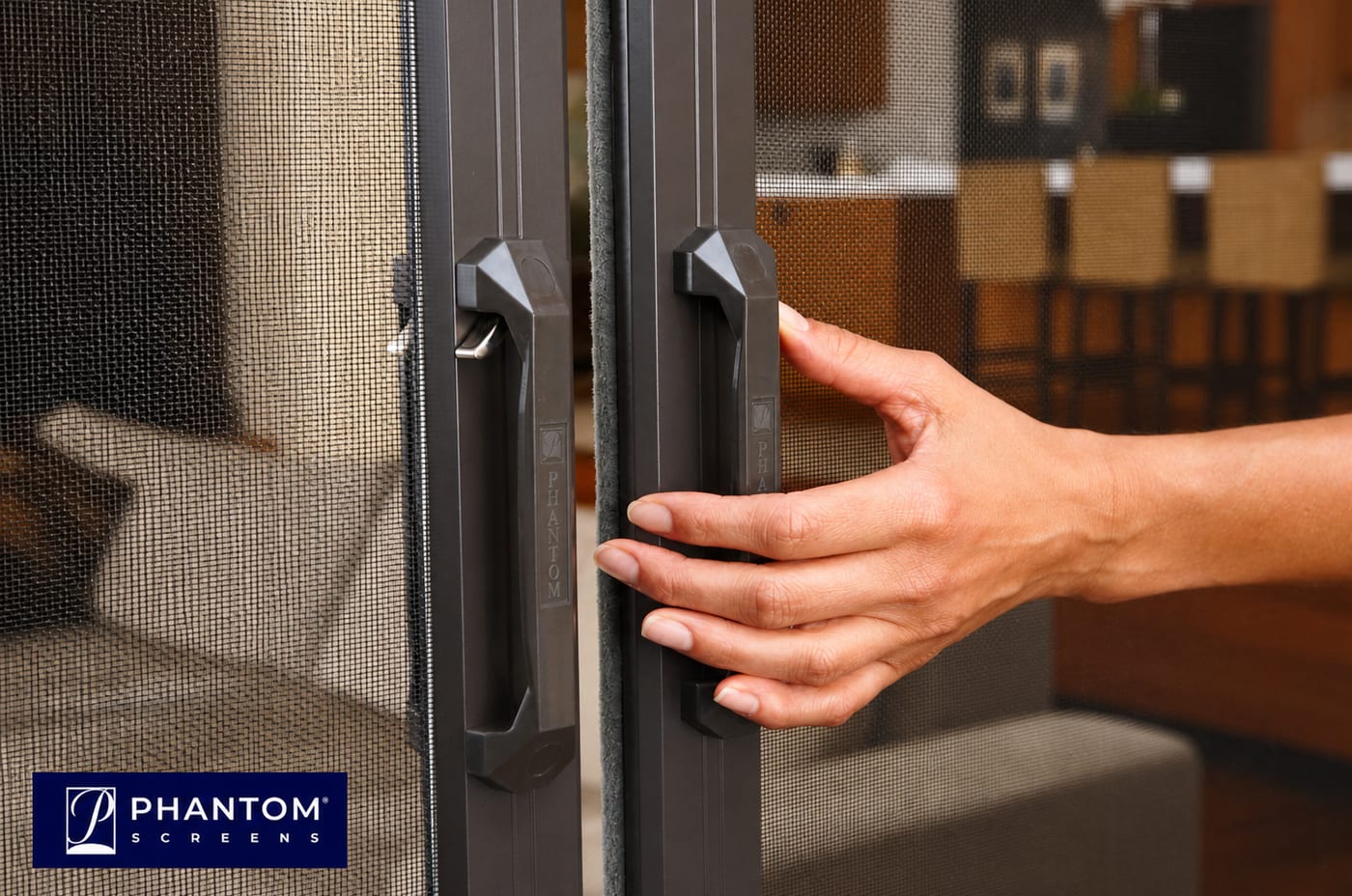
The mechanism is not complicated. What is difficult is fitting a precision assembly to an opening that is not square, at a tension calibrated to that specific opening, with tracks aligned closely enough that the screen runs without binding across its full travel.
The common DIY outcomes are predictable: a screen that binds partway, one that does not seat at the bottom, one that develops a gap at the centre on a French pair, or mesh that wrinkles because the tension is wrong. None are dramatic failures — they are just a screen that does not work properly, on an opening you use daily.
There is also a warranty consideration. Installation is included in the price here, and the work carries a 24-month labor warranty alongside the limited lifetime component warranty and 7-year motor warranty.
Doing Several Openings at Once
Most households end up screening more than one opening, and there are practical reasons to plan that even if you intend to phase the work.
Measuring everything in a single visit costs nothing extra and means later openings are quoted accurately when you come to them, rather than needing another visit. It also lets a specialist look at the house as a whole — which openings face the afternoon sun, which are on the windward side, which take the most traffic — and recommend accordingly rather than opening by opening.
Installing several at once is more efficient than returning, since the setup and tooling are already on site. Where budget is the constraint, a common approach is to do the openings you use daily first — the patio door, the main entry — and add bedrooms or secondary doors in a later phase.
The one thing worth avoiding is measuring piecemeal over months. Openings get quoted in isolation, mesh choices end up inconsistent across the house, and you pay for repeat visits that a single assessment would have covered.
Lead Times and When to Start
Because every screen is fabricated to its opening, there is a genuine lead time between the measurement and the installation. That is not a scheduling inefficiency — it is what "custom-built" means in practice.
Demand also concentrates sharply. The first properly warm stretch of the year is when most people decide they want screens, which is exactly when the calendar fills.
Starting in late winter or early spring means installing before the season rather than partway through it. A patio door screened in May delivers a full summer; the same order placed in July delivers considerably less of one.
Preparing for the Visit
Very little is required, but a few things help.
Clear access to the opening on both sides. Move furniture back a few feet, and on a patio door move outdoor furniture clear of the threshold.
Have the sun exposure in mind. If you have not decided on mesh, being able to say which way the opening faces and what time of day it becomes uncomfortable helps the specialist recommend properly.
Mention pets. It changes the mesh retention recommendation more than anything else, and it is easier to specify at the outset than to retrofit.
What It Costs
Installation is included in every price. A single retractable door screen starts at $989, a double French pair at $1,949, and large-opening systems at $4,200 manual or $5,400 motorized.
Mesh Lock adds $250 on a single or $500 on a double. Openings roughly 96¼ to 120 inches tall add $200. A $200 deposit starts the order and is applied to the total.
Full pricing is in What Phantom Screens Cost, and the variables are broken down in What Drives the Price of a Retractable Screen.
After Installation
Maintenance is minimal: keep the bottom track clear of grit, clean the mesh occasionally with mild soap and water, and let the screen complete its travel rather than releasing it halfway.
In high-desert country the track matters most. Blowing dust collects in the bottom channel, and that is the most common cause of a screen that starts to drag months later.
If something does need attention, a service call is $150. See Retractable Screen Door Repair for what is typically involved.
Next Steps
Request a free quote — measurement and consultation are free and carry no obligation. Or browse door screens to see the configurations available.
Starting prices are current for Phantom Screens of Twin Falls and include professional installation. Final pricing is confirmed after an in-home measurement.
Frequently Asked Questions
Is installation included in the price? Yes, on every configuration. It is not a separate line item, and the work carries a 24-month labor warranty.
How long does installation take? A single door screen is a straightforward appointment. French pairs take longer because the halves must meet cleanly at the centre, and motorized systems take longer again for wiring and control setup.
Can I install a retractable screen myself? The mechanism is not complex, but fitting a precision assembly to an out-of-square opening at the correct tension is where these succeed or fail. Poor fitting shows up as binding, sagging, or a screen that does not seat properly.
Why does someone have to measure first? Because whether the opening is square, how much frame depth exists, which way the door swings, and the condition of the threshold all affect both the price and whether the screen works. None can be established over the phone.
What if my opening is not square? Entirely normal in older homes and handled as routine — every screen is built to the opening as measured rather than to a nominal size.
What should I do to prepare? Clear access on both sides of the opening, know which way it faces and when it becomes uncomfortable, and mention any pets — that last one changes the mesh recommendation.
Tags
Written by
Phantom Screens of Twin Falls Team
Custom retractable screen solutions for homes across Idaho and Western Wyoming.
Related Articles

Pet-Resistant Retractable Screens
What pets actually do to screens, how pet-resistant mesh and mesh retention differ, which of the two you need, and what each costs.

Screen Mesh Options Explained
Insect, solar, privacy, no-see-um, pet-resistant and clear vinyl — what each does, what it trades away, and how to match one to a specific opening.

Retractable Screens for Large & Oversized Openings
Openings past 96 inches need a different system. What covers up to 15 feet wide and 12 feet high, how spans divide, and what oversized systems cost.
Interested in Retractable Screens?
Get a free quote for custom Phantom retractable screens — motorized, door, or window screens for your home.
Get a Free Quote