Screening a Covered Patio: What It Takes
What is involved in screening an existing covered patio — what the structure needs to support it, how wide spans are divided, sun and wind considerations, and what it costs.

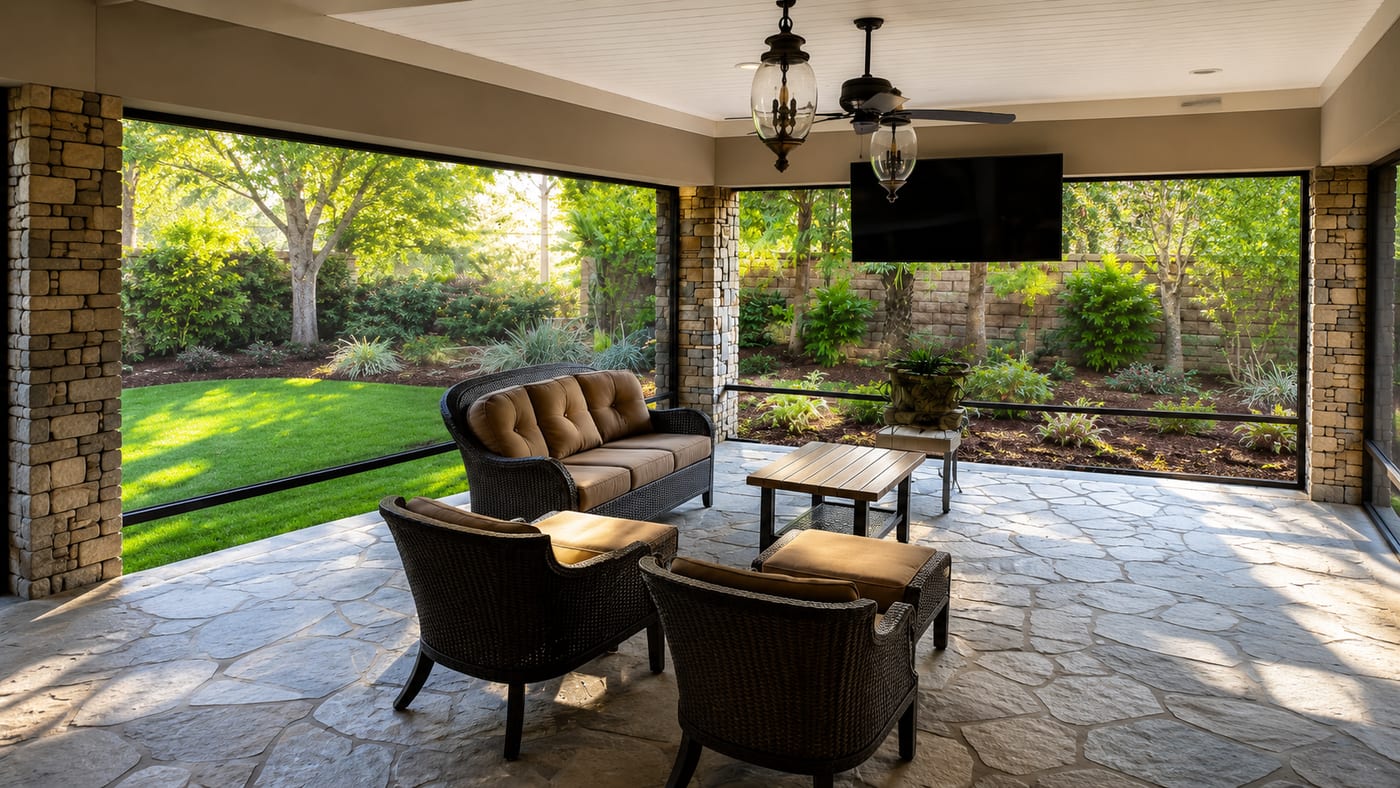
A covered patio is the easiest outdoor space to screen well, because the hard part is already built. There is a roof, there are posts, and there is a defined opening. What remains is a question of what the structure can carry and how the span gets divided.
Here is what the process actually involves.
What the Structure Needs to Provide
Two things: something solid to mount the housing to at the top, and something to run side tracks down at each end of each screen.
On a typical covered patio, that means a header, beam or fascia along the top of the opening, and posts or walls at the sides. Most patios built as patios have both, which is why this tends to be a straightforward installation rather than a construction project.
What gets checked during the measurement is whether those elements are sound and whether they are straight. A header that sags across a long span, or posts that are out of plumb, affects how the screen tracks — and both are common enough on older structures that they are looked for rather than assumed away.
How Wide Spans Get Divided
A single screen covers up to 15 feet wide and 12 feet high. Most covered patios are wider than that across the full opening, which means the span is divided.
The natural division points are the existing posts. A patio with posts every ten or twelve feet gets a screen per bay, and the posts carry the side tracks — so the division is structural rather than arbitrary, and it reads as part of the architecture rather than as a seam.
This is also where cost is decided. Patio screens are priced per screen, so a 30-foot patio in three bays is three screens. Knowing that early makes the quote predictable rather than surprising.
Which Sides to Screen
Not every side needs a screen, and screening all of them is often unnecessary.
The side that matters most is usually the one facing the prevailing weather or the low sun. On a west-facing patio the setting sun is the problem, and screening that side does most of the work. On an exposed site, the windward side matters more than the others.
A common approach is to screen two sides — the sun side and the wind side — and leave the rest open. That keeps the space feeling like a patio rather than a room, costs less than a full enclosure, and solves the actual problem.
If the goal is a fully enclosed space, screening every side works too. That is a different outcome and worth being deliberate about, because a patio that can be fully closed will get used differently from one that is partly open.
Sun: the Problem Most People Are Actually Solving
Insects are what people mention first. Sun is frequently what is really stopping them using the space.
A covered patio has a roof, which handles overhead sun. What the roof does nothing about is low afternoon sun coming in horizontally under it — and in southern Idaho that arrives with real intensity from mid-afternoon through evening on west-facing spaces.
Solar mesh is the answer. It blocks a substantial share of heat, UV and glare while keeping the outward view, and on a west-facing patio it converts several hours a day from unusable to comfortable through the summer.
Worth deciding at specification time, because mesh cannot be changed later without a mesh replacement.
Wind, and Why It Drives the Motorized Decision
Wind is the other local factor, and it shapes the manual-versus-motorized choice more than convenience does.
A large screen is a large surface. Deployed in a strong gust, it takes load the system is not meant to hold indefinitely — which is why every large-opening screen is designed to be retracted in high wind.
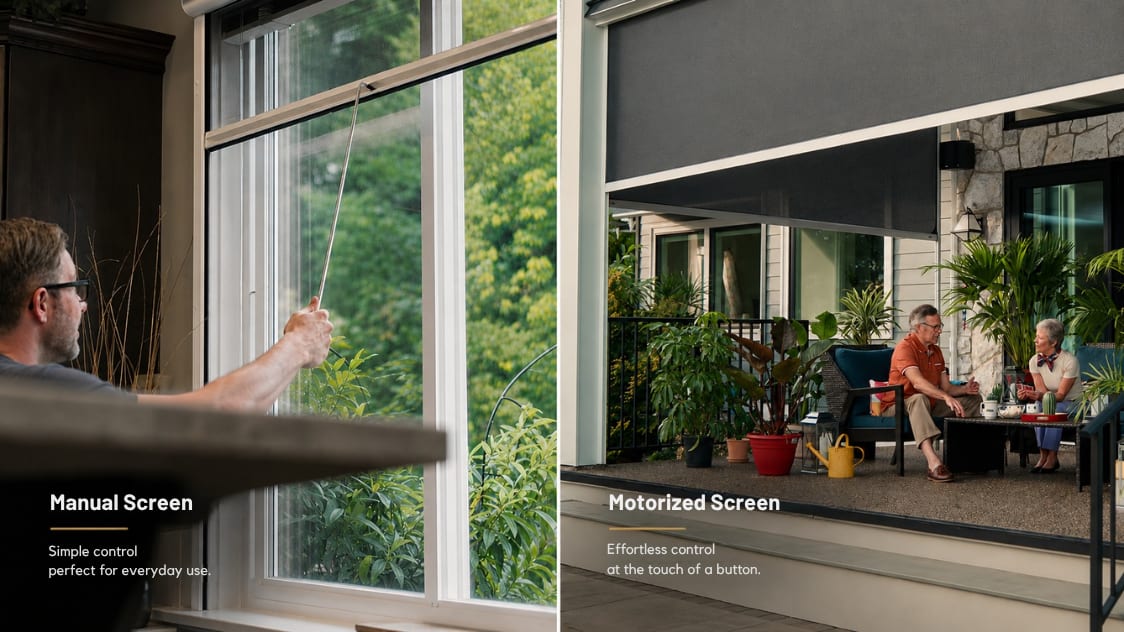
The problem is being there to do it. Wind arrives quickly here, and frequently when the house is empty. A wind sensor on a motorized system retracts the screen automatically when gusts reach a threshold, which removes the need for anyone to be home.
On a sheltered patio this matters far less and a manual system at $4,200 is the sensible choice. On an exposed one, the sensor is a strong argument for the $5,400 motorized version by itself.
Extending the Season with Vinyl
Mesh solves summer. Clear luxury vinyl panels solve shoulder season.
Vinyl blocks wind and holds warmth rather than filtering insects. On a covered patio it turns a space that is pleasant in July into one that is usable in April and October — which in this climate is a meaningful extension, because spring and autumn days here are often bright and calm but too cool to sit out in unprotected.
Many patios end up running both: mesh for the insect season and vinyl for the shoulders. On a large opening these can be specified across different bays or swapped seasonally depending on the configuration.
Screens or a Built Screened Porch?
The realistic alternative to screening a covered patio is enclosing it — framing the openings and fitting fixed screen panels, effectively converting the patio into a screened porch.
That is a legitimate choice, and it is the better one if what you want is a room. A built enclosure is permanent, can be insulated later, and can eventually take glass.
The trade is that it is permanent. Once the openings are framed and panelled, the patio is a porch — on the calm July evening when you would rather have an open patio, you still have a porch. You have also converted an outdoor space into something closer to an addition, with the cost and the permitting that implies.
Retractable screens keep both options available from the same structure. Deployed, the space is sheltered and insect-free. Retracted, it is the open patio it was built as. For most households that flexibility is the point, which is why they end up here rather than framing the openings.
Where a built enclosure genuinely wins is year-round use in a heated space. Retractable screens with vinyl panels extend the season considerably, but they do not turn a patio into a conditioned room, and it would be dishonest to suggest otherwise.
What Installation Involves
The measurement comes first and determines everything: span widths, what the header can carry, whether posts are plumb, and how many screens the opening calls for.
Fabrication follows, because every screen is built to its specific bay rather than cut down from stock. Installation mounts the housings, runs the side tracks, and confirms each screen operates smoothly across its full travel before the installer leaves.
Professional installation is included in the price. So is the warranty — a limited lifetime warranty on components, 7 years on motors, and 24 months on labor.
What It Costs
Large-opening patio screens start at $4,200 manual and $5,400 motorized per screen, installed. A patio divided into multiple bays is priced per screen.
A $200 deposit starts the order. Should the system need attention later, a service call is $150.
Full pricing is in What Phantom Screens Cost, and the manual-versus-motorized trade is worked through in Motorized Retractable Screen Pricing.
Next Steps
For the broader picture across patios and porches, see Retractable Screens for Patios & Porches. If your structure is a pergola rather than a solid roof, read Retractable Screens for Pergolas.
Request a free quote and a specialist will assess the structure and tell you how the span divides.
Starting prices are current for Phantom Screens of Twin Falls and include professional installation. Final pricing is confirmed after an in-home measurement.
Frequently Asked Questions
What does it cost to screen a covered patio? From $4,200 per screen manual and $5,400 motorized, installed. A wide patio divided into bays at the posts is priced per screen.
Does my patio need a solid roof? It needs something solid to mount the housing to at the top and posts or walls to run side tracks down. A solid roof is the straightforward case; a pergola needs its framing assessed first.
Do I have to screen every side? No, and often you should not. Screening the sun side and the wind side solves most of the problem while keeping the space feeling like a patio rather than a room.
How wide can one screen span? Up to 15 feet wide and 12 feet high. Wider patios are divided at the existing posts, with a screen per bay.
Will it help with afternoon sun? Solar mesh blocks a substantial share of heat, UV and glare. A patio roof handles overhead sun but does nothing about low horizontal light, which is what makes west-facing spaces uncomfortable in summer.
Can I use the patio in spring and autumn? Clear luxury vinyl panels block wind and hold warmth, which extends the usable season considerably compared with mesh alone.
Tags
Written by
Phantom Screens of Twin Falls Team
Custom retractable screen solutions for homes across Idaho and Western Wyoming.
Related Articles

Pet-Resistant Retractable Screens
What pets actually do to screens, how pet-resistant mesh and mesh retention differ, which of the two you need, and what each costs.

Screen Mesh Options Explained
Insect, solar, privacy, no-see-um, pet-resistant and clear vinyl — what each does, what it trades away, and how to match one to a specific opening.

Retractable Screens for Large & Oversized Openings
Openings past 96 inches need a different system. What covers up to 15 feet wide and 12 feet high, how spans divide, and what oversized systems cost.
Interested in Retractable Screens?
Get a free quote for custom Phantom retractable screens — motorized, door, or window screens for your home.
Get a Free Quote