Sure Fit Motorized Screens Explained
What Next Generation Spring Tension Technology actually does, why mesh tension is the thing that decides how a screen behaves in year five, and when Sure Fit is worth specifying.

Most of what separates a retractable screen that still works well after a decade from one that does not comes down to a single variable: mesh tension.
Sure Fit is Phantom's answer to that, and it is worth understanding what the technology actually addresses rather than treating it as a product name.
Why Tension Decides Everything
A retractable screen is a fabric held flat across an opening by tension between a roller and a track. Get that tension right and the screen runs smoothly, sits flat, and tracks evenly across its full travel.
Get it wrong in either direction and problems follow.
Too little tension and the mesh sags. A sagging screen wrinkles, catches at the edges, and can pull out of the side channels. It also looks wrong, which on a feature opening matters.
Too much tension and the system strains. Operation becomes stiff, the roller carries more load than it was meant to, and wear accelerates at every contact point.
The complication is that correct tension is not a fixed number. It varies with the width and height of the opening, and it changes over time as components settle and materials respond to temperature.
What Next Generation Spring Tension Technology Does
Sure Fit's track is built so tension self-adjusts through every cycle rather than being set once at installation and left.
The practical effect is that the mesh stays aligned and wrinkle-free as the screen deploys and retracts, without depending on the initial setting remaining correct for the life of the product.
That is the distinction worth understanding. A conventional system is tensioned properly at installation and then drifts — slowly, as components bed in and seasons cycle. A self-adjusting system corrects continuously, so the screen behaves the same way in year five as it did in week one.
Why This Matters More on a Motorized Screen
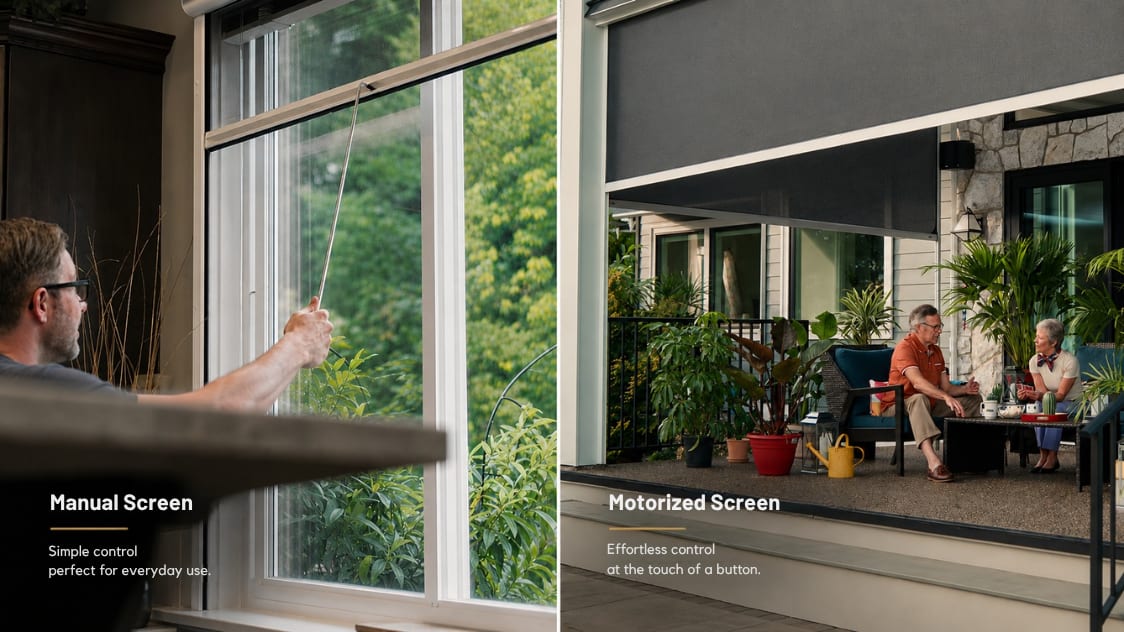
On a manual screen, a person is the feedback loop. If tension has drifted and the screen starts binding, you feel it — resistance, an uneven pull, a catch partway across. Most people respond by getting it looked at.
A motor has no such feedback. It drives the screen to its stop regardless of what is happening in the track. A screen running slightly out of tension keeps being driven, and the wear that a person would have noticed accumulates unobserved.
That is the core argument for self-adjusting tension on a powered system: it reduces how often the situation arises in the first place, on exactly the systems least likely to report it.
What It Changes in Southern Idaho Specifically
Two local conditions make tension drift more likely here than in milder climates.
Temperature swing. Materials expand and contract, and this region moves through a wide range both daily and seasonally. A screen tensioned on a mild spring afternoon experiences considerably different conditions in July and again in January.
Freeze-thaw movement. Structures shift over winter. An opening that moves a fraction takes its track alignment with it, and that shows up in spring as a screen behaving differently than it did in autumn.
Neither is dramatic in isolation. Both are the kind of gradual drift a self-adjusting system absorbs and a fixed-tension one accumulates.

When It Is Worth Specifying
Wide spans. Tension problems scale with width. A 15-foot screen has far more fabric to hold flat than a door screen, and a small tension error shows up as a visible sag across that distance.
High-cycle installations. A patio screen operated several times an evening through summer accumulates cycles quickly, and cycles are what drive drift.
Motorized systems. For the feedback reason above.
Feature openings. Where the screen is visible on a prominent elevation, a mesh that stays flat and wrinkle-free is worth more than on a side door nobody looks at.
When It Is Not the Deciding Factor
On a standard door screen operated by hand a few times a day, conventional tensioning performs well and is properly specified for the job. The width is modest, the cycle count is low, and a person is there to notice if anything changes.
A single door screen at $989 is not the place this technology is aimed, and it would be overselling to suggest otherwise.
What Wrinkled Mesh Actually Signals
Worth knowing how to read, because it is the earliest visible sign that tension has drifted.
Mesh that has gone slightly wavy across its width, or that shows a soft diagonal crease when deployed, is not a cosmetic defect in the fabric. It is the screen telling you it is no longer being held flat the way it was.
Left alone, that progresses. A screen not sitting flat tracks marginally off-line, which loads one side channel more than the other and wears the rollers unevenly. The wrinkle is the symptom; the uneven load is what eventually causes the service call.
On a conventional system this is exactly the point to have it looked at — a tension adjustment then is far cheaper than roller wear later. On a self-adjusting track, the correction happens through normal operation, which is the practical value of the technology stated in plain terms.
Track Contamination and Why It Compounds
Tension and track cleanliness are related problems, and in this region they compound.
Blowing dust collects in the bottom channel. A screen running through grit meets uneven resistance across its width, which pulls it fractionally off-square on every cycle — the same effect as a tension problem, arriving from a different direction.
The two together are worse than either alone. Grit creates uneven resistance, uneven resistance encourages drift, and drift means the screen sits less flat and picks up more contact with the track.
Clearing the bottom track periodically is the single most useful maintenance habit here, and it matters as much on a self-adjusting system as on a conventional one. Self-correcting tension handles drift; it does not sweep the track.
How It Fits With Everything Else
Sure Fit is the track and tensioning system. Everything else about specification remains a separate decision.
Mesh type is chosen per opening — standard insect, solar, privacy, no-see-um, or clear luxury vinyl for wind and warmth. Control method is separate: remote, wall switch, app, or voice through Alexa and Google Home, with Control4, Crestron and Lutron integration available. Sensors are specified independently.
The warranty is the same across configurations: a limited lifetime warranty on components, 7 years on the motor, and 24 months on labor. Screen mesh is not included under the component warranty, but it can always be repaired or replaced.
Questions Worth Asking Any Supplier
Tension is not something you can assess by looking at a showroom sample, so it is worth asking about directly when comparing quotes.
How is tension set, and does it hold over time or need periodic adjustment? What happens as the opening moves seasonally? Is tension adjustment covered under warranty, or billed as a service call?
The answers separate systems more meaningfully than most of the specifications that get advertised. A screen that needs its tension revisited every couple of years has a real ownership cost attached that never appears on the quote.
What It Costs
Sure Fit motorized systems are quoted as part of the large-opening range, starting at $5,400 installed against $4,200 for a manual system. Custom fabrication and professional installation are included.
Full pricing is in What Phantom Screens Cost.
Next Steps
For motorized systems generally, read Motorized Retractable Screens: A Complete Guide. For patio application, see Motorized Patio Screens. Or browse Sure Fit motorized screens.
Request a free quote and a specialist will advise whether the opening justifies it.
Starting prices are current for Phantom Screens of Twin Falls and include professional installation. Final pricing is confirmed after an in-home measurement.
Frequently Asked Questions
What is Sure Fit? Phantom's motorized screen track, built around Next Generation Spring Tension Technology, where mesh tension self-adjusts through every cycle rather than being set once at installation.
Why does mesh tension matter? Too little and the mesh sags, wrinkles and can pull out of the side tracks. Too much and operation stiffens and wear accelerates. Correct tension varies by opening and drifts over time.
Why is it more important on motorized screens? A person operating a manual screen feels resistance and gets it checked. A motor drives to its stop regardless, so drift accumulates without being noticed.
Is it worth it on a door screen? Generally not. Standard door screens are modest in width, low in cycle count, and hand-operated, so conventional tensioning is properly suited to them.
Does Sure Fit change my mesh options? No. Mesh is specified separately per opening — standard insect, solar, privacy, no-see-um, or clear luxury vinyl.
What does it cost? Sure Fit motorized systems are quoted within the large-opening range, from $5,400 installed against $4,200 for manual.
Tags
Written by
Phantom Screens of Twin Falls Team
Custom retractable screen solutions for homes across Idaho and Western Wyoming.
Related Articles

Pet-Resistant Retractable Screens
What pets actually do to screens, how pet-resistant mesh and mesh retention differ, which of the two you need, and what each costs.

Screen Mesh Options Explained
Insect, solar, privacy, no-see-um, pet-resistant and clear vinyl — what each does, what it trades away, and how to match one to a specific opening.

Retractable Screens for Large & Oversized Openings
Openings past 96 inches need a different system. What covers up to 15 feet wide and 12 feet high, how spans divide, and what oversized systems cost.
Interested in Retractable Screens?
Get a free quote for custom Phantom retractable screens — motorized, door, or window screens for your home.
Get a Free Quote