Motorized Patio Screens
What motorized screens do for a covered patio specifically — how spans divide, which bays to power, sensor placement, and what it costs per screen.

A covered patio is where motorization earns itself more clearly than anywhere else on a house. The spans are wide, the screens get used constantly through summer, and the exposure is real.
This covers what changes when you power a patio specifically, rather than motorized screens in general.
Patios Are Wide, and Width Changes the Argument
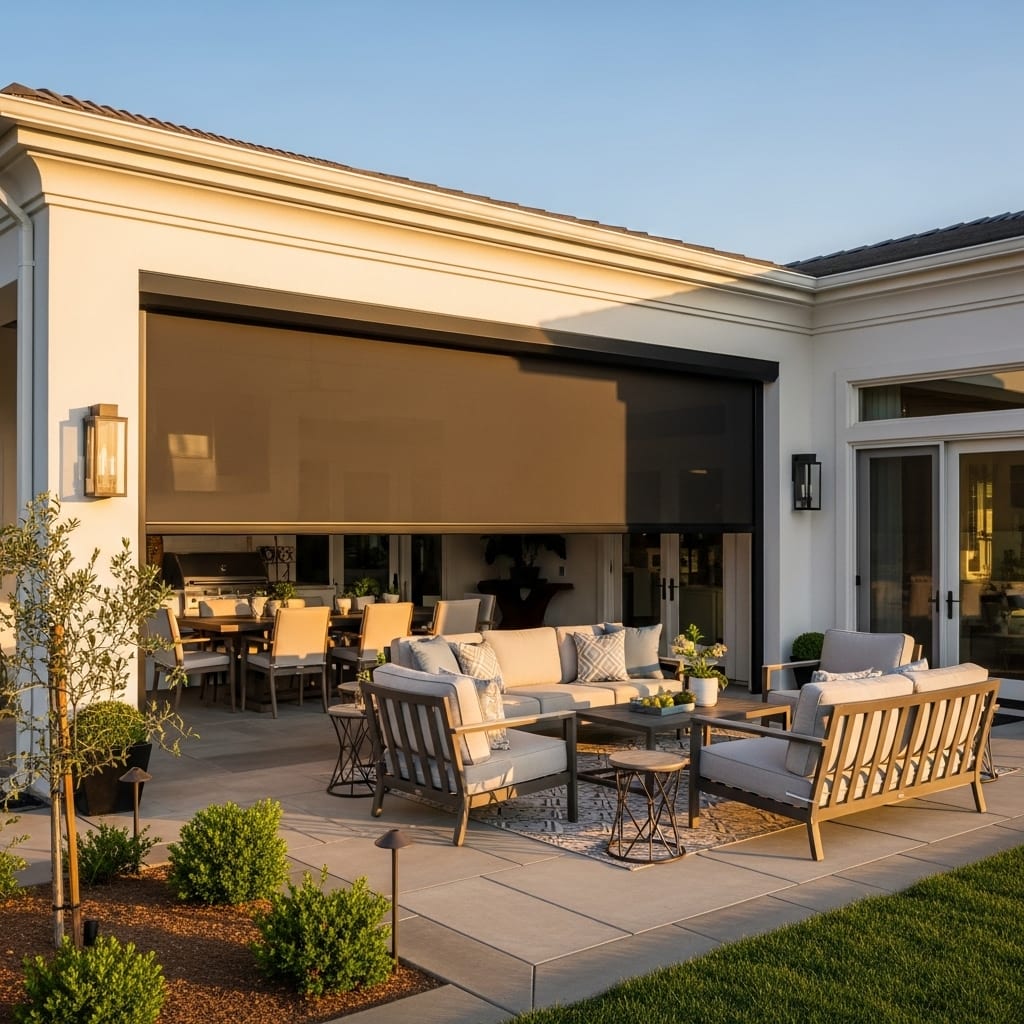
A single screen covers up to 15 feet wide and 12 feet high. Most covered patios are wider than that across the whole opening, which means the span divides at the existing posts, with a screen per bay.
That is where hand operation starts to lose its appeal. Screening a three-bay patio manually means walking three slide bars across, then reversing all three later. Once, that is nothing. Every evening through July, it is the reason the screens stop getting used.
Motorization turns that into one command. On a grouped installation, all bays operate together from a wall switch.
Which Bays to Power
A useful point most people do not realise: you do not have to power every bay.
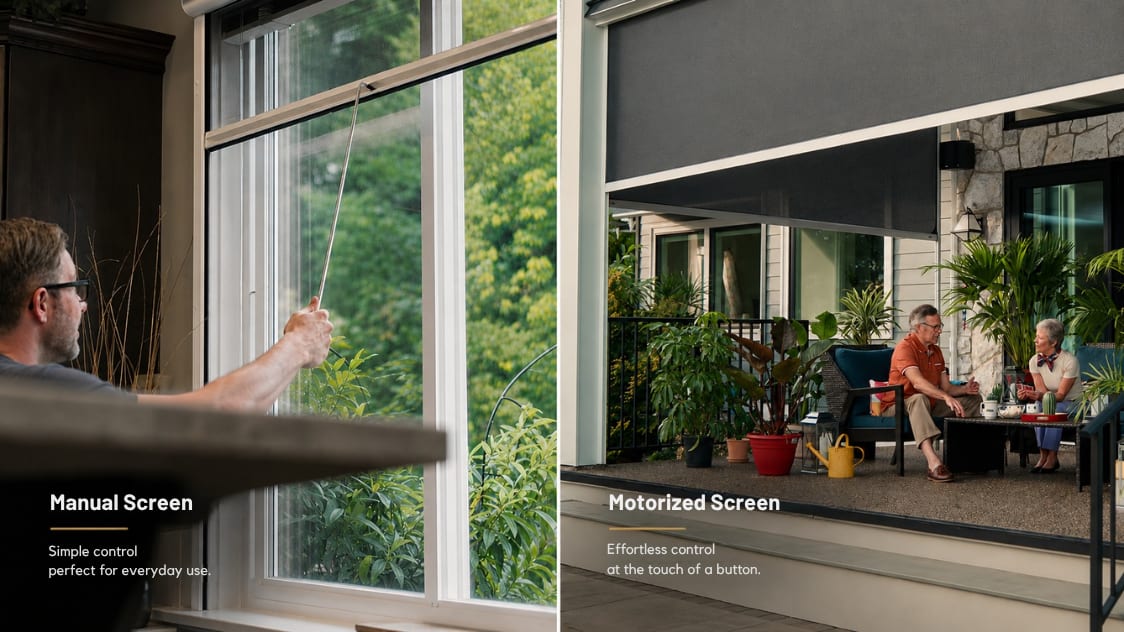
Screens are specified per bay, and manual and motorized can be mixed on the same patio. A common and sensible configuration is to power the bays that get used daily — typically the ones facing the yard or the sun — and leave a side bay manual if it is rarely deployed.
At $5,400 motorized against $4,200 manual per screen, that decision is worth making deliberately rather than defaulting to all-or-nothing across a wide patio.
Where the Wind Sensor Goes
On a patio, sensor placement matters more than on a single opening, because the bays face different directions.
A wind sensor has to sit where it reads the wind actually reaching the screens. Mounted in a sheltered corner of the patio, it under-reads and fails to trigger when the exposed bay is taking the gust. The usual approach is to position it on the most exposed face, so it responds to the conditions the most vulnerable screen is experiencing.
On a grouped installation, one sensor retracting all bays is the safer configuration. A gust hitting the west face is a gust the whole patio should be clear of.
This is worked out during the measurement rather than on installation day, because it affects the wiring route.
Sun Control Across the Day
A patio's bays rarely need the same thing at the same time, and this is where individual control earns its place alongside grouping.
The west bay is the problem from mid-afternoon onward, taking direct high-desert sun for hours. The north side may want nothing at all. A sun sensor on the west face, or simply the ability to lower one bay independently, handles that without closing in the whole space.
Most installations end up with both — a group command for everyday use and individual control available when conditions differ across the patio.
Mesh and Vinyl by Bay
Because bays are specified independently, a patio can carry different panels on different faces.
Solar mesh on the west bay, dealing with afternoon heat and glare. Standard insect mesh on the sheltered faces, maximising airflow. Clear luxury vinyl on the windward bay, blocking wind and holding warmth for shoulder-season use.
That mixed configuration is usually the right answer on a patio with more than two open sides, and it is a stronger outcome than picking one panel type for the whole space.
What This Does for How the Patio Gets Used
The practical difference is that screens get operated as conditions change rather than being set once.
An unpowered patio screen tends to end up in whatever position it was last put in, because moving it is a task. A powered one goes down when the sun drops, up when the breeze is pleasant, down again at dusk when insects arrive — because each of those costs nothing.
In southern Idaho that matters through summer specifically. Evenings cool substantially after sundown, and the hour around dusk is both the most pleasant time to be outside and the worst for insects. A screen that is easy to deploy is a screen that is actually down during that hour.
Corner Patios and Wrapping Two Sides
A patio that turns a corner is common on newer builds, and it raises a question worth settling before quoting.
Screens run in straight lines along their tracks, so a corner is handled as two separate screens meeting at the corner post rather than one screen bending around it. That post carries a side track for each run.
Practically, that means a corner patio is at minimum two screens, and the corner is where the two meet. On a well-built patio with a solid corner post, that junction closes cleanly. Where there is no post at the corner — some patios are cantilevered specifically to keep the corner open — screening it requires adding one, which is worth knowing early because it changes the look of the space.
It is also a case where powering both runs is usually worth it. A corner patio tends to be the one that gets furnished and used most, and operating two runs by hand across a corner is the arrangement people abandon fastest.
What Happens to the View
Worth addressing directly, because it is the most common hesitation on a patio that was built for a view.
Retracted, the screens are inside their housings and the patio is exactly as it was — nothing across the opening, nothing to look through. That is the state the space sits in for most of the day.
Deployed, standard insect mesh keeps the outward view clear. Mesh is visible at close range and effectively disappears at distance, which is why a screened patio still reads as an open one from a seat in the middle of it.
Solar mesh trades slightly more visibility for heat and glare control, so on a patio where the view is the entire point, running solar only on the bay taking direct afternoon sun and standard mesh elsewhere is usually the better configuration.
Installation on an Existing Patio
The structure has to provide two things: something solid to mount the housing to along the top, and posts or walls to run side tracks down. Most covered patios have both.
What differs for motorized is the wiring. Power has to reach each housing, and the route affects where housings can practically sit. That is planned during the measurement rather than improvised on the day, and it is one of the reasons a motorized patio takes longer to install than a manual one.
Before the installers leave, each screen is run through its full travel and the controls and any sensors are confirmed working.
What It Costs
Motorized large-opening screens start at $5,400 per screen installed, against $4,200 manual. A patio divided into bays is priced per screen, so a three-bay patio is three screens.
Custom fabrication, professional installation and the warranty are included — limited lifetime on components, 7 years on the motor, 24 months on labor. A $200 deposit starts the order.
Full pricing is in What Phantom Screens Cost, and the manual-versus-motorized economics in Motorized Retractable Screen Pricing.
Next Steps
For the structural side of patio screening, read Screening a Covered Patio. For motorized systems generally, see Motorized Retractable Screens: A Complete Guide. For automation, Smart-Home Retractable Screens.
Request a free quote and a specialist will work out how the span divides and which bays are worth powering.
Starting prices are current for Phantom Screens of Twin Falls and include professional installation. Final pricing is confirmed after an in-home measurement.
Frequently Asked Questions
How much are motorized patio screens? From $5,400 per screen installed, against $4,200 manual. A patio divided into bays is priced per screen.
Do all the bays have to be motorized? No. Screens are specified per bay, so you can power the bays used daily and leave a rarely-used side bay manual.
Can all the screens operate together? Yes. Grouped control operates every bay from one command, with individual control available when conditions differ across the patio.
Where does the wind sensor go? On the most exposed face, so it reads the wind actually reaching the screens. Mounted in a sheltered corner it under-reads and fails to trigger when it should.
Can different bays have different mesh? Yes, and on a patio with several open sides they usually should — solar on the west face, standard insect mesh on sheltered sides, vinyl on the windward bay.
How wide a patio can be screened? Any width. A single screen covers up to 15 feet; wider patios divide at the existing posts with a screen per bay.
Tags
Written by
Phantom Screens of Twin Falls Team
Custom retractable screen solutions for homes across Idaho and Western Wyoming.
Related Articles

Pet-Resistant Retractable Screens
What pets actually do to screens, how pet-resistant mesh and mesh retention differ, which of the two you need, and what each costs.

Screen Mesh Options Explained
Insect, solar, privacy, no-see-um, pet-resistant and clear vinyl — what each does, what it trades away, and how to match one to a specific opening.

Retractable Screens for Large & Oversized Openings
Openings past 96 inches need a different system. What covers up to 15 feet wide and 12 feet high, how spans divide, and what oversized systems cost.
Interested in Retractable Screens?
Get a free quote for custom Phantom retractable screens — motorized, door, or window screens for your home.
Get a Free Quote