What Are Retractable Window Screens and How Do They Work?
How retractable window screens work, which window types they fit, what mesh options are available from insect to solar to privacy, and why professional installation produces the best result.

A retractable window screen does what a fixed screen cannot: it disappears when you do not need it. When the window is closed, the screen is stored in a slim housing mounted at the side or top of the window frame, invisible against the wall. When the window opens and you want ventilation without insects, the screen deploys across the opening. When the window closes, the screen retracts.
That one difference changes how a window functions and how a room looks. Fixed screens sit in the frame year-round whether the window is open or not, blocking light and obscuring the view from both sides of the glass. Retractable screens are present only when they are useful.
How Retractable Window Screens Work
The mechanism is straightforward. The screen mesh wraps around a central coil inside a protective housing mounted at one side of the window opening. A slide bar runs along the mesh edge. When you want the screen deployed, you draw the slide bar across the opening, and it travels along a track at the top and bottom of the frame. When you are done, you release it, and the spring tension in the coil retracts the mesh back into the housing.
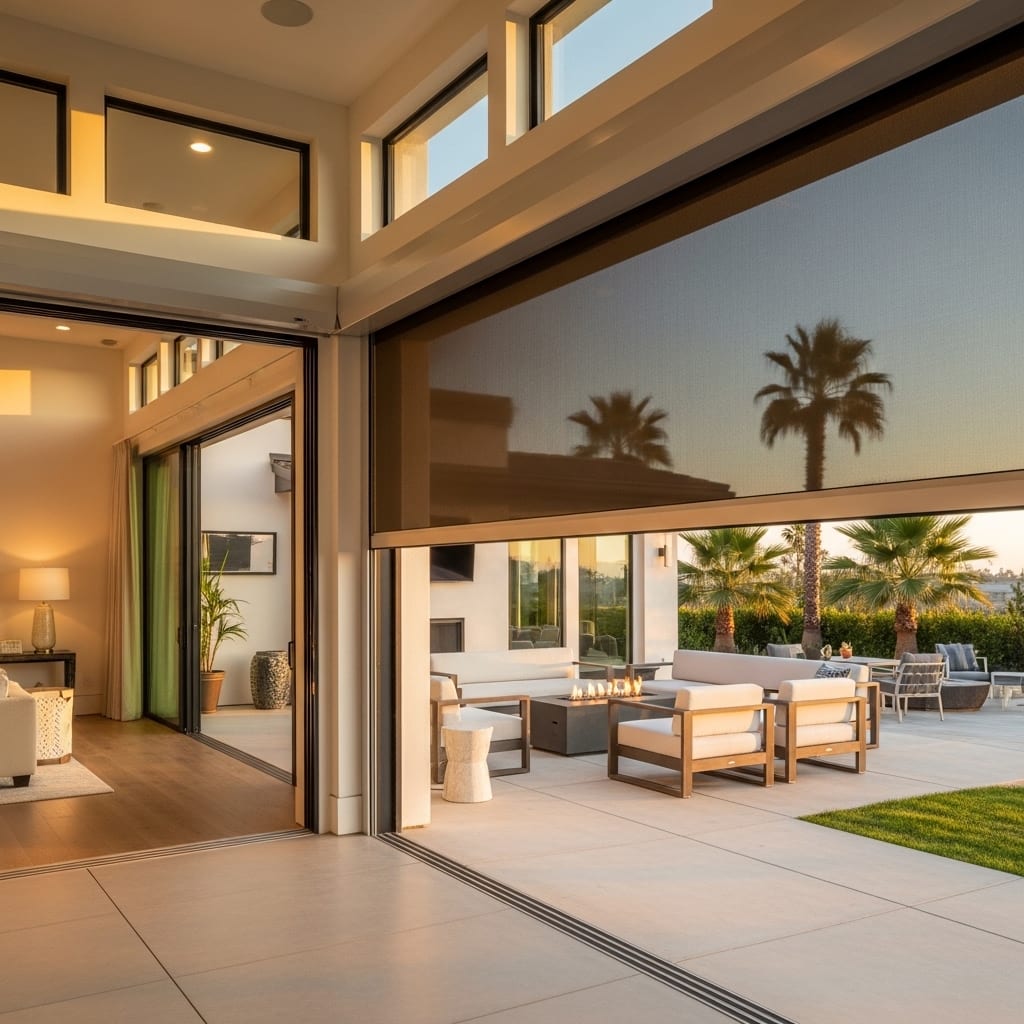
A rounded low-profile housing protects the screen mesh when it is retracted, keeping the mesh clean and out of direct UV exposure between uses. A mesh retention system at the track edges prevents the mesh from lifting or blowing out in light breezy conditions when deployed.
The result is a window screen that is protected when not in use, deployed only when it is doing something useful, and invisible the rest of the time.
Which Window Types Are Compatible
Phantom retractable window screens are compatible with virtually all operable window types: single-hung, double-hung, casement, sliding, awning, and tilt-and-turn windows. The mounting approach varies by window type.
Single-hung and double-hung windows are the most common residential window type. The screen mounts in the interior in-jamb of the frame, fitting within the existing frame depth.
Casement windows open outward on a hinge. Because the window swings away from the frame when open, the screen mounts on the interior side of the opening so it does not interfere with the window's outward swing.
Sliding windows work similarly to sliding doors. The screen mounts on the interior and travels across the portion of the frame that opens.
Awning and tilt-and-turn windows each have specific mounting approaches that the installer confirms based on your specific window configuration and frame depth. For any window type where the frame depth allows it, an in-jamb installation fits the screen housing entirely within the window frame, leaving no hardware visible against the wall.
Mesh Options for Window Screens
The mesh you choose determines what the screen does beyond keeping insects out.
Standard insect mesh at 18x14 or 18x16 threads per inch is the baseline: clear outward visibility, good airflow, and effective exclusion of mosquitoes, flies, and common insects. This is the appropriate specification for most residential windows where insect protection is the primary need.
BetterVue mesh is a finer, higher-clarity mesh that provides exceptional outward visibility while still functioning as an insect barrier. For homeowners who want the clearest possible view through a deployed screen, this is the premium insect mesh option.
Solar mesh in various openness factors manages heat and UV in addition to insects. Solar mesh blocks 80 to 90% of UV rays depending on density and is the appropriate upgrade for south and west-facing windows that receive direct afternoon sun.
Privacy mesh at tight openness factors provides daytime screening from outside while maintaining clear outward visibility from inside. Relevant for windows that face a street, a neighboring property, or a shared outdoor area where privacy matters during daylight hours.
No-see-um mesh at a tighter 20x20 thread per inch weave physically excludes smaller insects that pass through standard mesh. Appropriate for properties near water, wetlands, or areas where smaller midges and gnats are active.
The Wood Window Screen Option
For homes with real wood window frames, Phantom offers wood window screens with seven stain options that match the screen housing and slide bar to the existing wood finish. When the screen is retracted, the housing reads as a continuation of the window's own woodwork rather than an aluminum addition against a wood frame. For historic homes, Craftsman bungalows, and architecturally significant properties where every detail of the window matters, this option makes the installation look designed-in rather than added on.
Why Professional Installation Matters
A retractable window screen is custom fabricated to your specific window dimensions, not selected from a standard size range. For a screen to track smoothly, retract cleanly, and seal properly at the edges, the housing and slide bar need to be built to the exact dimensions of your opening.
Professional installation begins with on-site measurement at your specific windows, followed by custom fabrication and installation that confirms smooth operation across the full range of travel before the installer leaves.
For casement windows, the mounting approach also depends on whether the window opens inward or outward and what depth is available in the frame. For historic homes with original wood frames, the anchoring approach for old-growth wood requires different hardware than a standard aluminum or vinyl window frame. These are determinations made during the on-site assessment, not decisions that can be made accurately from measurements alone.
At Phantom Screens of Twin Falls, our factory-trained local team serves Southern Idaho and Jackson Hole, Wyoming. Every window screen installation is custom built to your specific window dimensions and installed with the mounting approach appropriate for your window type and frame material. Standard insect mesh, BetterVue mesh, solar mesh, privacy mesh, no-see-um mesh, and wood stain options are all available. Every installation is backed by a limited lifetime component warranty and a 24-month labor warranty. Screen mesh is not included under the component warranty, but it can always be repaired or replaced if needed.
Request a free quote and one of our local specialists will assess your specific windows and recommend the right screen configuration for your home.
Window Screens in a High-Desert Climate
Southern Idaho puts a specific set of conditions on a window screen, and they are worth naming because they drive the mesh decision more than anything else does.
Summer sun here is intense and long. South- and west-facing windows take direct afternoon light for hours, which fades flooring and furnishings and turns a room uncomfortable well before evening. Solar mesh is the answer on those elevations, and it is a specification made per window rather than for the whole house.
Blowing dust is the second factor. Grit abrades mesh over time and collects in tracks, which is exactly why a screen that stores inside a housing when not in use holds up better here than a fixed screen does. A fixed window screen is exposed to every dusty afternoon of the year whether the window is open or not.
Then there is the freeze-thaw cycle. Screens that sit permanently in an opening through repeated freezing and thawing accumulate stress that a retracted screen simply does not experience. Storing the mesh for the months you are not using it is the single biggest reason retractable screens last longer in this climate.
Which Windows Are Worth Screening
Not every window needs one, and it is worth being deliberate rather than screening the whole house by default.
The windows that earn a retractable screen are the ones you actually open — bedrooms for night air, kitchens for ventilation while cooking, and any window on a view worth preserving. Those are the openings where the mechanism does real work.
The ones that usually do not are windows you rarely open, and windows with no view to protect. A basement egress, a bathroom obscure-glass window, a laundry window facing a fence — a fixed screen serves those adequately and the money is better spent elsewhere.
A practical approach is to screen the openings you use daily first and add the rest later. Screens can be phased without any structural complication, and having a specialist measure everything in one visit means the later ones are quoted accurately when you come to them.
Sizing and What Fits
Retractable window screens are custom-built to each opening, in sizes from roughly 13.25 to 84 inches wide and up to 90 inches tall. That covers effectively every standard residential window type — single-hung, double-hung, casement, awning, sliding and specialty shapes.
Because every screen is built to the measured opening, out-of-square windows are handled as a matter of course rather than as a problem. That matters in older homes around Twin Falls and the wider Magic Valley, where settling is normal and a screen built to a nominal size would bind or gap.
For what screens cost across every configuration, see What Phantom Screens Cost. If you are weighing the category itself, read Are Retractable Screens Worth It? Ready for a number on your windows? Request a free quote.
Frequently Asked Questions
Can retractable window screens be installed on any window type? Yes, for all operable window types including single-hung, double-hung, casement, sliding, awning, and tilt-and-turn windows. Fixed windows that do not open do not require a screen. The mounting approach varies by window type and is confirmed during the on-site assessment.
Will a retractable window screen affect my view when deployed? Standard insect mesh and BetterVue mesh maintain clear outward visibility when deployed. The mesh is visible at close range but does not obstruct the view at distance. When the window is closed and the screen is retracted, the glass is completely unobstructed.
What is the difference between in-jamb and surface mount installation? An in-jamb installation fits the screen housing entirely within the existing window frame depth, leaving no hardware visible against the wall when the screen is retracted. A surface mount installation attaches the housing to the face of the wall alongside the window frame. The appropriate approach depends on your specific window frame depth and is confirmed during the on-site measurement.
Do retractable window screens require much maintenance? Minimal. Keeping the top and bottom tracks clear of dust and debris with occasional cleaning and applying a light silicone lubricant to the tracks periodically is the primary maintenance. Because the mesh is stored in the housing when not in use, it is protected from continuous dust accumulation and UV exposure between deployments.
Are wood window screens available for all window types? Phantom's wood window screen option with seven stain options is available for standard residential window openings. Compatibility with your specific window type and frame configuration is confirmed during the on-site consultation.
Tags
Written by
Phantom Screens of Twin Falls Team
Custom retractable screen solutions for homes across Idaho and Western Wyoming.
Related Articles

Pet-Resistant Retractable Screens
What pets actually do to screens, how pet-resistant mesh and mesh retention differ, which of the two you need, and what each costs.

Screen Mesh Options Explained
Insect, solar, privacy, no-see-um, pet-resistant and clear vinyl — what each does, what it trades away, and how to match one to a specific opening.

Retractable Screens for Large & Oversized Openings
Openings past 96 inches need a different system. What covers up to 15 feet wide and 12 feet high, how spans divide, and what oversized systems cost.
Interested in Retractable Screens?
See real prices for retractable door screens, installation included. Window and specialty openings are quoted after a $19.99 on-site measurement.
Get Started