Best Retractable Screen Doors: A Buyer’s Guide
What actually separates one retractable screen door from another — build, mesh retention, tension, warranty terms and fitting — and how to compare quotes fairly.

Retractable screens look interchangeable in photographs. The differences appear two or three years in, on a door used every day — and by then the decision has been made.
Here is what actually separates them, and what to ask before you commit.
1. Whether It Is Built to Your Opening
The single largest difference. A screen built to your measured opening fits it; a screen selected from a size range and adjusted on site approximates it.
On a square, modern opening you may never notice. On an older home that has settled — common across Twin Falls and the wider Magic Valley — a screen made to nominal dimensions binds on one side and gaps on the other.
Ask: is this built to my measurements, or fitted from stock sizes?
2. Whether Mesh Retention Is Available
A standard screen lets the mesh float along its track. Lateral pressure — a dog, a child, a gust — can push it out of the channel.
Mesh retention secures the mesh into the track edges so it resists that. Here it is the Mesh Lock option, at $250 on a single and $500 on a double.
If a supplier does not offer retention at all, their quote is lower because the product does less, not because it is better value.
Ask: is mesh retention offered, and what does it cost?
3. The Housing Profile
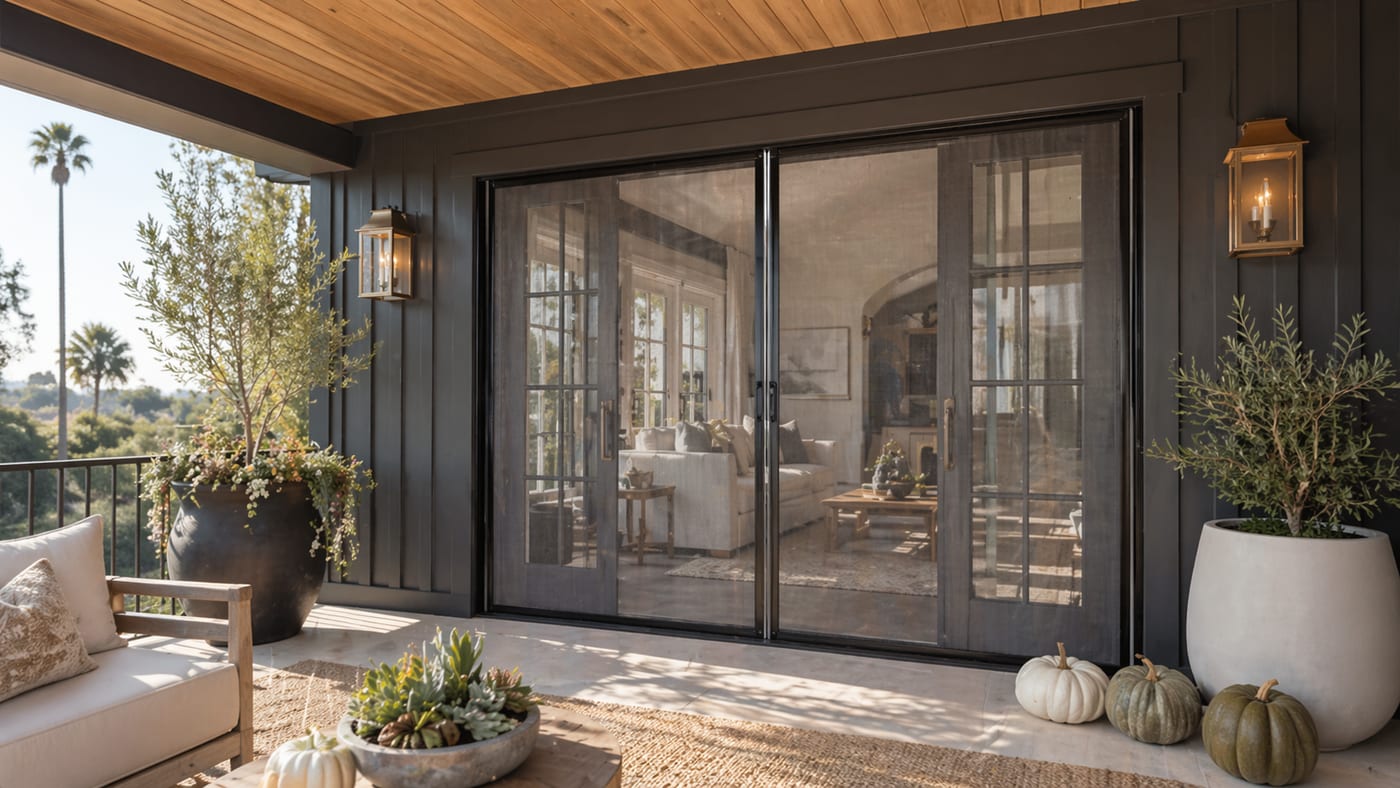
The housing holds the retracted mesh. A bulky one announces itself against the frame and undermines the entire point of a screen that disappears.
A 2.5-inch aluminum housing reads as trim rather than as an addition. Where frame depth allows, an in-jamb fit puts it within the existing frame so nothing shows against the wall at all.
Ask: how deep is the housing, and can it mount in-jamb on my frame?
4. Track Quality and Tension
Everything about how a screen feels comes from the track and the tension across it.
Smooth-glide tracks with precision ball-bearing rollers keep one-hand operation viable even on wide spans. Cheap tracks bind as soon as grit enters them — and in high-desert country, grit is not optional.
Tension is the related question, and the one that determines behaviour years later rather than on installation day. On motorized systems, self-adjusting tension maintains it through every cycle rather than relying on the initial setting holding.
Ask: how is tension set, does it hold over time, and is adjustment covered or billed?
5. What the Warranty Covers — and Excludes
Warranty language describes how long a manufacturer expects its own product to last, which is more informative than any marketing claim.
Phantom screens carry a limited lifetime warranty on components, 7 years on motors, and 24 months on labor. Screen mesh is not included under the component warranty, but it can always be repaired or replaced.
Read that split correctly. It says the structure is built to outlast the mesh, and the mesh is the serviceable part. A product warranted as a single sealed unit for two years is describing something quite different.
Ask: what is covered, for how long, and what is explicitly excluded?
6. Whether Anyone Measures
A quote produced without a measurement is an estimate that gets corrected later.
Four things can only be established at the door: whether the opening is square, how much frame depth exists, which way the door swings, and the condition of the threshold. Each affects both price and whether the screen works.
Ask: does someone come and measure before quoting?
Signals Worth Reading in a Quote
Beyond the six points above, a few things tell you what kind of supplier you are dealing with before any work starts.
Whether they ask which way the door swings. On a French pair this determines where the housing can physically go. A quote produced without that question was not produced for your door.
Whether they ask about pets. It changes the mesh retention recommendation more than any other single fact, and a supplier who never raises it is quoting a product rather than solving a problem.
Whether they ask which way the opening faces. Sun exposure drives the mesh decision, and it is the specification that cannot be revised later without replacing mesh.
Whether they tell you an opening does not need one. A supplier willing to say a rarely-opened utility window is fine with a conventional screen is one giving you an assessment rather than a maximum order.
Where People Go Wrong
Three patterns recur often enough to be worth naming.
Motorizing a door that did not need it. Powered operation is built for span and height. On a standard patio door a manual screen operates easily with one hand and does the identical job for considerably less.
Declining mesh retention on the busiest door. Saving $250 on a $989 screen, then paying a $150 service call plus mesh repair a season or two later, is a common sequence.
Taking standard mesh on a west-facing opening. It works, but it leaves the room uncomfortable through summer afternoons — and unlike almost everything else, mesh cannot be changed without a replacement.
Making Quotes Comparable
Two questions convert different numbers into like-for-like comparisons.
Is installation included? It is here, on every configuration, and the work carries a 24-month labor warranty. An installation line added afterwards is the most common reason a cheaper quote stops being cheaper.
Is custom fabrication included? Every screen here is built to the measured opening as standard, because there is no non-custom option.
What the Cheapest Quote Usually Leaves Out
A materially lower number is generally explained by one of four things: installation priced separately, stock sizing instead of custom fabrication, no mesh retention option, or a shorter warranty covering less.
None of that makes the cheaper option wrong. It makes it a different product — worth choosing deliberately rather than by price alone.
What Happens After the Sale
Worth weighing alongside the product itself, because a screen is something you own for years rather than buy once.
Is service available locally? A screen is a mechanical assembly fitted to a specific opening. When it eventually needs adjustment, someone has to come out. A supplier who installs and disappears leaves you with a product nobody in the area will touch.
Is mesh replaceable independently? This is the difference between a serviceable product and a disposable one. Where mesh can be replaced without disturbing the housing, tracks or motor, replacement is a service call — $260 on a standard single here — rather than a new installation.
What does a service call cost? Knowing the number in advance is reasonable. It is $150 here for assessment and adjustment.
These questions rarely appear on a comparison sheet, and they determine what ownership actually costs across a decade far more than the difference between two quotes does.
Matching the Product to the Opening
The best screen is the one specified for what the opening actually needs.
Single door or slider — a single screen, from $989.
French pair — a matched double, from $1,949.
Beyond 96 inches — an oversized or large-opening system, from $4,200 manual or $5,400 motorized.
Mesh is specified per opening: standard insect for airflow and clarity, solar for heat and glare on south and west elevations, privacy where overlooked, no-see-um near water.
Next Steps
For French doors specifically, read Best Retractable Screens for French Doors. For choosing between configurations, see How to Choose a Retractable Screen. For pricing, What Phantom Screens Cost.
Request a free quote — measurement and consultation are free.
Starting prices are current for Phantom Screens of Twin Falls and include professional installation. Final pricing is confirmed after an in-home measurement.
Frequently Asked Questions
What should I look for in a retractable screen door? Whether it is built to your measured opening, whether mesh retention is available, the housing depth, track and tension quality, what the warranty covers and excludes, and whether anyone measures before quoting.
Why are some quotes so much cheaper? Usually installation priced separately, stock sizing rather than custom fabrication, no mesh retention option, or a shorter warranty. Each makes it a different product rather than better value.
Is installation normally included? It is here, on every configuration, and carries a 24-month labor warranty. That is not universal, so it is worth confirming when comparing.
What does the warranty exclude? Screen mesh is excluded from the limited lifetime component warranty, because it is the serviceable part. It can always be repaired or replaced.
Do I really need someone to measure? Yes. Squareness, frame depth, door swing and threshold condition all affect price and function, and none can be assessed remotely.
What does a good retractable screen door cost? A single starts at $989 installed and a French pair at $1,949, both custom-built with professional installation included.
Tags
Written by
Phantom Screens of Twin Falls Team
Custom retractable screen solutions for homes across Idaho and Western Wyoming.
Related Articles

Pet-Resistant Retractable Screens
What pets actually do to screens, how pet-resistant mesh and mesh retention differ, which of the two you need, and what each costs.
Screen Mesh Options Explained
Insect, solar, privacy, no-see-um, pet-resistant and clear vinyl — what each does, what it trades away, and how to match one to a specific opening.

Retractable Screens for Large & Oversized Openings
Openings past 96 inches need a different system. What covers up to 15 feet wide and 12 feet high, how spans divide, and what oversized systems cost.
Interested in Retractable Screens?
Get a free quote for custom Phantom retractable screens — motorized, door, or window screens for your home.
Get a Free Quote