Retractable Screens for Sliding Glass Doors
Why the screen your slider came with sags and jumps the track, how a retractable screen is built differently, and what it costs to screen a sliding glass door properly.

Almost every sliding glass door arrives with a screen, and almost every one of those screens eventually sags, binds, or pops out of its track. That is not bad luck or poor maintenance. It is the design.
Understanding why the factory screen fails explains why a retractable screen does not, and it is worth knowing before you spend money replacing like with like.
Why the Factory Screen Fails
A standard slider screen rides in the same track assembly as the door itself — a shallow channel, shared with a much heavier glass panel, hung on lightweight rollers.
Three things follow from that. The rollers wear, because they are carrying a full-height frame on hardware sized down to fit alongside the door. The frame racks slightly out of square over time, because a thin aluminum rectangle under its own weight does. And the shallow channel gives the screen very little to hold onto once either of those happens — so it starts jumping the track.
There is a fourth problem that is easy to miss: the screen is permanently in the opening. It absorbs UV every daylight hour of every day, all year. UV is what turns mesh brittle, and brittle mesh tears at the edges where it is under the most tension.
In high-desert country that exposure is worse than average. Long, intense summer sun and blowing dust that abrades the mesh are both working on a screen that never gets put away.
How a Retractable Screen Is Built Differently
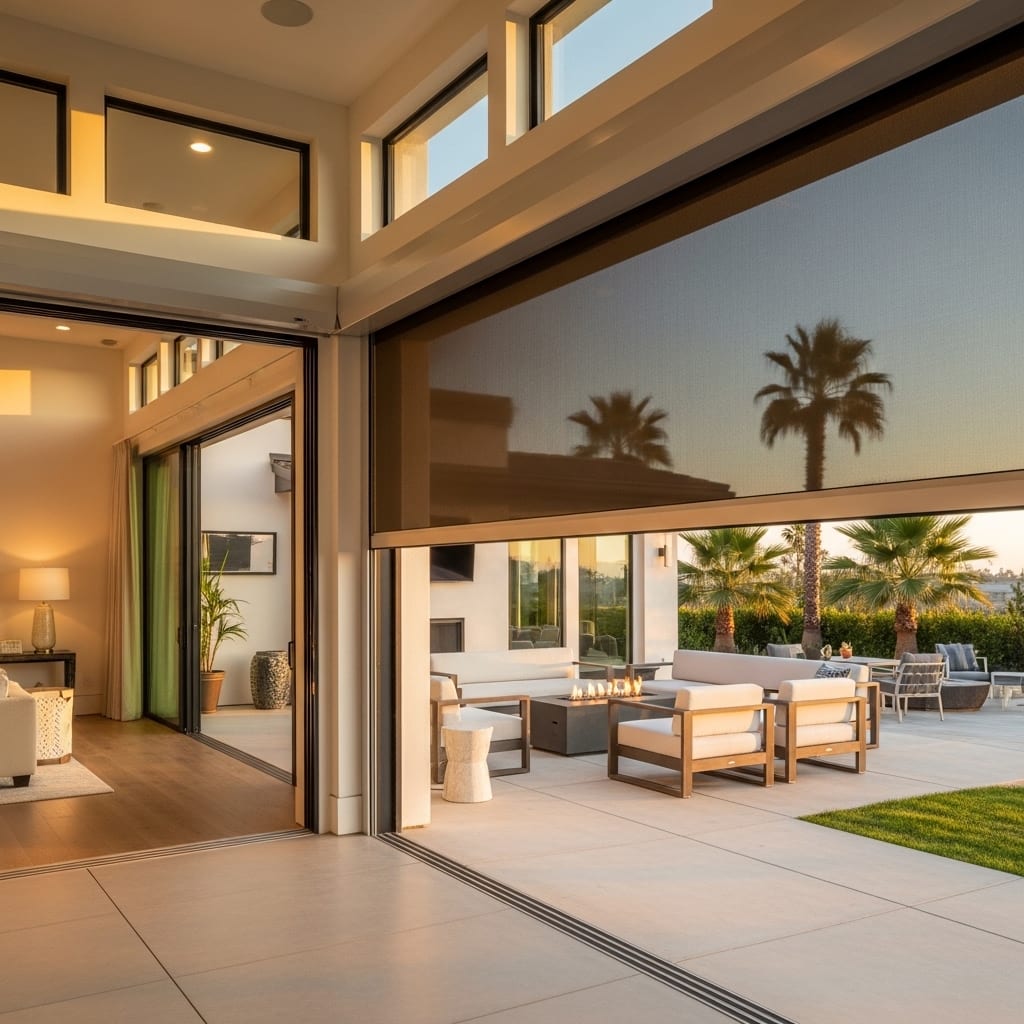
A retractable screen shares nothing with the door. Its own housing, its own track top and bottom, its own tensioning system.
The mesh stores on a roller inside a 2.5-inch aluminum housing mounted at one side of the opening. You draw the slide bar across when you want airflow; release it and spring tension takes the mesh back in. Between uses, the mesh is inside the housing rather than out in the weather.
The practical consequences are direct. Nothing to jump out of a shared track, because the track is not shared. Nothing sagging under its own weight, because the mesh is not permanently suspended in a frame. No permanent grey layer over the view. And mesh that is protected from sun and dust for the large majority of its life.
Sizes and Configurations
A standard slider takes a single screen — one unit travelling across the opening — custom-built to your measurement up to 96 inches wide and 120 inches tall.
Wider multi-panel sliders and stacking glass walls move to an oversized system, which covers openings up to 15 feet wide and 12 feet high in a single screen. A smooth-glide track with precision ball-bearing rollers keeps one-hand operation realistic even at full width.
Worth identifying which you have before collecting quotes. If one panel slides past a fixed panel, that is a single. If you have a three- or four-panel arrangement where multiple panels move, it is usually an oversized job regardless of how manageable the width sounds.
Manual or Motorized
On a normal slider, manual is the right answer and there is no reason to spend past it. The screen operates easily with one hand and spring tension does the retracting.
On a wide patio span used every evening, powered operation starts to earn itself — and wind sensors become relevant on exposed sites, retracting the screen automatically when gusts pick up. Large-opening systems start at $4,200 manual and $5,400 motorized; that trade-off is worked through in Motorized Retractable Screen Pricing.
Replacing a Failed Slider Screen: What Actually Happens
Most people arrive at this from the same place — the existing screen has failed and they want it gone rather than repaired again.
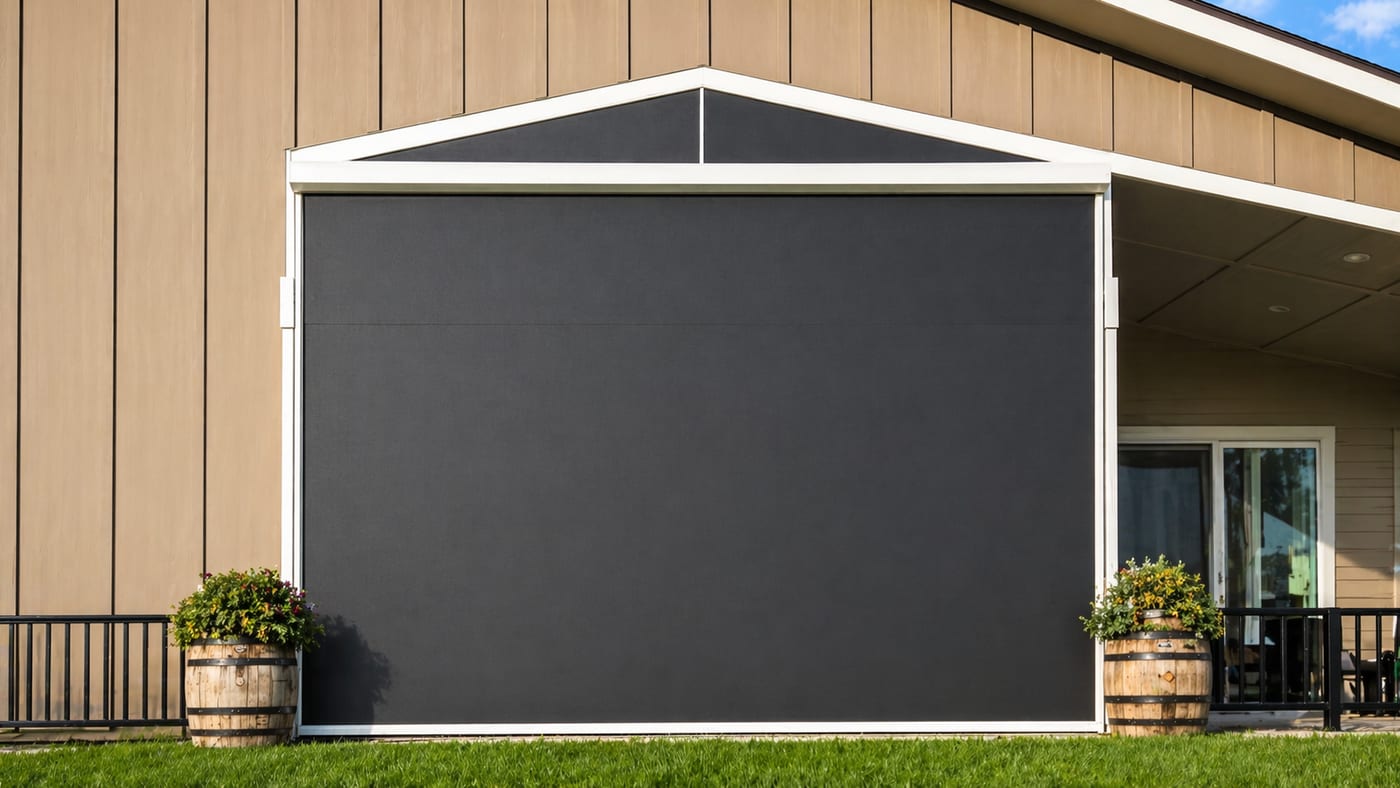
The retractable screen mounts to the existing door frame. The old screen and its track hardware come out; the new housing and tracks go on. The glass door itself is untouched, and it keeps operating exactly as before.
The measurement is what determines whether the result is any good. Four things get assessed: whether the opening is square, the frame depth available, the condition of the threshold, and where the housing can sit without interfering with the door. None of those can be established over the phone, which is why a quote without a measurement is really an estimate that gets corrected later.
Repair the Old Screen, or Replace It?
A reasonable question, and the answer depends on what has actually failed.
If a factory slider screen has torn mesh but a straight frame and sound rollers, re-screening it is cheap and buys a few more seasons. That is a legitimate outcome and worth doing.
If the frame has racked out of square, or the rollers are worn enough that the screen keeps leaving the track, re-screening does not address the cause. New mesh in a bent frame on tired rollers fails the same way, on the same timeline. That is the point at which people usually stop repairing and change the approach.
The distinction matters because the failure mode tells you which you have. Torn mesh with everything else working is a repair. Repeated jumping, binding, or a screen that no longer sits square in its channel is a frame and roller problem, and re-screening it is money spent on the symptom.
For existing Phantom retractable screens, service is straightforward: a service call is $150, and mesh repair runs $260 on a standard single or $290 on a custom 8-foot single. That is by design — the housing, track and hardware are built to outlast the mesh, so replacing mesh alone is the expected maintenance path rather than an unusual one.
Choosing Mesh for a Slider
Sliders usually face the yard, and in most southern Idaho homes that means facing south or west into direct afternoon sun.
Standard insect mesh gives the clearest view and best airflow — the right default on shaded or north-facing openings.
Solar mesh blocks a meaningful share of heat, UV and glare while keeping the outward view. On a west-facing slider it changes how usable the room behind the glass is in late afternoon through summer.
Mesh Lock, at $250 on a single, secures the mesh into the track edges against lateral pressure. On a patio slider that a dog uses as a doorway, it is the upgrade that most reliably extends the mesh's life.
What It Costs
A single sliding door screen starts at $989, including custom fabrication and professional installation. Mesh Lock adds $250. Openings roughly 96¼–120 inches tall add $200.
If a screen needs attention later, a service call is $150 and mesh repair starts at $260 — because these are built to be serviced rather than thrown away.
See What Phantom Screens Cost for every configuration, or the overview in Retractable Screens for Sliding & French Doors.
Ready for a number on your door? Request a free quote.
Starting prices are current for Phantom Screens of Twin Falls and include professional installation. Final pricing is confirmed after an in-home measurement.
Frequently Asked Questions
Can I replace my sliding door screen with a retractable one? Yes, and it is one of the most common reasons people call. The retractable screen mounts to the door frame with its own track, independent of the slider, and the glass door is untouched.
Why does my sliding screen door keep coming off the track? Factory slider screens ride in the door's own shallow channel on lightweight rollers. As the rollers wear and the frame racks slightly out of square, the screen starts jumping out. A retractable screen has a dedicated track and does not share the door's.
How much does a retractable screen for a sliding door cost? From $989 including professional installation for a standard single slider.
What about a wide multi-panel slider? Openings past 96 inches move to an oversized system covering up to 15 feet wide and 12 feet high with a single screen.
Does it work in winter? Yes. The mesh retracts into its housing when not in use, which protects it through freeze-thaw cycles and blowing dust rather than leaving it exposed all season.
Will it slow down using the door? No. The screen operates with one hand and retracts out of the way completely, so the doorway is clear when you are not using it.
Tags
Written by
Phantom Screens of Twin Falls Team
Custom retractable screen solutions for homes across Idaho and Western Wyoming.
Related Articles

Pet-Resistant Retractable Screens
What pets actually do to screens, how pet-resistant mesh and mesh retention differ, which of the two you need, and what each costs.

Screen Mesh Options Explained
Insect, solar, privacy, no-see-um, pet-resistant and clear vinyl — what each does, what it trades away, and how to match one to a specific opening.

Retractable Screens for Large & Oversized Openings
Openings past 96 inches need a different system. What covers up to 15 feet wide and 12 feet high, how spans divide, and what oversized systems cost.
Interested in Retractable Screens?
Get a free quote for custom Phantom retractable screens — motorized, door, or window screens for your home.
Get a Free Quote