Retractable Screens for Sliding & French Doors
How retractable screens work on sliding patio doors and double French doors, the sizes they cover, what they cost in southern Idaho, and how to choose between a single and a double configuration.

Sliding patio doors and French doors are the two openings homeowners most want screened and least want obstructed. They are usually the largest glass in the room and the main route out to the patio — which makes a permanently installed screen an expensive thing to look through for eleven months of the year.
A retractable screen resolves that by being present only while it is working. This guide covers how the mechanism applies to each door type, what sizes are covered, what it costs, and how to decide between configurations.
How a Retractable Screen Works on a Sliding Door
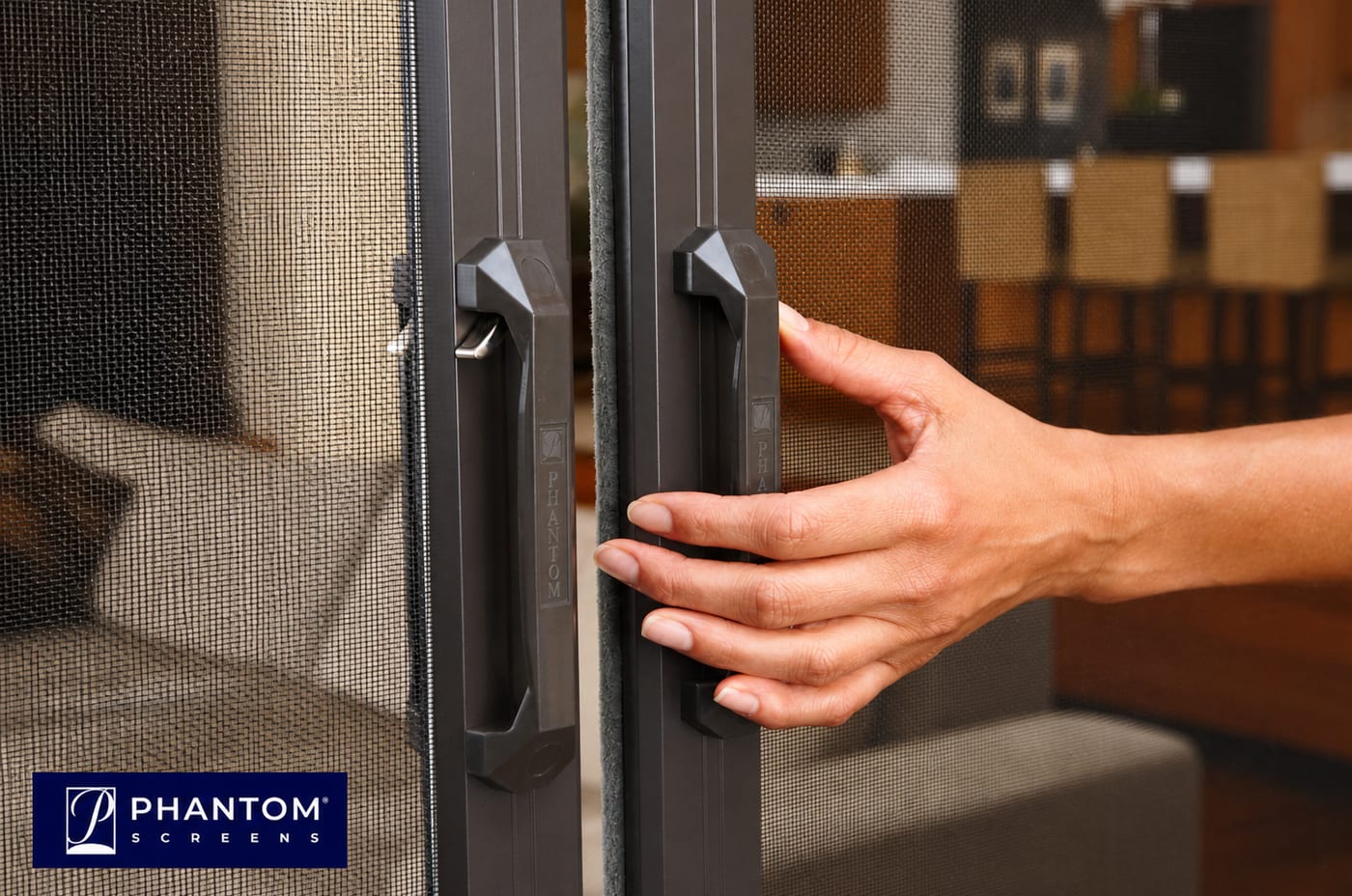
A slider needs one screen travelling across the opening. The screen mounts to the existing door frame; the mesh stores on a roller inside a slim 2.5-inch aluminum housing at one side; and a slide bar draws it across on a track running top and bottom. Release it and spring tension takes the mesh back into the housing.
This is a fundamentally different mechanism from the screen most sliders ship with. A factory slider screen rides in the same shallow track assembly as the door itself, hung on lightweight rollers, competing with a much heavier panel for the same channel. That is why it eventually sags, binds and jumps the track — the design gives it nowhere else to go.
A retractable screen shares nothing with the door. Its own track, its own tensioning, its own housing.
How It Works on French Doors
A French door pair is a double: two screens, one per leaf, meeting in the middle. Each retracts to its own side, so with both retracted the doorway is completely clear from jamb to jamb.
The centre join is the part that decides whether the installation is any good. The two halves have to meet flush and seal against each other, which means both are fabricated as a matched set and hung to tighter tolerance than two unrelated single screens would need. A gap at that join is not a cosmetic problem — it is the one place insects reliably find, and it defeats the entire purpose of the screen.
That tolerance is the work behind the price difference: a double starts at $1,949 against $989 for a single.
Swing direction matters too. French doors come in-swing and out-swing, and the screen has to sit where it never fouls the door's travel. On an out-swing pair the doors move away from the opening and the screen has clear interior travel. On an in-swing pair the doors sweep into the room, so the screen and housing must sit outside that arc. Both are workable; which approach applies depends on your frame depth and hardware, which is settled at the measurement.
Sizes: What Is Covered, and What Moves to a Bigger System
Standard retractable door screens are custom-built to your opening at widths up to 96 inches and heights up to 120 inches. That covers the overwhelming majority of residential sliders and French door pairs.
Past that, the job moves to an oversized door screen, which covers openings up to 15 feet wide and 12 feet high in a single screen. That range handles bi-fold and accordion doors, stacking glass walls, lift-and-slide systems, and multi-panel configurations — including the door systems from makers like La Cantina, NanaWall, Marvin and Pella.
Worth knowing the boundary exists, because "we can screen that" from a company that only fits standard door screens sometimes means stretching a product past what it is built for.
What It Costs
- Single slider or single door — from $989
- Double French doors — from $1,949
- Mesh Lock upgrade — $250 single, $500 double
- Openings roughly 96¼–120 inches tall — $200
Professional installation and custom fabrication are included in every one of those. The full breakdown across all configurations, including large-opening systems, is in What Phantom Screens Cost.
Choosing Mesh for a Patio Door
Patio doors face the yard, which in most southern Idaho homes means facing south or west into direct high-desert afternoon sun. That should shape the specification.
Standard insect mesh gives the clearest view and the most airflow. The right default on shaded or north-facing openings.
Solar mesh trades a little visibility to block a meaningful share of heat, UV and glare. On a west-facing slider it changes how usable the room behind it is from four o'clock onward in July, and it slows the fading that direct sun does to flooring and furniture.
No-see-um mesh uses a tighter weave to exclude the smaller insects standard mesh lets through — worth specifying near the Snake River, irrigation canals, or any standing water.
Mesh is chosen per opening, so the patio slider can run solar while the bedroom windows stay standard. It is not a whole-house decision.
The Upgrade Most Worth Taking on a Door Like This
If the door is the main route in and out — and on a patio door it usually is — Mesh Lock is the option that matters most.
A standard door screen lets the mesh float along the track. Push it sideways and it can come out of the channel: a dog's shoulder, a child running through, a gust funnelling down the canyon. Mesh Lock secures the mesh into the track edges so it resists that pressure.
At $250 on a single it is frequently the best-value line in the quote, and declining it to save $250 on a $989 screen is how people end up paying a $150 service call plus mesh repair a season or two later.
Single or Double: Which Do You Actually Have?
Straightforward in most cases, but worth checking before you get quotes.
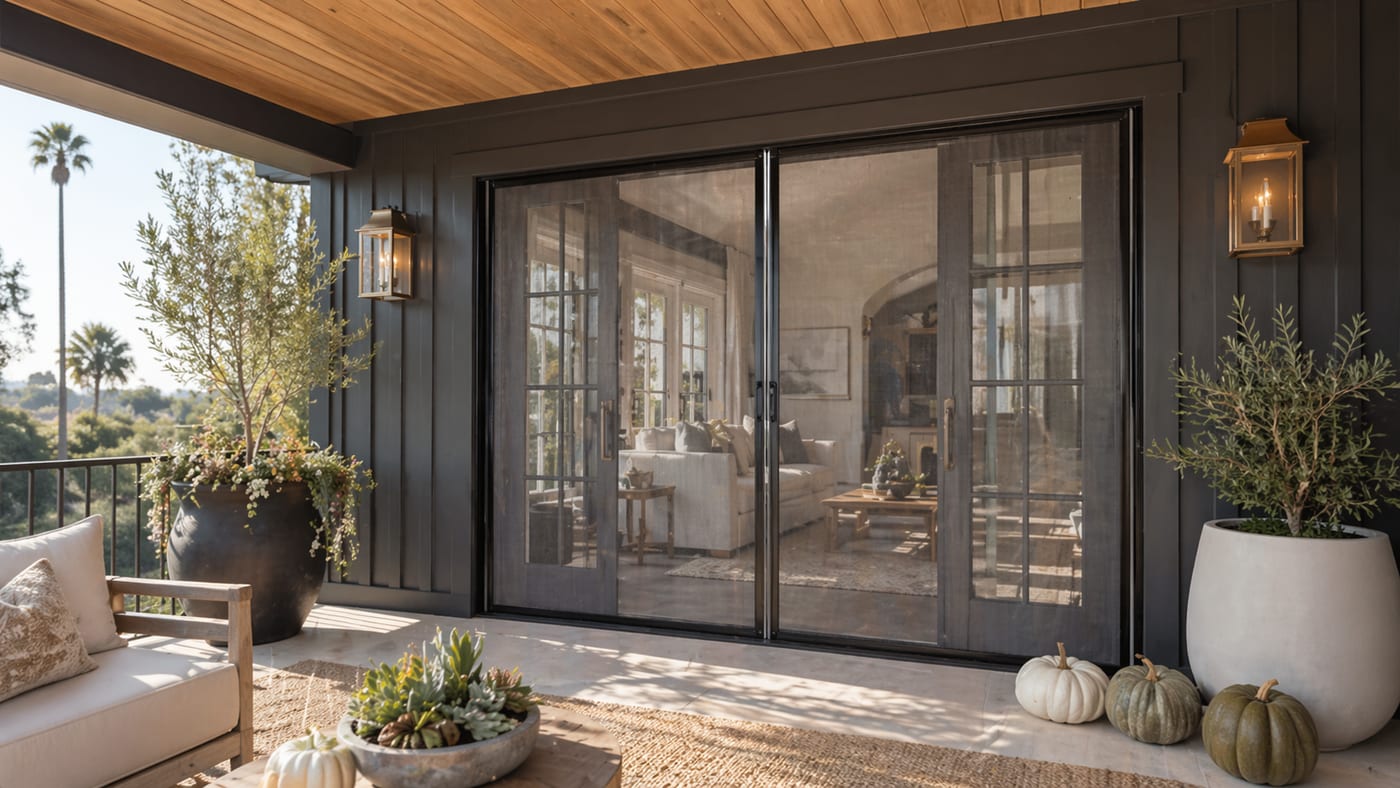
If one panel slides past a fixed panel, that is a single — one screen across the operable half. If two doors swing and meet in the middle, that is a double. If you have a three- or four-panel slider where multiple panels move, that is usually an oversized job even if the total width seems manageable.
The reason it matters is that quotes are not comparable across configurations, and a company quoting a single price for what is really a double will either revise upward later or deliver something that does not seal at the centre.
Installation: What Actually Happens
The measurement is the part that determines whether the screen works. Four things get checked and none can be assessed over the phone.
Whether the opening is square. Houses settle. Out-of-square openings are entirely normal and workable — but only when they are measured that way rather than assumed square.
Frame depth. Where there is enough depth, the housing can sit within the existing frame so nothing reads against the wall when retracted. Where there is not, a surface mount is used.
Threshold condition. The bottom track needs a clean, level run. A damaged or uneven threshold shows up months later as a screen that drags.
Hardware clearance. On French doors particularly, handles sit at the centre join — exactly where the screens meet.
Installation is included in the price, and the screen is confirmed to operate smoothly across its full range of travel before the installer leaves.
Which Door Are You Screening?
For detail on each, read French Door Screens: What to Know Before You Buy, Retractable Screens for Sliding Glass Doors, or Retractable Screens for Patio Doors. If you are comparing suppliers, Best Retractable Screens for French Doors covers what to ask.
When you want a number for your opening, request a free quote.
Starting prices are current for Phantom Screens of Twin Falls and include professional installation. Final pricing is confirmed after an in-home measurement.
Frequently Asked Questions
Can you put a retractable screen on a sliding glass door? Yes. A single retractable screen travels across the opening on its own track, entirely independent of the door. It starts at $989 including professional installation.
How do retractable screens work on French doors? A French door pair takes two screens, one per leaf, meeting in the middle and retracting to opposite sides. That configuration starts at $1,949.
What is the widest door a standard retractable screen covers? Standard door screens are built to 96 inches wide and 120 inches tall. Wider openings move to an oversized system covering up to 15 feet wide and 12 feet high in a single screen.
Will it work with an in-swing French door? Yes. In-swing and out-swing both work; the swing direction determines where the housing and track are mounted, confirmed during the on-site measurement.
Is this better than the screen my slider came with? Structurally, yes. A factory slider screen rides in the door's own shallow track on lightweight rollers, which is why it sags and jumps out. A retractable screen has a dedicated track, its own tensioning, and stores in a housing when not in use.
Does the screen block the view when retracted? No. Retracted, the mesh sits fully inside a 2.5-inch housing and the doorway is unobstructed.
Can I screen a three-panel slider? Yes, though multi-panel sliders usually move to an oversized system rather than a standard door screen, depending on total width and how many panels operate.
Tags
Written by
Phantom Screens of Twin Falls Team
Custom retractable screen solutions for homes across Idaho and Western Wyoming.
Related Articles

Pet-Resistant Retractable Screens
What pets actually do to screens, how pet-resistant mesh and mesh retention differ, which of the two you need, and what each costs.
Screen Mesh Options Explained
Insect, solar, privacy, no-see-um, pet-resistant and clear vinyl — what each does, what it trades away, and how to match one to a specific opening.

Retractable Screens for Large & Oversized Openings
Openings past 96 inches need a different system. What covers up to 15 feet wide and 12 feet high, how spans divide, and what oversized systems cost.
Interested in Retractable Screens?
Get a free quote for custom Phantom retractable screens — motorized, door, or window screens for your home.
Get a Free Quote