How Do Retractable Screen Doors Work?
The mechanism explained — how spring tension, guide tracks and the housing work together, what keeps the mesh flat, and why installation decides how well it runs.

The mechanism is simpler than most people expect, and understanding it explains almost everything about how these screens behave — including why fitting matters so much and why the common problems happen.
The Basic Principle
A retractable screen is a fabric wound onto a spring-loaded roller, held flat across an opening by tension between that roller and a pair of guide tracks.
Pull the mesh out and the spring winds tighter, storing energy. Let it go and that energy pulls the mesh back in. It is the same principle as a roller blind, adapted to run horizontally and to hold a much larger span of fabric flat rather than letting it hang.
The difference between a screen that works well and one that does not is almost entirely about how well that tension is matched to the specific opening.
The Housing and Roller
The housing is a slim aluminum casing — around two and a half inches deep — mounted at one side of the doorway. Inside it sits the roller: a tube containing a spring, with the mesh wound around it.
The housing does two jobs. It contains the mechanism, and it protects the stored mesh from sun, dust and weather whenever the screen is not deployed. That second job is why retractable mesh outlasts fixed screen mesh, and it matters a great deal in a climate with intense summer UV and blowing dust.
The Guide Tracks
Two tracks run along the top and bottom of the opening. As the mesh is drawn across, its edges run within these tracks, which hold it flat and stop it billowing or lifting.
The tracks are what turn a piece of loose fabric into a taut screen. Without them the mesh would simply hang and flap.
They are also where most operating problems originate. A track with grit in it creates resistance; a track slightly out of alignment causes binding; a track that is not level makes the screen sit unevenly. That is why the bottom track is the thing worth keeping clear, and why threshold condition gets checked before installation.
The Slide Bar and Latch
The slide bar is the vertical member at the leading edge of the mesh. You draw it across, it travels along the tracks, and at the far side it latches to hold the screen deployed.
To retract, you release the latch and let the bar travel back under spring tension. The correct technique is to let it return in a controlled way rather than releasing it and letting it snap — repeatedly snapping it back puts uneven load into the roller over years.
Why Tension Is the Critical Variable
Tension has to be right for the specific opening, and "right" is a range rather than a number.
Too little and the mesh sags, wrinkles, tracks unevenly and can pull out of the side channels under pressure.
Too much and operation becomes stiff, the roller carries more load than intended, and wear accelerates.
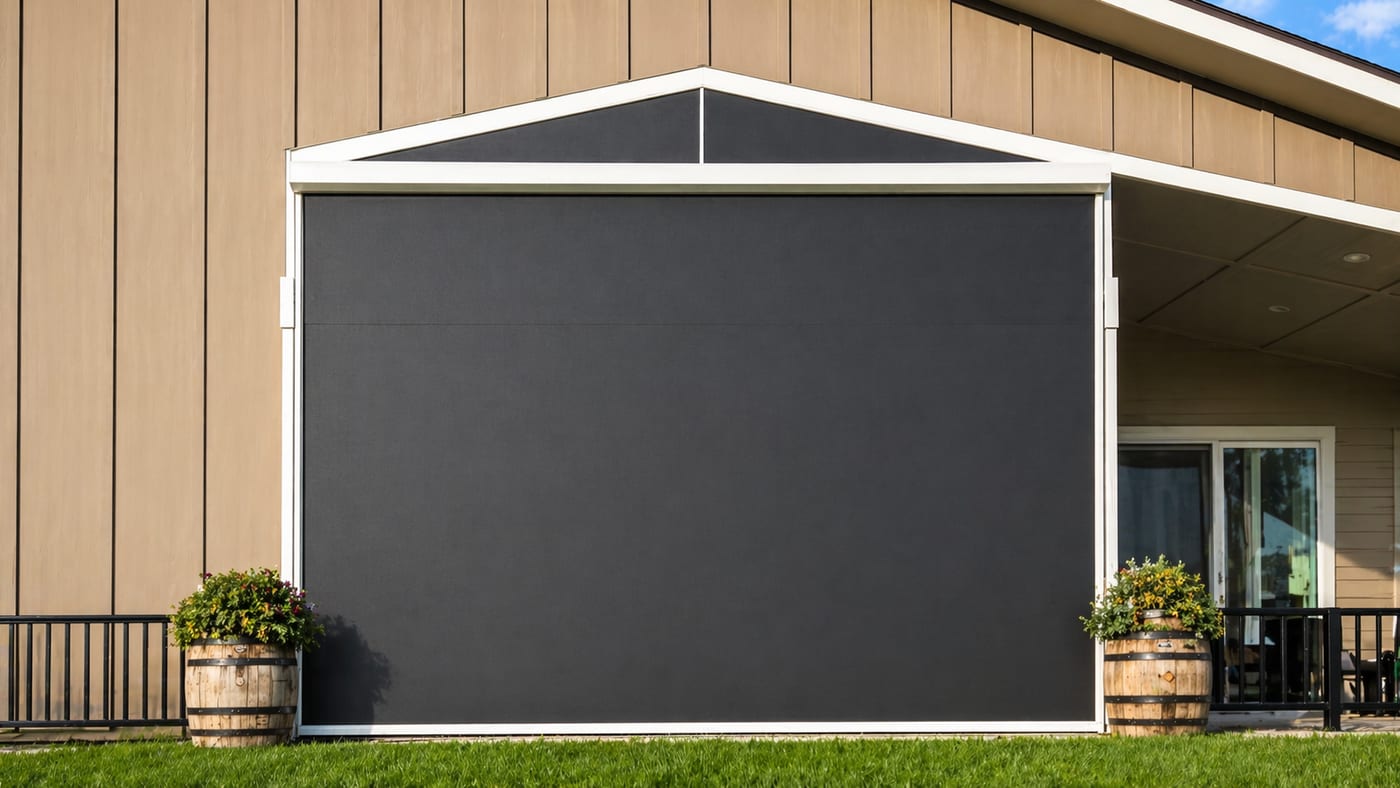
Correct tension depends on the width and height of the opening, which is one of several reasons these are custom-built rather than sold in stock sizes. On motorized systems, self-adjusting tension technology maintains it through every cycle — covered in Sure Fit Motorized Screens Explained.

How Double Screens Work
On a French door pair, two screens work together — one per leaf, each with its own housing at the outer edge, drawing inward to meet in the middle.
The centre join is the demanding part. Both halves have to meet flush and seal against each other, which requires them to be built as a matched set and hung to tighter tolerance than two independent screens would need. A gap at that join is where insects get through, which defeats the purpose.
How Motorized Systems Differ
The principle is identical; the difference is what drives the roller.
On a motorized system, a motor inside the roller tube turns it, lowering the screen down side tracks and raising it back. Because the motor sits inside the tube, a motorized screen looks essentially the same as a manual one.
What changes practically is that the track is built for repeated powered travel, and that sensors become possible — a wind sensor retracting the screen automatically when gusts pick up is the most useful of them in this region.
Why Installation Decides How Well It Runs
Everything above assumes the screen is fitted to an opening that is square, with tracks aligned and tension set correctly. Real openings are rarely square, particularly in older homes that have settled.
That is the actual work: fitting a precision assembly to an imperfect opening at a tension calibrated for it, with tracks aligned closely enough that the screen runs cleanly across its full travel.
Get it right and the screen runs smoothly for years. Get it wrong and it binds partway, fails to seat at the bottom, or wrinkles because the tension is off — none dramatic, all annoying on a door you use daily. More on that in Retractable Screen Door Installation.
Why the Mesh Outlasts a Fixed Screen
This follows directly from the mechanism, and it is the most underrated consequence of the design.
Screen mesh degrades from two things: ultraviolet light, which makes the fibres brittle until they tear at the edges where tension is highest, and abrasion from wind-borne grit, which wears the weave.
A fixed screen sits in the opening absorbing both, every daylight hour of every day, all year. A retractable screen absorbs them only while deployed — perhaps a few hours a day, a few months a year. The rest of the time the mesh is rolled up inside an aluminum housing.
In southern Idaho that difference is amplified. Summers deliver long, intense UV, and blowing dust is a constant. A screen that spends the majority of its life stored is simply not accumulating the exposure that ends a fixed screen's usable life.
It is also why the mesh is treated as the serviceable component while the structure carries a limited lifetime component warranty — the housing, tracks and hardware are engineered to outlast multiple mesh cycles.
What Goes Wrong, and Why
Knowing the mechanism makes the common faults obvious.
Dragging is nearly always grit in the bottom track creating resistance.
Not retracting fully is usually tension, or mesh that has come out of a side track and is catching.
Mesh coming out of the track happens when lateral pressure pushes it out of the channel — which is what mesh retention prevents.
Stiff operation is track contamination, tension, or roller wear on an older system.
Covered in Retractable Screen Door Repair.
What They Cost
A single retractable door screen starts at $989 installed, a double French pair at $1,949, and large-opening systems at $4,200 manual or $5,400 motorized. Full pricing is in What Phantom Screens Cost.
Next Steps
For a plainer overview, read What Is a Retractable Screen Door? Request a free quote for a number on your opening.
Starting prices are current for Phantom Screens of Twin Falls and include professional installation. Final pricing is confirmed after an in-home measurement.
Frequently Asked Questions
How do retractable screen doors work? The mesh winds onto a spring-loaded roller inside a slim housing. You draw it across using a slide bar, guide tracks top and bottom hold it flat, and spring tension retracts it into the housing when released.
What holds the screen flat when it is out? Guide tracks along the top and bottom of the opening, combined with the tension between them and the roller.
Why does tension matter so much? Too little and the mesh sags and can pull out of the tracks; too much and operation stiffens and wear accelerates. Correct tension depends on the specific opening size.
Do they close by themselves? Spring tension retracts the screen when you release the latch. It should be allowed to travel back in a controlled way rather than snapping.
How do motorized ones differ? A motor inside the roller tube drives it instead of spring tension alone, and the track is built for repeated powered travel. Sensors also become possible, including automatic wind retraction.
Why does my screen drag along the bottom? Almost always grit in the bottom track. Clearing the channel resolves most cases.
Tags
Written by
Phantom Screens of Twin Falls Team
Custom retractable screen solutions for homes across Idaho and Western Wyoming.
Related Articles

Pet-Resistant Retractable Screens
What pets actually do to screens, how pet-resistant mesh and mesh retention differ, which of the two you need, and what each costs.

Screen Mesh Options Explained
Insect, solar, privacy, no-see-um, pet-resistant and clear vinyl — what each does, what it trades away, and how to match one to a specific opening.

Retractable Screens for Large & Oversized Openings
Openings past 96 inches need a different system. What covers up to 15 feet wide and 12 feet high, how spans divide, and what oversized systems cost.
Interested in Retractable Screens?
Get a free quote for custom Phantom retractable screens — motorized, door, or window screens for your home.
Get a Free Quote