What Is a Retractable Screen Door?
A plain explanation of what a retractable screen door is, how it differs from a hinged or sliding screen, which doors it fits, and what one costs.

A retractable screen door is a screen that is only there when you need it. The mesh stores on a roller inside a slim housing at the edge of the doorway, pulls across when you want airflow without insects, and rolls back out of sight when you do not.
That is the whole idea. Everything else follows from it.
How It Differs From the Screens You Already Know
Most people have used two kinds of screen door, and a retractable is neither.
A hinged screen door swings on hinges in front of your real door. It is permanently there, permanently visible, and takes up space in the doorway whether you want a screen that day or not.
A sliding screen door rides in the same track as a patio slider. It is also permanently in the opening, and because it shares the door's shallow track on lightweight rollers, it is the one that eventually sags and jumps out.
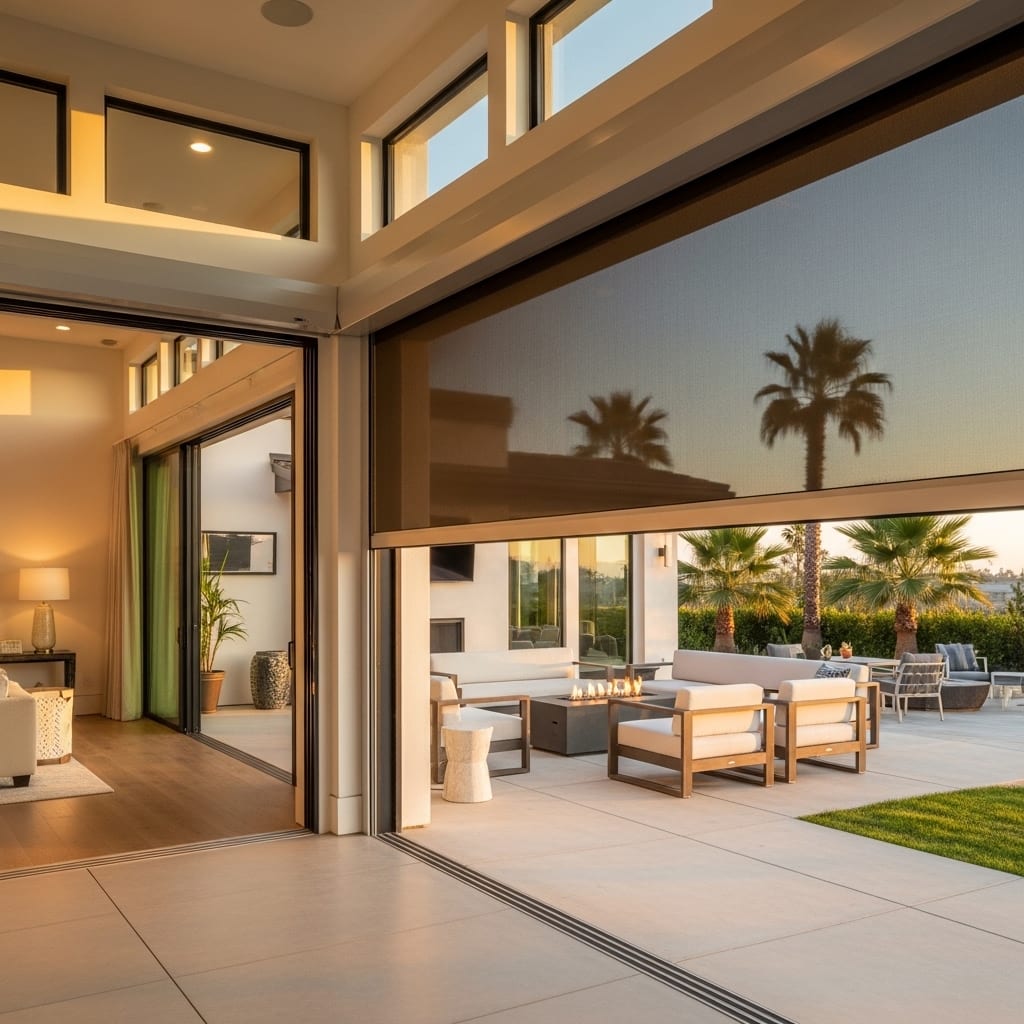
A retractable screen is stored rather than parked. When retracted, the mesh is fully inside a housing roughly two and a half inches deep, and the doorway is completely clear — no frame, no mesh, nothing to look through.
The Parts
Four components, and knowing them makes everything else easier to follow.
The housing is the slim aluminum casing that holds the roller and the stored mesh, mounted at one side of the opening (or at the top on large systems).
The roller is the spring-loaded tube the mesh winds onto. Spring tension is what pulls the screen back in.
The tracks run along the top and bottom of the opening and hold the mesh taut and straight when it is deployed.
The slide bar is the vertical handle at the leading edge of the mesh — what you actually touch to draw the screen across.
How You Use One
You draw the slide bar across the opening until it meets the other side, where it latches. The mesh is now held flat between the top and bottom tracks, and the doorway is screened.
To put it away, you release the latch and let the slide bar travel back — controlled, not snapped — and the spring tension winds the mesh back into the housing.
The whole operation takes a couple of seconds with one hand. On very large openings a motor does it instead, driven by a remote, wall switch, app or voice command.
Which Doors They Fit
Single entry doors, back doors, sliding patio doors, and double French doors. A French pair takes two screens — one per leaf, meeting in the middle.
Standard door screens are custom-built to your opening at widths up to 96 inches and heights up to 120 inches. Larger openings — bi-fold doors, stacking glass walls, wide covered patios — move to an oversized system covering up to 15 feet wide and 12 feet high in a single screen.
They are also made for windows, in sizes from roughly 13.25 to 84 inches wide.
What the Mesh Does
The mesh is chosen per opening, and it determines what the screen actually accomplishes beyond keeping bugs out.
Standard insect mesh gives maximum airflow and the clearest view. The default for most doors.
Solar mesh blocks a significant share of heat, UV and glare — worth it on south- and west-facing openings.
Privacy mesh screens the space from outside during daylight while keeping your view out.
No-see-um mesh uses a tighter weave to stop the smaller insects that pass through standard mesh.
Where the Housing Sits
One detail that affects how the finished installation looks, and it is worth knowing the two options exist.
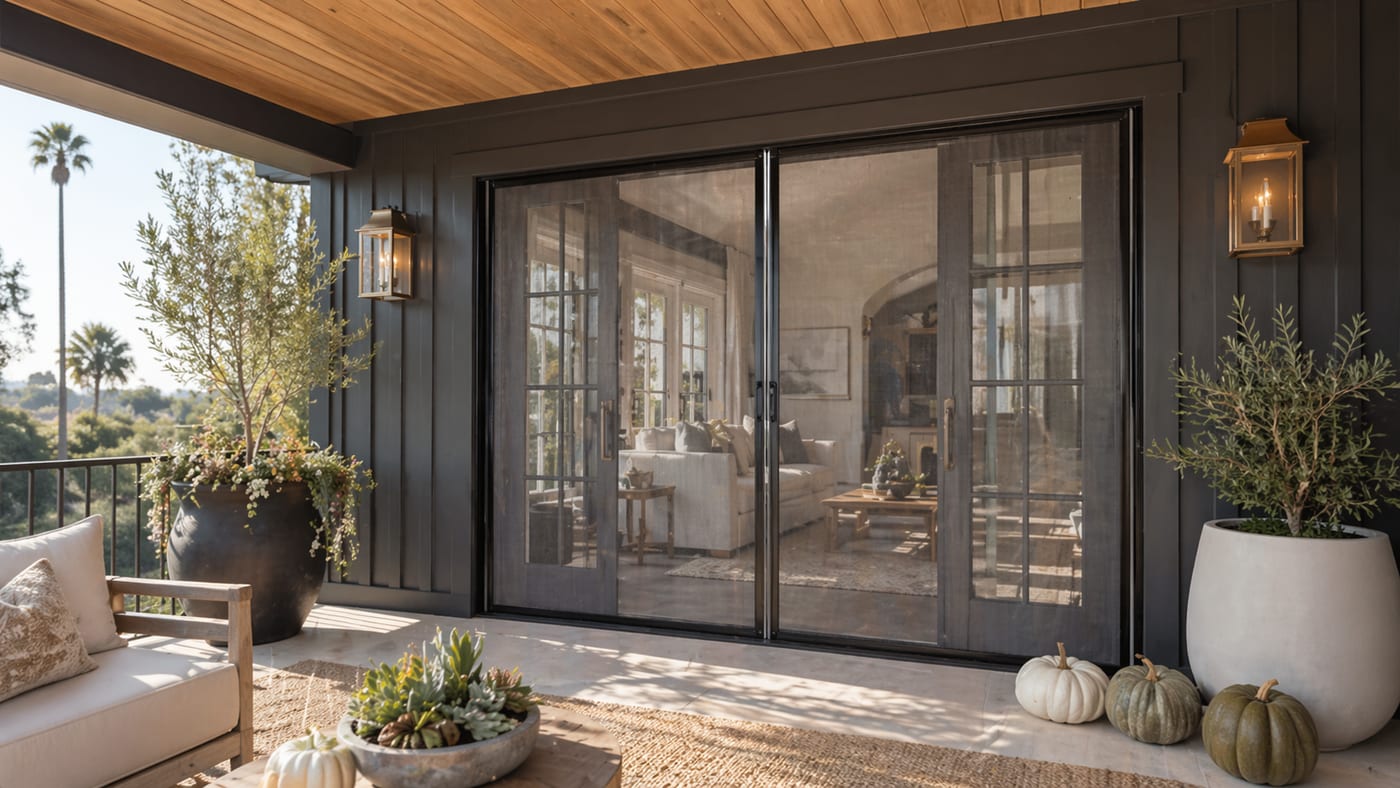
An in-jamb installation fits the housing within the existing frame depth, so nothing reads against the wall when the screen is retracted. On a door you look at every day, this is the cleaner result and it is the default wherever the frame allows it.
A surface mount attaches the housing to the face of the wall alongside the frame. This is used where frame depth is insufficient — common on older doors and on some replacement units with shallow jambs.
Which applies is established by measuring the frame rather than assumed, because the difference is visible and permanent.
What They Are Not
Worth setting expectations plainly, since these get oversold.
A retractable screen is not a security product. It keeps insects out and lets air in. It is not a barrier and should never be treated as one.
It is not insulation. Solar mesh meaningfully reduces heat and glare coming through an opening, but it is not glazing and will not perform like it.
And on a window, no screen of any kind is a fall barrier. That applies equally to conventional and retractable screens, and it matters most on upper-floor windows.
Why People Choose Them
Three reasons come up consistently.
The view. On a door with glass worth looking through, a permanent screen greys it year-round. A retractable one is only there while it is working.
The mesh lasts longer. Because it is stored inside a housing rather than exposed permanently, it accumulates far less UV damage and dust abrasion. In a high-desert climate with long summers and blowing dust, that difference is substantial.
They fit openings fixed screens cannot. Past a certain width, a fixed screen is not a product that exists in usable form. Retractable systems cover spans up to 15 feet.
What They Cost
A single retractable door screen starts at $989 installed. A double French configuration starts at $1,949. Large-opening systems start at $4,200 manual or $5,400 motorized.
Those prices include custom fabrication to your measured opening and professional installation, plus a limited lifetime warranty on components, 7 years on motors and 24 months on labor. Screen mesh is not covered under the component warranty, but it can always be repaired or replaced.
Full detail is in What Phantom Screens Cost.
How Long They Last
Two different answers, because the product has two different lifespans built into it deliberately.
The structure — the extruded aluminum housing, the tracks, the hardware — is engineered to outlast multiple mesh cycles. That is why it carries a limited lifetime warranty on components, with 7 years on motors for powered systems.
The mesh is the consumable part. How long it lasts depends on exposure and use rather than a fixed timetable: a south-facing door deployed daily through summer works its mesh considerably harder than a shaded side entry used occasionally.
When the mesh does reach the end of its life, it is replaced on its own. The housing, tracks and any motor stay exactly where they are — a service appointment rather than a reinstallation. Mesh repair runs $260 on a standard single.
That split is the design stated plainly, and it is worth reading correctly: mesh being excluded from the component warranty is not a gap in coverage, it is the manufacturer identifying which part is structural and which is serviceable.
Are They Worth It?
They cost more than a fixed screen, so it depends on the opening.
On a door you use daily, with a view worth keeping and real sun or wind exposure, they generally are. On a rarely-opened utility door with nothing to look at, a conventional screen is the honest recommendation.
That question is worked through properly in Are Retractable Screens Worth It?
Next Steps
For the mechanism in more detail, read How Do Retractable Screen Doors Work? For specific door types, see Retractable Screens for Sliding & French Doors, or browse door screens.
Request a free quote — measurement and consultation are free.
Starting prices are current for Phantom Screens of Twin Falls and include professional installation. Final pricing is confirmed after an in-home measurement.
Frequently Asked Questions
What is a retractable screen door? A screen whose mesh stores on a roller inside a slim housing at the edge of the doorway. You draw it across when you want airflow without insects, and it rolls back out of sight when you do not.
How is it different from a regular screen door? A hinged or sliding screen is permanently in the opening. A retractable screen is stored in its housing when not deployed, leaving the doorway completely clear.
Do they block the view? Only while deployed, and standard insect mesh keeps the outward view clear. Retracted, there is nothing across the opening at all.
What doors do they fit? Single entry doors, back doors, sliding patio doors and double French doors, at widths up to 96 inches and heights to 120 inches. Larger openings use an oversized system covering up to 15 feet wide.
How much does one cost? A single door screen starts at $989 installed, a French pair at $1,949, and large-opening systems at $4,200 manual or $5,400 motorized.
Are they hard to use? No. You draw the slide bar across with one hand and release it to retract. It takes a couple of seconds.
Do they need much maintenance? Very little. Keep the bottom track clear of grit and clean the mesh occasionally with mild soap and water.
Tags
Written by
Phantom Screens of Twin Falls Team
Custom retractable screen solutions for homes across Idaho and Western Wyoming.
Related Articles

Pet-Resistant Retractable Screens
What pets actually do to screens, how pet-resistant mesh and mesh retention differ, which of the two you need, and what each costs.

Screen Mesh Options Explained
Insect, solar, privacy, no-see-um, pet-resistant and clear vinyl — what each does, what it trades away, and how to match one to a specific opening.

Retractable Screens for Large & Oversized Openings
Openings past 96 inches need a different system. What covers up to 15 feet wide and 12 feet high, how spans divide, and what oversized systems cost.
Interested in Retractable Screens?
Get a free quote for custom Phantom retractable screens — motorized, door, or window screens for your home.
Get a Free Quote