Retractable Deck Screens
Screening a deck is a different problem from screening a patio, because most decks have nothing overhead to mount to. What is possible, what has to be added first, and what it costs.

Deck screening is the request where the honest answer most often starts with a question about the structure. Not because decks cannot be screened, but because the majority of them are missing the one thing a retractable screen requires.
The Requirement Most Decks Do Not Meet
A retractable screen mounts its housing at the top of an opening and runs side tracks down each edge. That means it needs something solid overhead to fix to, and something vertical at each side.
An open deck has neither. Railings are not structural in the way a side track needs, and there is nothing above at all. So the first question on any deck project is what exists overhead.
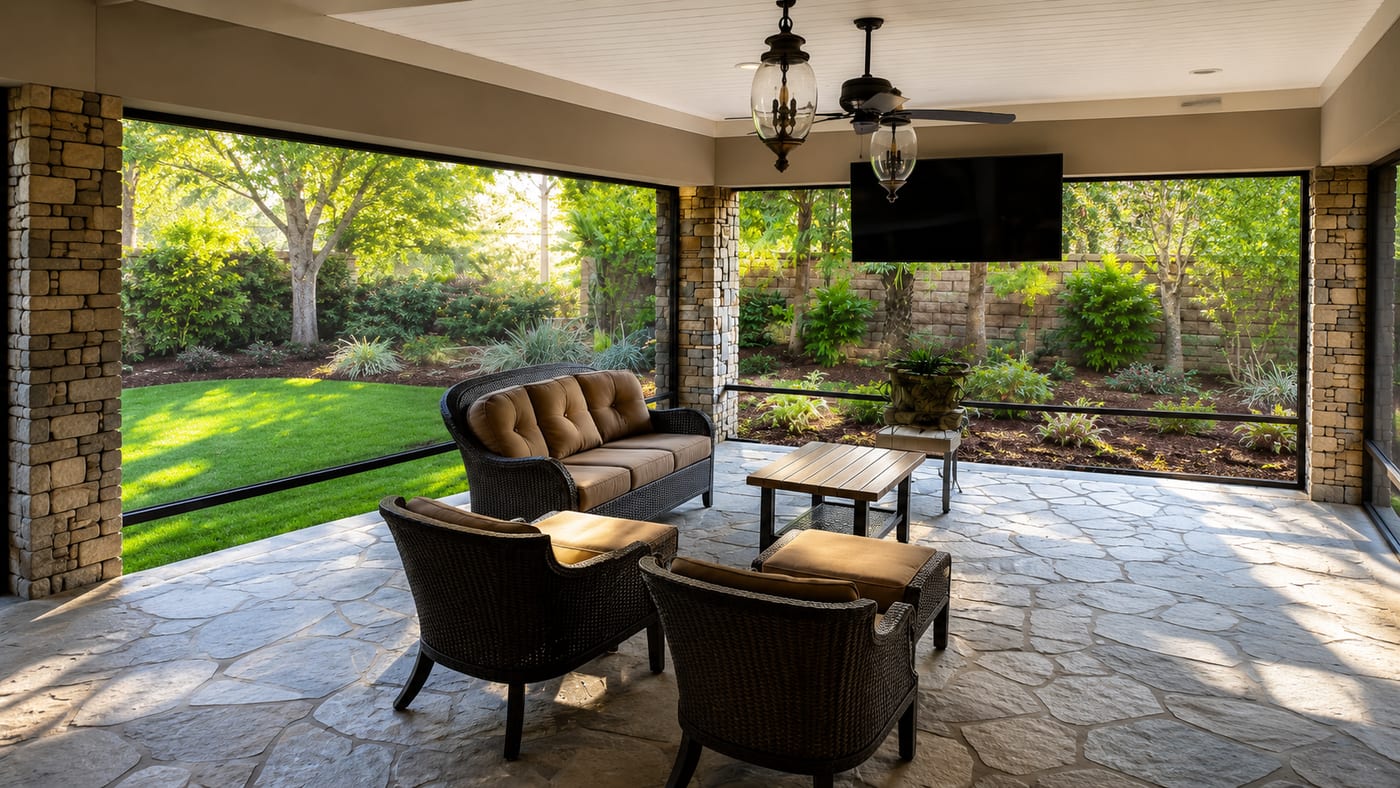
A covered deck — roofed, with posts — is effectively a patio raised off the ground, and screens it exactly the same way.
A deck under a balcony, upper deck or roof overhang often works, because there is structure above to mount to. What gets checked is whether that structure is sound and continuous enough along the run.
An open deck needs overhead structure added before any screen goes in. That is a construction project, not a screen installation.
Adding Structure: What That Usually Means
If the deck is open and you want it screened, something has to be built. Three approaches are common, and they differ in cost and in what they leave you with.
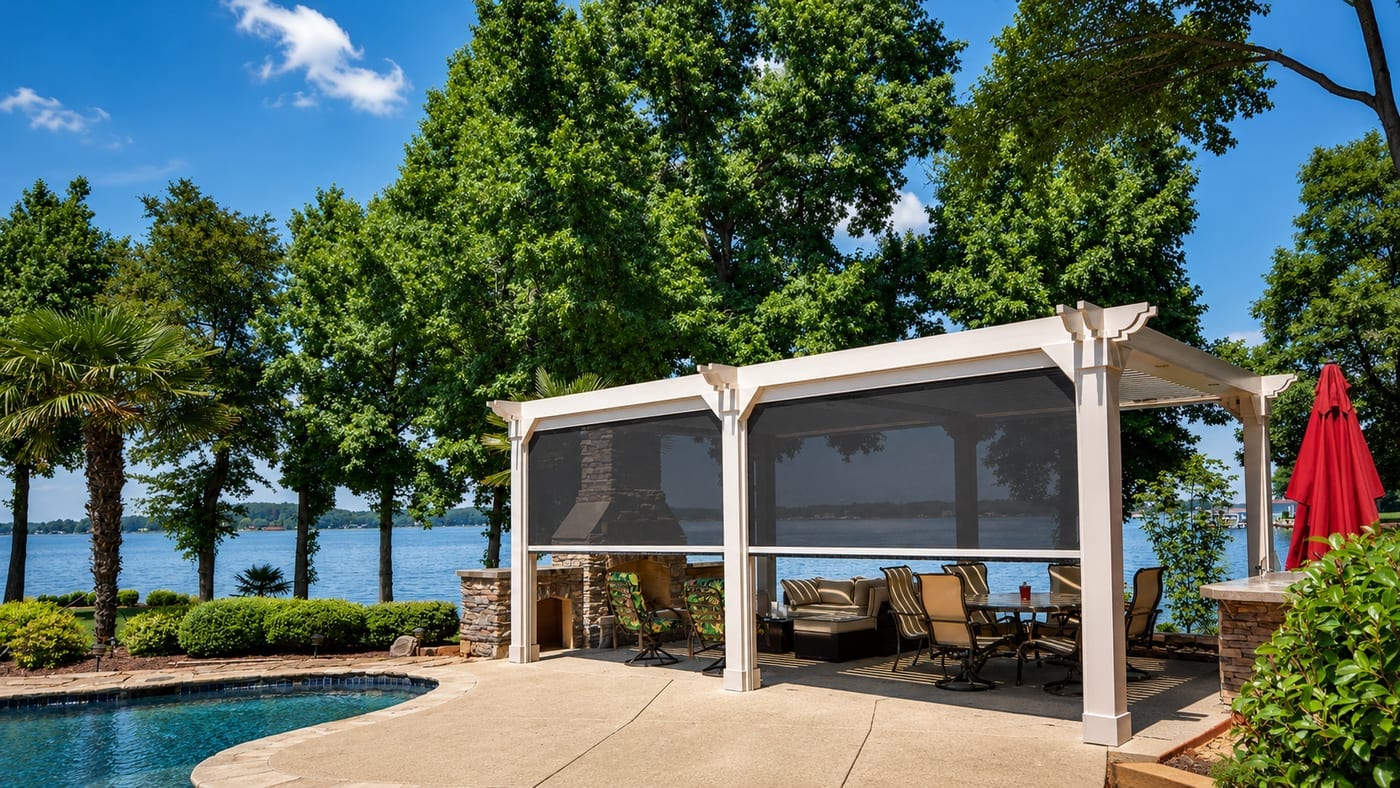
A pergola over the deck. Posts and beams give the screens something to mount to, and the slatted top filters sun. This is the lightest option and often the least expensive, but it leaves an open top — which limits how insect-free the space can become. Details in Retractable Screens for Pergolas.
A solid roof over the deck. More work and more cost, but it produces a genuinely covered outdoor room and lets screens do their full job. This is the option that most reliably delivers what people picture when they imagine a screened deck.
An awning or canopy structure. Sits between the two. Whether it can carry screens depends entirely on how it is built, and retractable fabric awnings generally cannot.
None of that construction is screen work, and it is worth pricing separately with a contractor before assuming a screened deck is a screen-sized project.
What Screens Do for a Covered Deck
Where the structure is already there, a deck gains the same things a patio does, with one difference worth noting: decks are usually more exposed.
A deck is often raised, frequently on the side of the house with the view, and typically has less around it to break wind. That makes the wind conversation more central than it is on a ground-level patio tucked against the building.
Solar mesh handles low afternoon sun, which hits raised decks hard because there is rarely anything to the west blocking it.
Standard insect mesh handles the evening bug problem, which on decks near water — along the Snake River corridor, near canals or ponds — is the reason people stop using the space in July.
Clear vinyl blocks wind and holds warmth. On an exposed deck this extends the usable season more noticeably than it does on a sheltered patio, precisely because there is less natural shelter to start with.
Wind on a Raised Deck
This deserves its own consideration, because raised decks are the most exposed places these systems get installed.
A deployed screen is a large surface, and on an elevated deck it catches wind that a ground-level patio would be partly sheltered from. Every large-opening screen is designed to be retracted in high wind — the question is whether someone will be there to do it.
A wind sensor on a motorized system retracts the screen automatically when gusts reach a threshold. On a raised, exposed deck, that is the single strongest argument for choosing motorized at $5,400 over manual at $4,200.
The Space Underneath a Raised Deck
Worth mentioning because it is frequently overlooked and often the better opportunity.
A raised deck creates a covered area beneath it. On homes where the deck sits a full storey up, that ground-level space already has everything a retractable screen needs — the deck itself is the roof, and the support posts give the side tracks something to run down.
In other words, the under-deck space is frequently easier to screen than the deck above it, and it is already sheltered from sun and rain. Where the underside has been finished with a drainage ceiling, it behaves much like a covered patio.
It is also more sheltered from wind by definition, being at grade and enclosed on at least one side by the house. That makes manual systems more viable down there than on the exposed deck above, which changes the cost.
If you have been looking at an open upper deck and concluding that screening means building a roof, it is worth having someone look at what is already underneath.
Planning a Deck You Have Not Built Yet
If the deck is still at the drawing stage, screens are considerably cheaper to accommodate now than to retrofit later.
Two things make the difference. Post spacing determines how the span divides — posts at or under 15-foot intervals mean each bay takes a single screen, while awkward spacing forces additional screens or intermediate posts added afterwards. And a header sized to carry a screen housing from the outset avoids reinforcing work later.
Neither adds meaningful cost during construction. Both are expensive to correct once the deck is finished.
Railings, Gaps and Realistic Expectations
One detail specific to decks. A screen runs from the housing down to the deck surface, and where it meets a railing there can be a gap around the rail structure.
On most installations this is handled by running the screen outside or inside the railing line so it lands cleanly on the deck. What it means practically is that the railing configuration is part of the measurement, and an unusual railing may affect how the screen is positioned.
It is worth raising during the assessment rather than discovering afterwards, because a screen that lands awkwardly against a rail is both less effective against insects and more prone to wear at the contact point.
What It Costs
Where the structure exists, deck screens are large-opening systems priced like any other: from $4,200 manual and $5,400 motorized per screen, installed, with custom fabrication and the warranty included.
A single screen covers up to 15 feet wide and 12 feet high. Wider decks are divided at posts, with a screen per bay, and priced per screen.
Any structural work to make an open deck screenable is separate and is not part of the screen quote.
Full pricing is in What Phantom Screens Cost.
Next Steps
If your deck is already covered, Screening a Covered Patio is the closest guide to your situation. For the broader overview, see Retractable Screens for Patios & Porches.
Request a free quote and a specialist will tell you honestly whether your deck is ready for screens or needs structure first.
Starting prices are current for Phantom Screens of Twin Falls and include professional installation. Final pricing is confirmed after an in-home measurement.
Frequently Asked Questions
Can you put retractable screens on a deck? If the deck is covered — by a roof, an upper deck, or a substantial overhang — yes, and it works the same as a patio. An open deck with nothing overhead needs structure added first.
What does it cost to screen a deck? Where the structure exists, from $4,200 manual and $5,400 motorized per screen, installed. Any construction to add overhead structure is separate.
Can I screen a deck with just railings? No. A retractable screen needs something solid overhead to mount the housing to. Railings alone do not provide that.
Would a pergola over the deck be enough? It gives the screens something to mount to, which makes the installation possible. The open top limits how insect-free the space can be, so it depends on what you are solving for.
Are raised decks harder to screen? Not structurally, if they are covered. But they are usually more exposed to wind, which makes a motorized system with a wind sensor a stronger recommendation than it would be at ground level.
How wide a deck can be screened? A single screen covers up to 15 feet wide. Wider decks are divided at the posts with a screen per bay.
Tags
Written by
Phantom Screens of Twin Falls Team
Custom retractable screen solutions for homes across Idaho and Western Wyoming.
Related Articles
Pet-Resistant Retractable Screens
What pets actually do to screens, how pet-resistant mesh and mesh retention differ, which of the two you need, and what each costs.

Screen Mesh Options Explained
Insect, solar, privacy, no-see-um, pet-resistant and clear vinyl — what each does, what it trades away, and how to match one to a specific opening.

Retractable Screens for Large & Oversized Openings
Openings past 96 inches need a different system. What covers up to 15 feet wide and 12 feet high, how spans divide, and what oversized systems cost.
Interested in Retractable Screens?
Get a free quote for custom Phantom retractable screens — motorized, door, or window screens for your home.
Get a Free Quote