Retractable Screens for Pergolas
Pergolas are harder to screen than covered patios, and the reason is structural. What a pergola needs to carry a retractable screen, what changes with a slatted roof, and what it costs.

Pergolas are one of the most common things people want screened and one of the more involved to screen properly. The difficulty is not the screen. It is the structure.
Here is what a pergola needs to carry a retractable system, what a slatted roof changes, and how to work out whether yours is a candidate.
Why a Pergola Is Different
A covered patio gives a screen everything it needs: a solid header to mount to, posts to track down, and a roof that keeps weather off the top.
A pergola gives you two of those three. The posts and beams are usually there. The roof is not — a slatted or open-top pergola is a sun filter, not a weather barrier.
That matters in two ways. Structurally, a pergola is often built lighter than a roofed structure because it was never designed to carry a roof load, and a screen adds load along the top beam. Practically, screening the sides of a structure with an open top gives you an insect-resistant space with a permeable ceiling — which does less than people expect if bugs are the whole reason for the project.
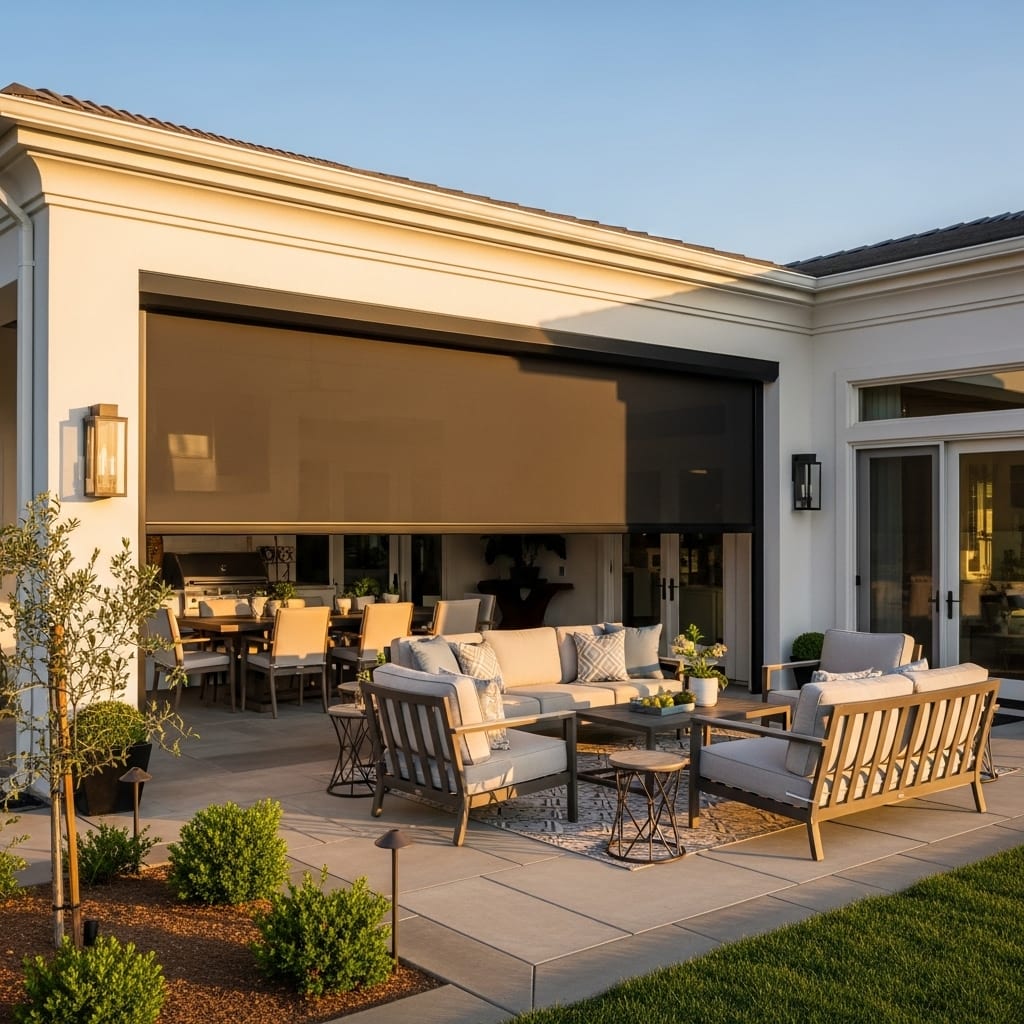
What Gets Assessed
Four things determine whether a pergola can take a screen, and all four are checked on site.
Beam adequacy. The top beam carries the housing and the load of a deployed screen. Whether it is sized for that depends on how the pergola was built — kit pergolas and lighter custom builds vary considerably.
Post stability. Side tracks run down the posts, and the screen's tension pulls against them. Freestanding pergolas are more affected here than attached ones, because there is no building providing lateral stiffness on one side.
Span between posts. A single screen covers up to 15 feet. Wider bays need dividing, and a pergola may not have posts where the division needs to be.
Whether it is square and plumb. Outdoor structures move with the seasons, particularly through freeze-thaw cycles. Screens are built to the opening as measured, but significant racking is worth knowing about.
None of this means a pergola cannot be screened. Most can. It means the answer comes from someone looking at your specific structure rather than from a product page.
The Open Roof Question
Worth being direct about, because it determines whether the project achieves what you want.
If the goal is wind and sun control, side screens on a pergola work well. Low afternoon sun comes in horizontally, which is exactly what a side screen blocks, and screening the windward side makes a considerable difference to comfort.
If the goal is an insect-free space, an open top is a limitation. Screening the sides reduces the problem substantially but does not close the space, and expectations should be set accordingly.
Where the top has been covered — with a solid panel roof, a retractable canopy, or dense slats with a membrane — the pergola behaves much more like a covered patio and the screens do the full job.
What Screens Do for a Pergola
Assuming the structure works, the outcome is a space that changes character on demand.
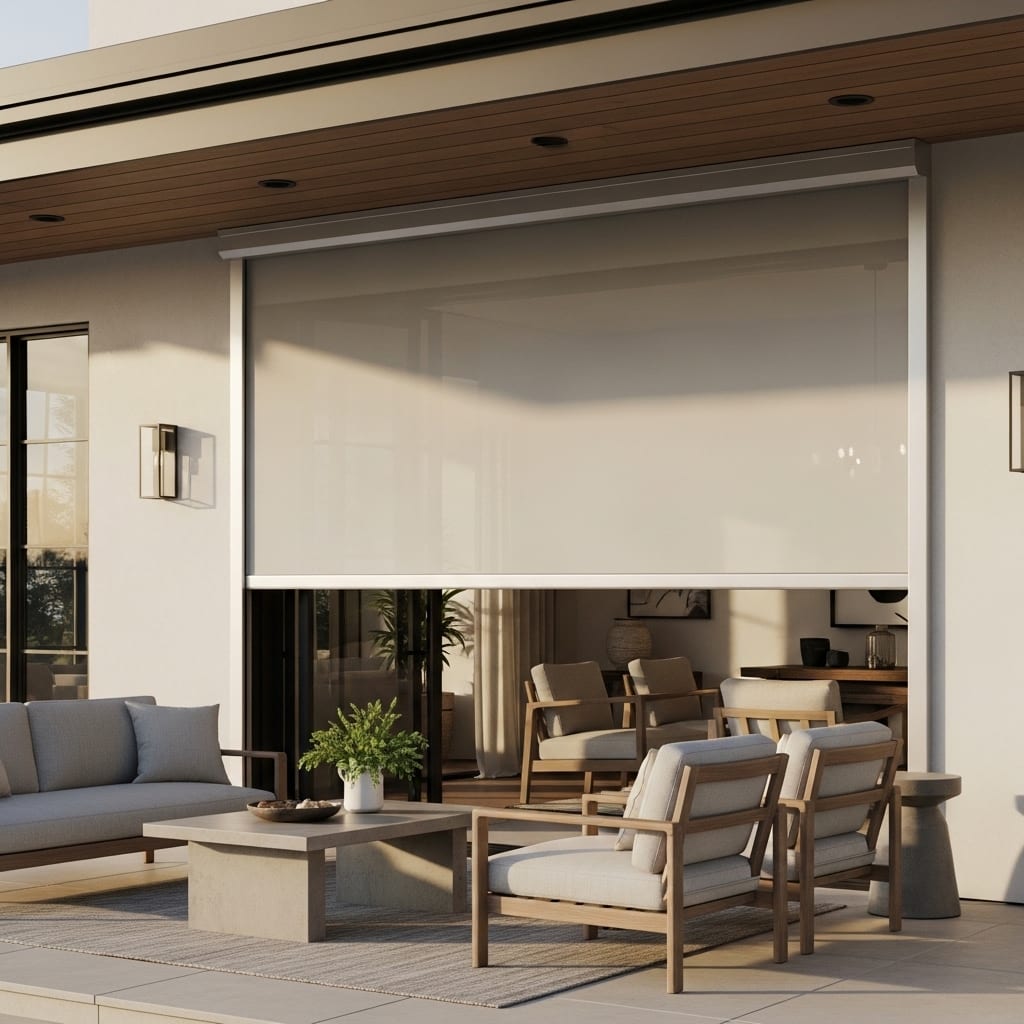
Retracted, the pergola is exactly what it was — open, airy, unobstructed. Deployed, the sides close and the space becomes sheltered. That flexibility is the reason to choose retractable screens over fixed panels or permanent enclosure, particularly on a structure whose whole appeal is openness.
Solar mesh on the west side deals with the low sun a slatted roof cannot. Privacy mesh screens the space from neighbouring lots during daylight. Clear vinyl blocks wind and holds warmth for shoulder-season use, which on a pergola makes a larger difference than on a covered patio because there is less shelter to begin with.
Manual or Motorized on a Pergola
The wind argument is stronger here than almost anywhere else.
A pergola is typically freestanding or lightly attached, often in the most exposed part of a yard, with no solid roof to break airflow. A screen deployed on it takes wind load directly, and the structure supporting it is lighter than a roofed patio would be.
A wind sensor on a motorized system retracts the screen automatically when gusts reach a threshold. On an exposed freestanding pergola, that protects both the screen and the structure it is mounted to, and it does so whether or not anyone is home.
Manual at $4,200 remains the right call on a sheltered pergola close to the house. Motorized at $5,400 is a stronger argument the more exposed the structure is.
Attached or Freestanding
The distinction matters more than most people expect, and it is the first thing worth establishing about your own structure.
An attached pergola runs off the house on one side. The building provides a solid mounting point and lateral stiffness, and one whole side of the structure is effectively braced. Screens on an attached pergola behave much like screens on a covered patio, and the assessment is usually straightforward.
A freestanding pergola stands on its own posts. Everything the screen pulls against is carried by those posts and their footings. That is not a problem in itself — plenty of freestanding pergolas are built solidly enough — but it is the case where beam sizing and post stability get looked at most carefully, particularly on kit structures.
Footings are part of this. A pergola set in proper concrete footings behaves very differently from one on surface anchors, and freeze-thaw movement over Idaho winters shows up in the latter over time.
If the Structure Is Not Ready
Sometimes the assessment concludes the pergola needs work before it can carry screens. Worth knowing what that usually means, because it is rarely dramatic.
The common findings are a top beam that needs reinforcing along the run where the housing mounts, posts that need additional bracing or better anchoring, or a bay that needs an intermediate post because the span exceeds what one screen covers.
That work is separate from the screen installation and is identified up front rather than discovered mid-project. Some homeowners handle it themselves or through their own contractor; either way, knowing about it before ordering is the point of assessing first.
The alternative outcome — that the structure is fine as built — is the more common one. Most pergolas that were built to carry a real load are candidates.
What It Costs
Pergola screens are large-opening systems, priced the same way: from $4,200 manual and $5,400 motorized per screen, installed, with custom fabrication and the warranty included.
A pergola with four bays screened on two sides is two screens, not four — you screen the sides you need. That flexibility is worth using; screening every bay of a pergola is rarely necessary and rarely the best value.
Any structural work needed to make the pergola ready is separate from the screen installation and is identified during the assessment, so it is not a surprise later.
Full pricing is in What Phantom Screens Cost.
Next Steps
For the broader picture, read Retractable Screens for Patios & Porches. If your structure has a solid roof, Screening a Covered Patio is the more direct guide. For decks without overhead structure, see Retractable Deck Screens.
Request a free quote and a specialist will assess whether your pergola can carry a screen and what it would take.
Starting prices are current for Phantom Screens of Twin Falls and include professional installation. Final pricing is confirmed after an in-home measurement.
Frequently Asked Questions
Can you put retractable screens on a pergola? Usually yes, but it is a structural question first. The top beam has to carry the housing and the load of a deployed screen, and the posts have to take the side tracks. That is assessed on site.
Do screens work on a pergola with an open slatted roof? For wind and low-sun control, yes — those come in horizontally and side screens block them. For a fully insect-free space, an open top is a limitation, since the ceiling remains permeable.
How much do pergola screens cost? They are large-opening systems, from $4,200 manual and $5,400 motorized per screen, installed.
Do I need to screen all four sides? Rarely. Screening the sun side and the windward side solves most of the problem, and you pay per screen rather than per structure.
Is a freestanding pergola harder to screen than an attached one? Generally yes. An attached pergola gets lateral stability from the building; a freestanding one relies entirely on its own posts, which matters when a deployed screen is pulling against them.
What about wind on an exposed pergola? This is the strongest case for a motorized system with a wind sensor, which retracts the screen automatically when gusts pick up — protecting both the screen and a structure that is usually lighter than a roofed patio.
Tags
Written by
Phantom Screens of Twin Falls Team
Custom retractable screen solutions for homes across Idaho and Western Wyoming.
Related Articles

Pet-Resistant Retractable Screens
What pets actually do to screens, how pet-resistant mesh and mesh retention differ, which of the two you need, and what each costs.

Screen Mesh Options Explained
Insect, solar, privacy, no-see-um, pet-resistant and clear vinyl — what each does, what it trades away, and how to match one to a specific opening.

Retractable Screens for Large & Oversized Openings
Openings past 96 inches need a different system. What covers up to 15 feet wide and 12 feet high, how spans divide, and what oversized systems cost.
Interested in Retractable Screens?
Get a free quote for custom Phantom retractable screens — motorized, door, or window screens for your home.
Get a Free Quote