Retractable Screens for Patios & Porches
How retractable screens turn a covered patio or porch into usable space, what sizes and products cover which openings, what it costs in southern Idaho, and how to decide what you actually need.

Most covered patios in southern Idaho get used far less than the people who built them expected. Not because there is anything wrong with the space, but because for a good stretch of the year it is too bright, too windy, or full of insects at exactly the hours you would want to be sitting out there.
Screening the space rather than the doorway is what changes that. This guide covers what the products actually do, which one fits which opening, what it costs, and how to work out what you need.
Screening the Space, Not the Door
Worth separating these clearly at the start, because people frequently ask about one and want the other.
A door screen screens the doorway between the house and the patio. It keeps insects out of the house. The patio itself stays open air — which is completely fine if the patio is already comfortable to sit on.
A patio or porch screen screens the outdoor space itself. It closes the open sides of a covered area so the space becomes usable: insects out, wind cut, low sun blocked.
The question that separates them is simple. Is the problem that bugs are getting into the house, or that the patio is unpleasant to sit on? If it is the second, no door screen will fix it regardless of quality.
What Actually Gets Installed
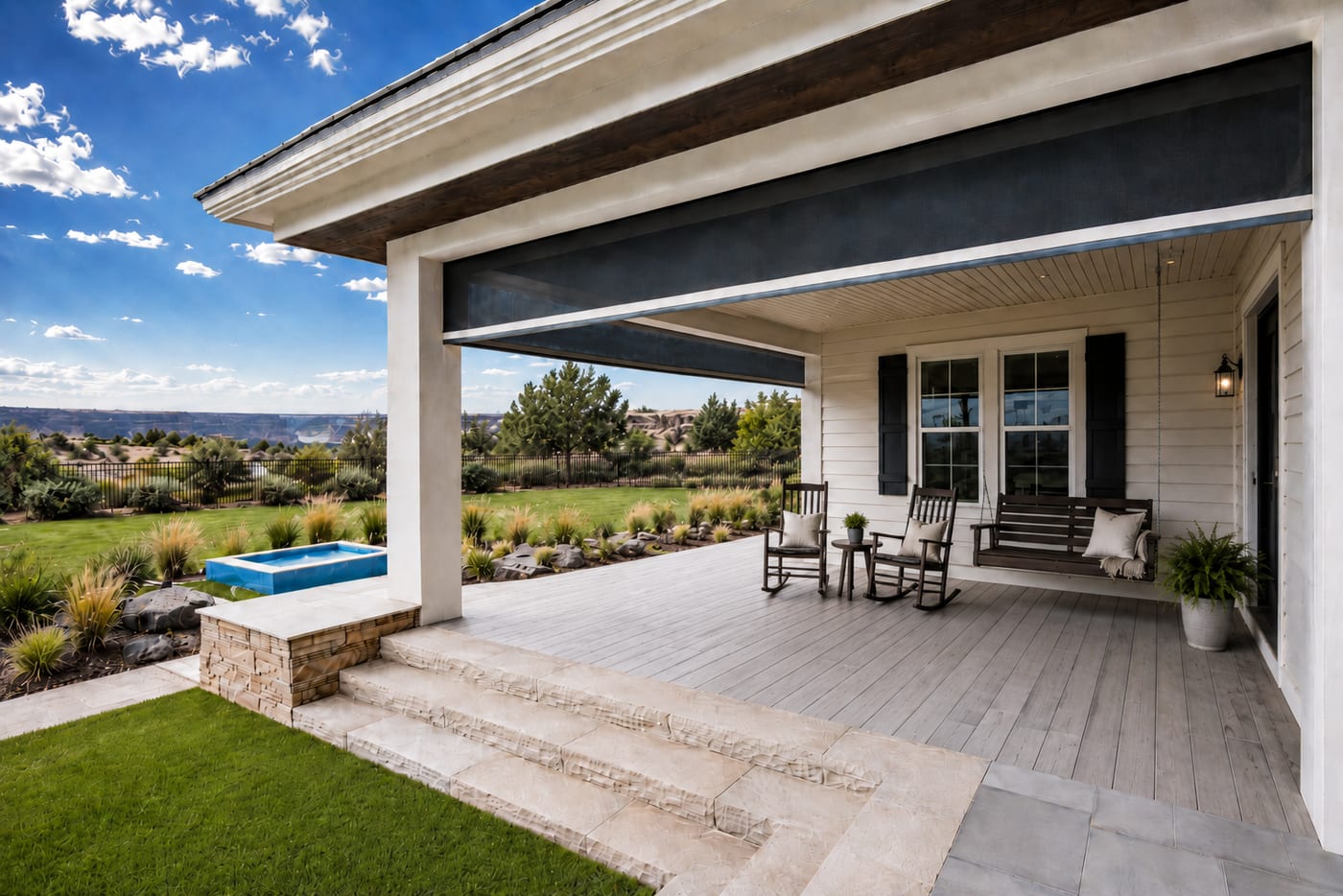
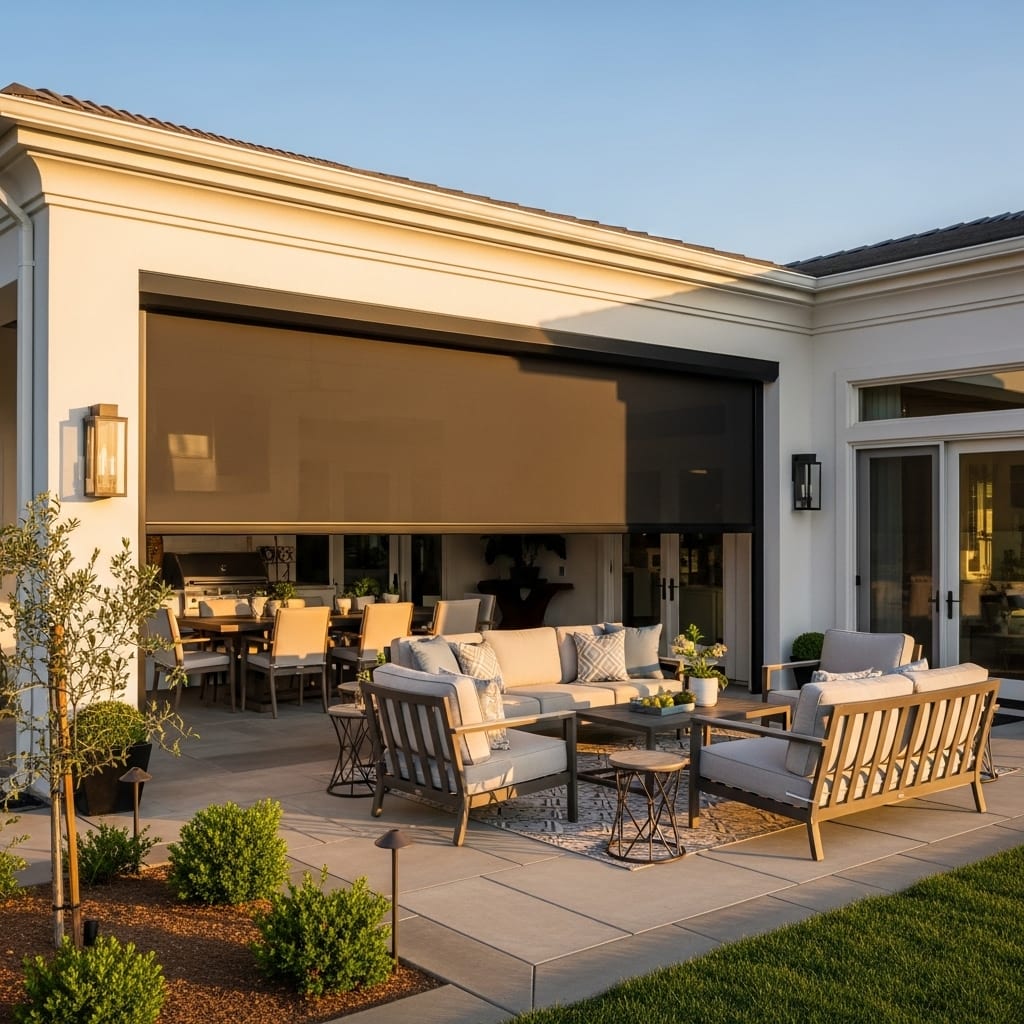
A patio screen is a large-opening retractable system. The mesh stores on a roller inside a housing mounted at the top of the opening, and drops down across the span when deployed. Side tracks hold it taut. When you do not need it, it rolls up and out of sight, and the patio is fully open again.
That last part matters more than it sounds. The alternative — a permanently screened porch — trades your open patio for an enclosed room whether you want one that day or not. A retractable system gives you both spaces from the same structure, which is usually the reason people choose it over building a screened enclosure.
These systems cover openings up to 15 feet wide and 12 feet high in a single screen. Wider spans are handled by running multiple screens across the opening, divided at posts or beams.
Manual or Motorized
Both are available on large openings: $4,200 manual, $5,400 motorized, installed.
Manual works, and a smooth-glide track with precision ball-bearing rollers keeps one-hand operation realistic even at full width. If the patio gets screened occasionally rather than daily, it is the sensible spend.
Motorized earns its difference when the screen is used constantly, when the drop is tall enough that hand operation is awkward, or when the site is exposed. Control is by remote, wall switch, app, or voice through Alexa and Google Home, with Control4, Crestron and Lutron integration available.
The argument that carries the most weight locally is the wind sensor. It retracts the screen automatically when gusts pick up — including when nobody is home. Along the canyon rim, out toward the open ground around Jerome and Filer, and up through the Wood River Valley, that is genuine protection rather than a convenience feature. A large screen left deployed in high wind is the most common way these systems get damaged.
Mesh and Panel Options
What you put in the track determines what the space becomes.
Standard insect mesh handles the bug problem with maximum airflow and the clearest view through. This is what most patios need most of the time.
Solar mesh blocks a substantial share of heat, UV and glare. On a west-facing patio taking direct high-desert sun from mid-afternoon, this is the difference between a space you use at six o'clock and one you avoid until eight.
Privacy mesh screens the space from outside during daylight while keeping your own view out — relevant on closer lots and newer subdivisions where patios face each other.
Luxury vinyl is not mesh at all. It is a clear panel that blocks wind and holds warmth rather than filtering insects, which is what extends a patio's usable season into the colder months. On a large opening it is often paired with a mesh screen so the space can do both jobs across the year.
Which Openings Can Be Screened
The structure decides this, and it is worth an honest look before planning.
A covered patio with a solid roof and posts is the straightforward case. There is a header to mount the housing to and posts to run side tracks down.
A covered porch is the same, and often easier because the openings tend to be smaller and better defined.
A pergola is more involved, because a slatted roof is not a weather barrier and the framing may need assessment before it carries a screen. That is covered in Retractable Screens for Pergolas.
An uncovered deck or patio has nothing to mount to overhead. Screening requires adding structure first — which is a real project, not a screen installation. Retractable Deck Screens goes through the options.
What It Costs
- Large opening manual — from $4,200
- Large opening motorized — from $5,400
- Door screens, if you also want the doorway screened — from $989 single, $1,949 for a French pair
Professional installation and custom fabrication are included. A $200 deposit starts an order and is applied to the total.
Multi-screen patios are priced per screen, so a wide space divided at posts costs more than a single-span opening of the same total width. The measurement establishes how many screens the structure calls for.
Full pricing across every configuration is in What Phantom Screens Cost.
How to Decide What You Need
Three questions get most people to the right answer.
What is actually stopping you using the space? If it is insects, mesh solves it. If it is afternoon sun, you want solar mesh. If it is wind, you want vinyl panels or a motorized system with a wind sensor. If it is cold evenings in shoulder season, vinyl is the answer rather than mesh.
How often will you use it? Daily summer use justifies motorization. Occasional use does not.
Is there something to mount to? A solid roof and posts means a straightforward installation. A pergola or an open deck means the structure needs assessing first.
Timing
One practical note. These are custom-fabricated systems, and demand peaks with the first genuinely warm stretch of the year — which is precisely when everyone realises they want one.
Starting the conversation in late winter or early spring means installing before the season rather than partway through it. A patio screened in June gets most of a summer; one ordered in June often does not.
Next Steps
For the specific cases, read Screening a Covered Patio, Retractable Screens for Pergolas, or Turning a Porch Into a Three-Season Room. For the motorized decision specifically, see Motorized Retractable Screen Pricing.
Request a free quote and a specialist will look at the structure and tell you what it can carry.
Starting prices are current for Phantom Screens of Twin Falls and include professional installation. Final pricing is confirmed after an in-home measurement.
Frequently Asked Questions
How much do retractable patio screens cost? A large-opening system starts at $4,200 manual and $5,400 motorized, including custom fabrication and professional installation. Wide patios divided at posts are priced per screen.
How wide an opening can one screen cover? Up to 15 feet wide and 12 feet high in a single screen. Wider spans are covered by running multiple screens, usually divided at existing posts or beams.
Can I screen a patio that has no roof? Not directly — a retractable screen needs a header to mount to and something to run side tracks down. An uncovered patio or deck needs structure added first.
Do the screens stay up all year? No, and that is the point. They retract into their housing when not in use, so the patio is fully open when you want it open, and the mesh is protected from sun and dust the rest of the time.
What is the difference between mesh and vinyl panels? Mesh filters insects while keeping airflow. Clear vinyl blocks wind and holds warmth, which extends the usable season into colder months. Many patios run both across the year.
Will a screen help with afternoon sun? Solar mesh blocks a substantial share of heat, UV and glare while keeping the outward view — a meaningful difference on west-facing patios through an Idaho summer.
What happens in high wind? Retract the screen. On motorized systems a wind sensor does it automatically when gusts pick up, which is the main reason motorization is worth considering on exposed sites.
Tags
Written by
Phantom Screens of Twin Falls Team
Custom retractable screen solutions for homes across Idaho and Western Wyoming.
Related Articles

Pet-Resistant Retractable Screens
What pets actually do to screens, how pet-resistant mesh and mesh retention differ, which of the two you need, and what each costs.

Screen Mesh Options Explained
Insect, solar, privacy, no-see-um, pet-resistant and clear vinyl — what each does, what it trades away, and how to match one to a specific opening.

Retractable Screens for Large & Oversized Openings
Openings past 96 inches need a different system. What covers up to 15 feet wide and 12 feet high, how spans divide, and what oversized systems cost.
Interested in Retractable Screens?
Get a free quote for custom Phantom retractable screens — motorized, door, or window screens for your home.
Get a Free Quote