Outdoor Living Screens: Making the Space Usable
Outdoor kitchens, dining areas and living spaces get built and then underused. What actually stops people using them in southern Idaho, and which screening approach fixes which problem.

Outdoor kitchens, covered dining areas and outdoor living rooms are among the most-built and least-used features in residential construction. The space gets designed, built and furnished — and then sits empty for most of the season it was meant for.
The reasons are consistent, and they are almost never about the space itself.
What Actually Stops People Using These Spaces
Three things, in roughly this order.
Low sun. An overhead structure handles midday sun and does nothing about the horizontal light that arrives from mid-afternoon. In southern Idaho that light is intense and lasts for hours, and a west-facing outdoor kitchen is genuinely unpleasant to work in through it. This is the most underestimated of the three, because people assume a roof solved it.
Wind. It makes eating outdoors awkward, blows out flames on a grill or heater, and takes napkins and lightweight furniture with it. Wind is also what makes a cool evening feel cold, which shortens the season at both ends.
Insects. The one everybody names first. Worth noting it is usually seasonal and time-of-day specific — the hour around dusk in mid-summer, which is exactly when people want to be eating outside.
Different problems, different solutions. Matching them correctly is the whole exercise.
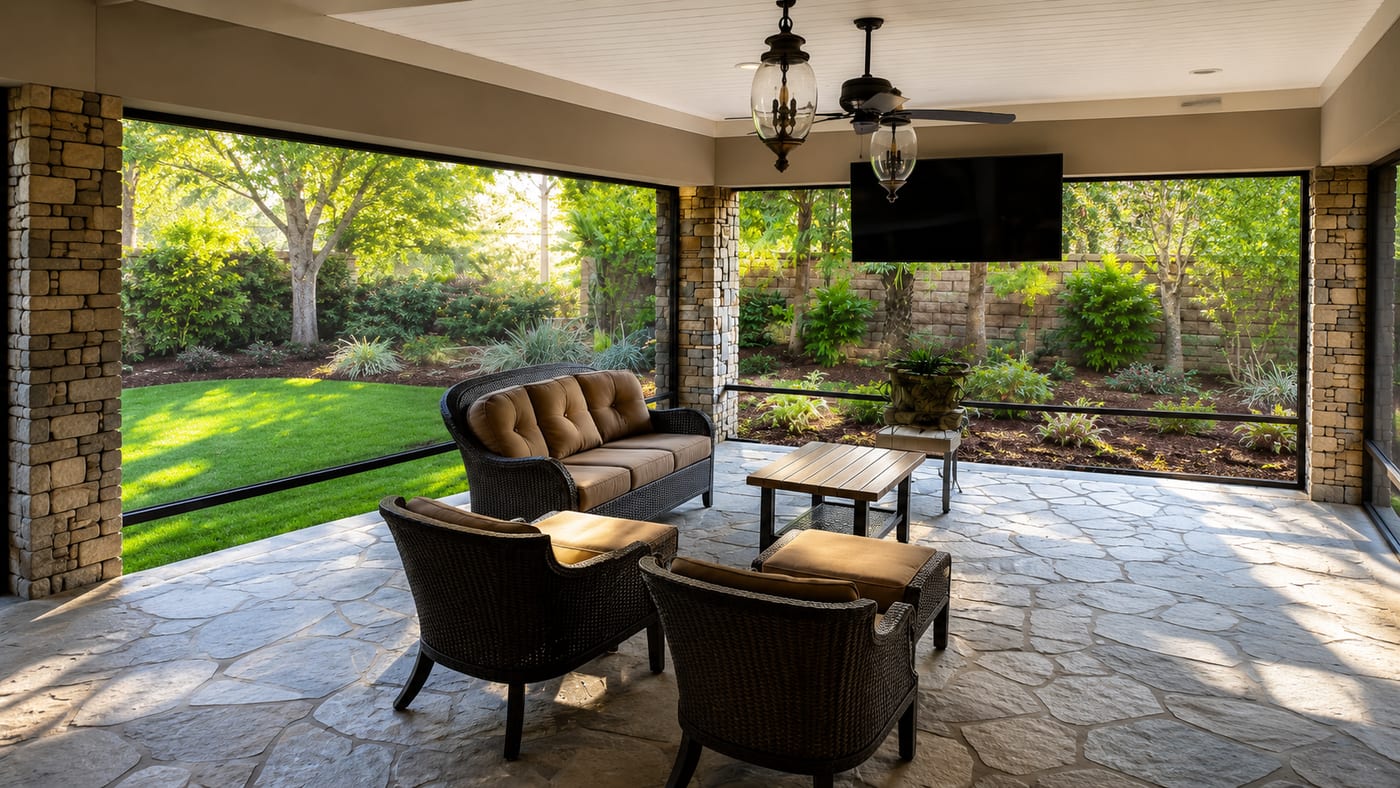
Matching the Screen to the Problem
For low sun: solar mesh on the west or south side. It blocks a substantial share of heat, UV and glare while keeping the outward view, and it is specified per opening — so the sun side can differ from everything else.
For wind: clear luxury vinyl on the windward side, which blocks air movement rather than filtering it. On an exposed site this changes the space more than any other single choice.
For insects: standard insect mesh, or no-see-um mesh near water. Along the Snake River corridor and near irrigation canals, the smaller insects that pass through standard weaves are frequently the actual nuisance.
Most outdoor living spaces have more than one of these problems, which is why bays are usually specified differently rather than uniformly.
Outdoor Kitchens Specifically
Cooking spaces have requirements the rest of a patio does not.
Ventilation is the first. A grill or cooktop needs air movement, and fully enclosing a cooking area with solid panels is not appropriate. Mesh maintains airflow while dealing with insects; vinyl on the cooking bay is generally the wrong choice.
The practical approach on a space that combines cooking and dining is to treat them as different zones — mesh or open over the cooking area, and whatever the dining side needs for sun and wind. Because screens are specified per bay, that is straightforward rather than a compromise.
Retraction matters here too. Being able to open the space completely when you are cooking for a crowd, then close it as the evening cools and insects arrive, is exactly the flexibility a fixed enclosure cannot offer.
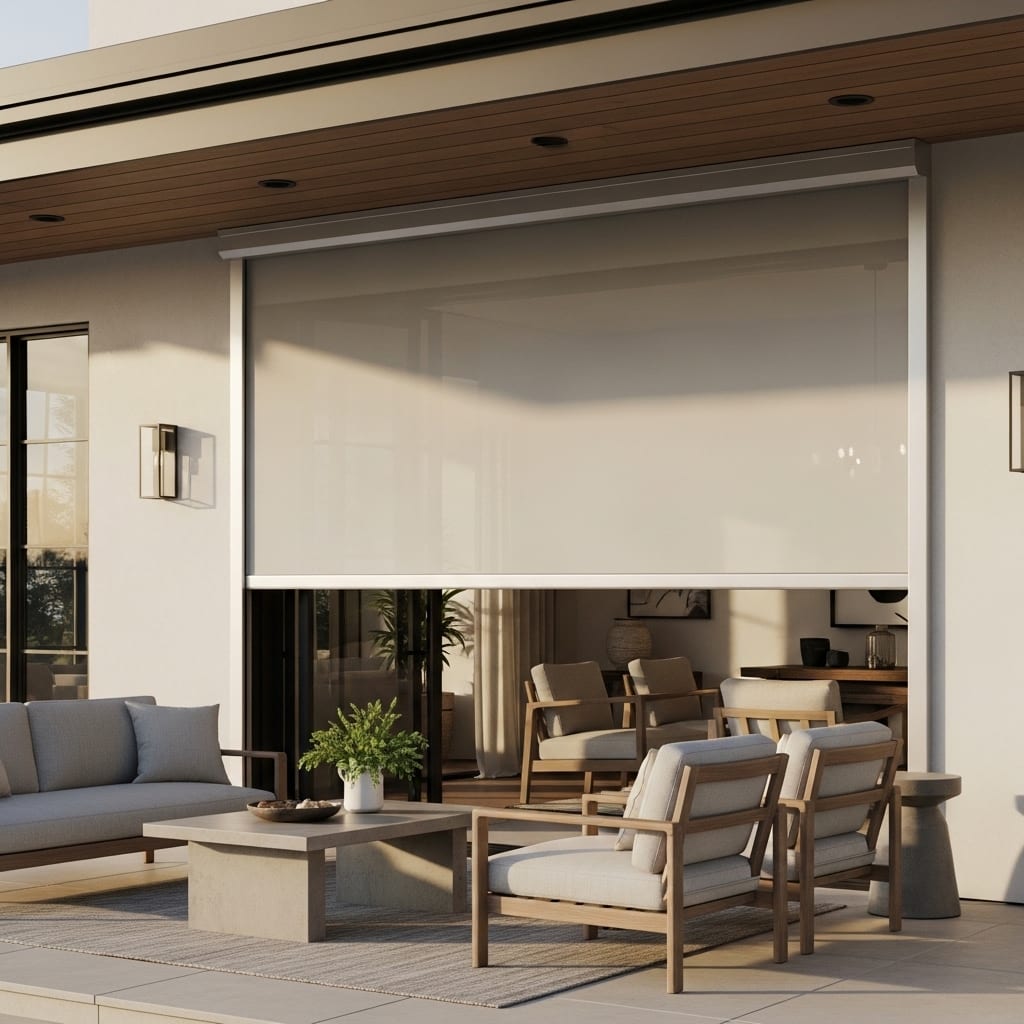
How Often You Will Actually Operate Them
This is the question that decides manual versus motorized, and it is worth answering honestly.
An outdoor living space in active use gets its screens adjusted constantly — down as the sun drops, up when the breeze is pleasant, down again at dusk. That is several operations an evening rather than one a season.
At that frequency, and particularly across a wide span, motorized operation at $5,400 against $4,200 manual stops being a luxury. Remote, wall switch, app or voice control through Alexa and Google Home means the screen actually gets used as conditions change rather than left in whatever position it was last put in.
The wind sensor is the other half. An outdoor living space is furnished, and a screen left deployed in a gust is the most common way these systems get damaged. Automatic retraction protects the investment when nobody is watching.
Privacy on Closer Lots
A fourth factor, and one that has become more common as subdivisions around the Treasure and Magic Valleys have been built at tighter spacing.
An outdoor living space on a standard modern lot is often directly overlooked by a neighbouring house or patio. That does not stop people building the space, but it does quietly stop them using it — particularly for dining, and particularly in the evening when interior lights make the space more visible than the owners realise.
Privacy mesh addresses this. It screens the space from outside during daylight while keeping your own view out, which is the asymmetry that makes it useful rather than simply blocking the opening.
Two honest caveats. It works on daylight; after dark, a lit space is visible from outside regardless of mesh, which is a lighting question rather than a screening one. And it does reduce view clarity slightly compared with standard insect mesh, so it belongs on the overlooked side rather than across the whole space.
Specified per bay, that is straightforward — privacy mesh facing the neighbour, standard mesh or open on the sides facing your own yard.
Getting the Season You Paid For
The economics here are worth stating plainly, because outdoor living spaces are not cheap to build.
An unscreened covered patio in this climate is genuinely comfortable for a fairly narrow window — call it high summer minus the hours around dusk when insects arrive, minus the afternoons when low sun makes the west side unusable, minus the windy days.
Screened well, that window widens considerably: the dusk hours come back, the west side becomes usable through the afternoon, and with vinyl panels the shoulder seasons open up. The space that was built for outdoor living starts being used for it.
Against the cost of building the space in the first place, screening it is usually a small fraction — and it is the difference between a feature that gets used and one that gets looked at.
What Changes About Furnishing the Space
One practical consequence people notice after the fact: a screened space can hold lighter furnishings than an open one.
Wind is what dictates outdoor furniture in this region. Open patios push people toward heavy pieces that will not move, which limits both the look and the flexibility of the space. With the windward side screened, cushions stay put, umbrellas stop being a liability, and lighter furniture becomes practical.
The same applies to soft furnishings and rugs, which on an open patio spend most of their life being blown around or brought inside. It is a small thing that meaningfully changes how much the space feels like a room.
What It Costs
Large-opening systems for outdoor living spaces start at $4,200 manual and $5,400 motorized per screen, installed, with custom fabrication and the warranty included. A single screen covers up to 15 feet wide and 12 feet high; wider spaces are divided at the posts and priced per screen.
Full pricing is in What Phantom Screens Cost, and the powered decision is covered in Motorized Retractable Screen Pricing.
Next Steps
For the structural side, read Screening a Covered Patio. For shoulder-season use specifically, see Turning a Porch Into a Three-Season Room. For the overview, Retractable Screens for Patios & Porches.
Request a free quote and a specialist will work through which bays need which treatment.
Starting prices are current for Phantom Screens of Twin Falls and include professional installation. Final pricing is confirmed after an in-home measurement.
Frequently Asked Questions
What stops people using outdoor living spaces? Low afternoon sun, wind, and insects around dusk — usually in that order of impact. Each has a different solution, which is why bays are typically specified differently rather than uniformly.
Can I screen an outdoor kitchen? Yes, but ventilation matters. Mesh maintains airflow around a grill or cooktop while handling insects; solid vinyl panels are generally not appropriate over a cooking area.
What does it cost to screen an outdoor living space? From $4,200 manual and $5,400 motorized per screen, installed. Wider spaces are divided at posts and priced per screen.
Should I use mesh or vinyl? Mesh for insects and airflow, vinyl for wind and warmth. Most spaces use mesh in summer and benefit from vinyl on the windward side for shoulder seasons.
Is motorized worth it for an outdoor living space? Usually, because these spaces get their screens adjusted several times an evening as conditions change. A screen that is awkward to operate tends to get left in one position.
How much of the year does screening add? It varies by exposure, but the common pattern is recovering the dusk hours in summer, the afternoons on west-facing spaces, and — with vinyl — a meaningful part of spring and autumn.
Tags
Written by
Phantom Screens of Twin Falls Team
Custom retractable screen solutions for homes across Idaho and Western Wyoming.
Related Articles

Pet-Resistant Retractable Screens
What pets actually do to screens, how pet-resistant mesh and mesh retention differ, which of the two you need, and what each costs.
Screen Mesh Options Explained
Insect, solar, privacy, no-see-um, pet-resistant and clear vinyl — what each does, what it trades away, and how to match one to a specific opening.

Retractable Screens for Large & Oversized Openings
Openings past 96 inches need a different system. What covers up to 15 feet wide and 12 feet high, how spans divide, and what oversized systems cost.
Interested in Retractable Screens?
Get a free quote for custom Phantom retractable screens — motorized, door, or window screens for your home.
Get a Free Quote